Waterfront Assets info for NY Rising Community Reconstruction Program (CRP) Red Hook Committee

Our Director Carolina Salguero is on the Red Hook committee of the NYS resiliency planning process "CRP."  That process has stressed that the planning exercise is about more than recovery, or flood prevention and mitigation.  It is supposed to take a long and broad view which includes economic resiliency years into the future.

This emphasis prompted Carolina Salguero to make some suggestions regarding Red Hook's waterfront assets, both their potential and the impediments to reaching their potential. She wrote a document to cover what was not being said in the CRP discussion that seemed essential to get into "Needs and Opportunities" document that was due on 10/28, a document that was first described as "a conceptual plan for Red Hook" and then later as a guide for issues to be discussed.  PortSide shares that document below.

Many of the themes about policy, permits and pier design reflect citywide issues, so this blogpost has relevance beyond Red Hook and beyond Sandy issues.

The document is marked DRAFT as it was done in a rush due to a NYS deadline of 10/28 for that  "Needs and Opportunities" document,. DRAFT signifying that it will be updated. After discussion at PortSide, we decided it was important to get this information out and shared without further delay given the pace of the CRP process -- also given the pace of the Bill de Blasio transition team. 

PortSide, along with many other waterfront operators and advocates hopes that the impediments described will be lifted. NYC created a great road map for activating the waterfront, and the water part of the waterfront, in its new comprehensive waterfront plan "Vision 2020."  Many of the changes proposed here would move the city towards fulfilling the great promise of that plan.

Download document Carolina Salguero waterfront suggestions for Red Hook CRP Committee 10/23/13

Some excerpts

“Understanding Red Hook waterfront options means understanding a lot of arcane regulation and policy, so I have written up the following observations and suggestions to help Red Hook committee members of the CRP who are not waterfront people. “

“Red Hook is a peninsula. Water is therefore our greatest resiliency challenge due to the risk of floods, but water is also the defining feature of this place and our greatest economic asset.”

“If nothing else, consider the clout: the largest land owner in Red Hook looks to be the Port Authority, and Red Hook’s relationship with the Port could be grown and improved. The Committee should be sitting down with the major property owners.”

“Understanding and capturing the potential of Red Hook’s waterfront involves understanding and engaging a constituency that is not usually at the table in Red Hook planning discussions, the maritime community.”

Action Items

Use CRP to improve NYS & NYC policy regarding pier design & use:

1.    Change State Dept of Environmental Conservation (DEC) policy regarding permits to install or repair a pier
2.    Change NYC policy, to go beyond just “access to the waterfront” to promote use of the water itself.
3.    Change NYC policy regarding pier design & management

Longer Term Improvement Opportunities

o    PANYNJ
o    Brooklyn Cruise Terminal Shed
o    Brooklyn Cruise Terminal Parking Lot
o    Atlantic Basin
            Reality Check: limitations on Atlantic Basin waterspace use
o    Valentino Park
o    A Home for PortSide NewYork

Appendices

A.    A Home for PortSide NewYork
B.    DEC Impediments to pier repair and construction

Testimony to New York City Council
Committee on Waterfronts
Re: 6/15/05 Regulatory Obstacles to Waterfront Development

C.    Frequent impediments to boat use of piers in NYC


"This-Old-Ship-Kitchen"Campaign-OR-renovating-Mary-Whalen-galley-December 2013

How would PortSide describe an "ideal" volunteer? TWIC card holder, with Merchant Marine credentials, a background in PR and journalism, asking to do ship work.

Erika Stetson in Afghanistan

Erika Stetson in Afghanistan

Donate via PayPal or make out checks to "PortSide NewYork"' and send to P.O. Box 195, Red Hook Station, Brooklyn, NY 11231, USA

Thanks to Home Depot ,QuinnCo of NY & We Strip Wood for their support of this project!

Erika's generous offer of time prompted us to launch a December campaign "This Old Ship Kitchen" to return the Mary A. Whalen galley to its 1938 glory. We are looking for donations of materials, services and funds. 

PLEASE DONATE TO SUPPORT THIS WORK!

Erika's offer is particularly important to us because security regulations in the Red Hook Container Port tightened last year so that our Director Carolina Salguero is now the only person who can bring in visitors who don't have the Homeland Security ID, the TWIC card, and the TWIC card limit is 5 visitors per card. In short, PortSide can only have 5 visitors at a time who don't have a TWIC card. This limitation pretty much shut down our volunteer program in March 2012 (one of the reasons we are so keen to get a home out of the port.)  Erika's having a TWIC card allows her to come and go without Carolina.

Erika is an Air Force veteran whose resume says compelling things such as "Prepared strategic communications plan for Army drawdown in Afghanistan on behalf of a four-star U.S. Army headquarters."She's changing careers and starts at SUNY Maritime College in January.We'll give her some intro maritime training before SUNY, and she's going to do major work renovating the galley of MARY A. WHALEN. 

As Erika put it, MARY’s “galley is a treasure within a treasure.” The cozy space has a Webb Perfection cast iron stove patented in 1918 which burns diesel (Our Director Carolina has learned how to use it), a wood paneled fridge and freezer, and handsome black and white tiled floors. Silver details in Monel metal; bronze portholes (in need of paint removal, fomer crews clearly tired of polishing), a large table which seats eight. It's bigger than most NYC apartment kitchens!

Supper Club "friendraiser" dinner in 2012

Supper Club "friendraiser" dinner in 2012

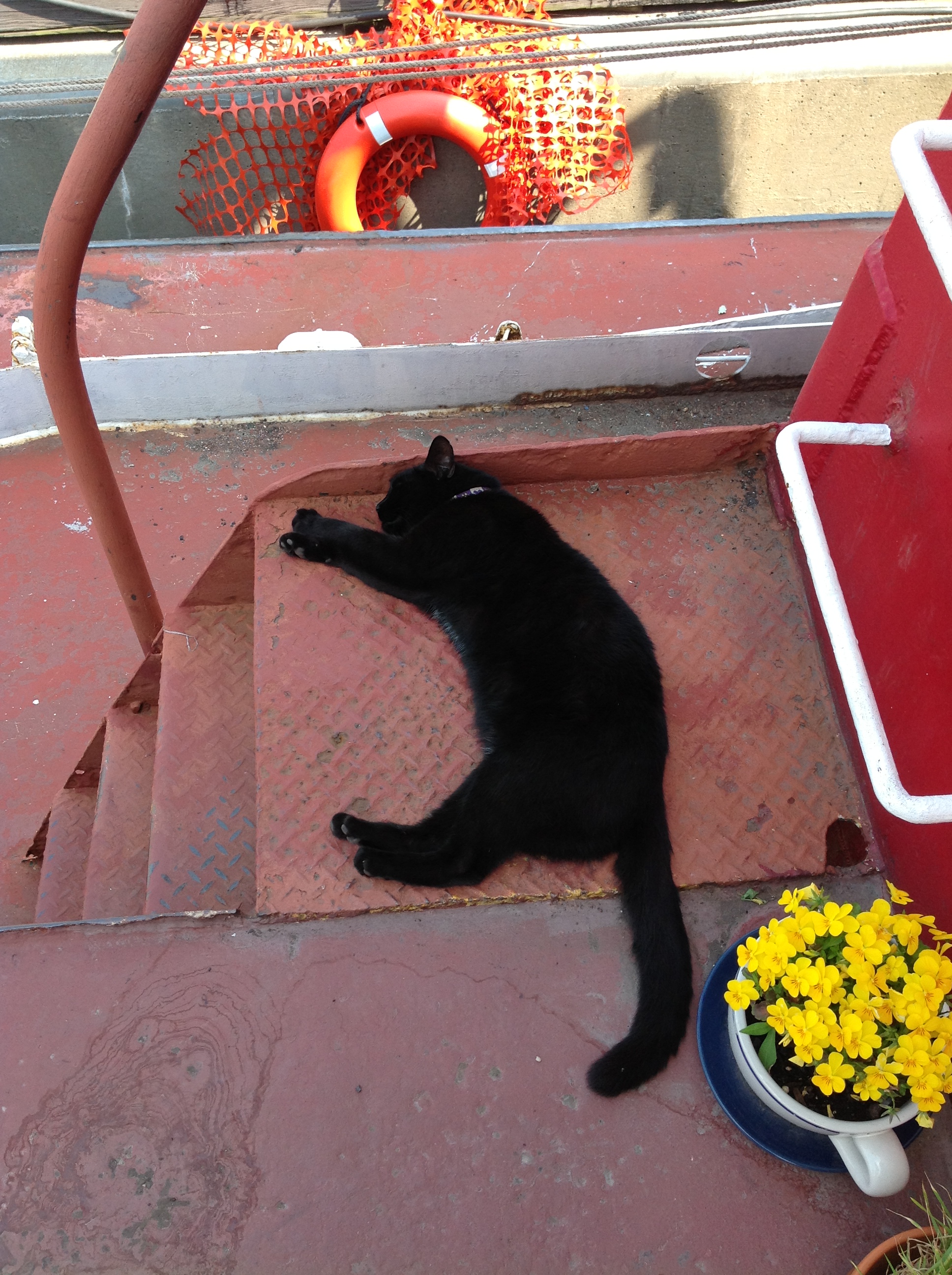
Carolina has started chipping paint in the galley to look at the history of paint layers to determine original colors, but stopped after shipcat Chiclet starting trying to eat paint chips. Chiclet was ushered out and chips swept up.  We've been researching 1930s kitchen photos  on line and started a rash of buying 1930s kitchware on eBay. Wait til you see the toaster!

Carolina has also posted questions to the Tugboatinformation group on Facebook, to ask for guidance. Here's part of one post:

kitchen 1930s antique homestyle,com.jpg

I have a restoration question about galley paint color. We are about to do over the galley. Any of you have memories, photos or information as to how galleys might have been painted in 1938? I've been chipping paint here and there to see underlying colors, but I strongly suspect that some paints changed their color as they aged cuz I can't believe that lots of Mary A Whalen bulkheads were painted a kind of nasty khaki mustard color. Also, since I don't think all the cabinets in MARY's galley are original, I cant count on the layers in the paint history to tell me what was original. I"m pretty sure the galley was not all white at the outset. Could cabinet doors and drawers have been painted a different color from the cabinet as was common in 1930s kitchen's ashore and as in this photo? There's a light apple green that is very typical of that time ashore as in this photo. Could that have been on a workboat? I've found it on overhead and bulkheads in one cabin. Thanks for any info!

The galley is one of the tanker’s most popular spaces during our TankerTours - whether we are showing it to elementary school kids, professors or the general public. PortSide uses the galley as office space, board room and as the site of Supper Club dinners we will revive after the renovation.

We also use it as a board room, conference room and office space, not to mention staff lunch room (when it is too cold to use the picnic table on deck)

BoatBox planning meeting 

BoatBox planning meeting
 

Services

  • Paint stripper (for metal dishrack & stove hood, 5 brass portholes, 4 steel drawers, 2 small wood shelves)
  • Chemical cleaning of tile floor
  • Furniture restorer to rebuild backs of 8 galley stools, and 5 galley seats.
  • Re-activate fridge & freezer. Change compressors from DC to AC electricity, replace Freon, change gaskets.

Equipment & material

  • Compressor and needle guns
  • Paint
  • 2 cordless electric drills
  • industrial cleaners and degreasers
  • Thinners
  • Sandpaper
  • painters’ paper to cover the tile floor
  • small number of floor tiles and adhesive to replace missing tiles
  • Tyvek suits
  • Disposable latex gloves

What donors get
Donors who give over over $500 in funds or services get two seats at Supper Club dinner in the newly renovated galley, credit on our website on the pages DONATE and MARY WHALEN PRESENT for one year.

PortSide NewYork Hyster eligible for National register of Historic Places - updated 6/320

karry krane logo.jpg

2020 update

Have you got experience repairing a 1941 Hyster Karry Krane? We could use your help! We expect to get a 1941 Fairbanks Morse engine from Kennett, Missouri in July, so we are interested in repairing our 1941 Hyster Karry Krane in order to have a crane to use to lift parts off that engine preparatory to bringing them aboard our ship MARY A. WHALEN. We will be using parts from the 1941 Kennett engine to restore the 1938 Fairbanks Morse engine in the MARY. Below is an edited version of our 2013 blogpost about our Hyster.

Our manual for the 1941 Hyster Karry Krane is here.

Edit of 2013 blogpost below

Another triumph!  Another historic item for Red Hook! Our Hyster crane (built in 1941) has been deemed eligible to be on the National Register of Historic Places! and in record time~

What triggered this accomplishment

In just two days, our Historian/Curator Peter Rothenberg researched the history of our 1941 Hyster and the history of this "Karry Krane" model, submitted an application to SHPO (the NYS Historical Preservation Office) to see if it was eligible to be listed on the National Register of Historic Places, and got that application approved! 

We profusely thank the staff at SHPO for reviewing our application in just hours, and we also profusely thank Jenny Bernstein of FEMA who told us about the grant that prompted us to focus on the Hyster. The Hyster was flooded by Sandy, and the grant is for Sandy damage to historic and cultural resources. 

PortSide-NewYork-DOE-1941-Hyster-Karry-Krane.jpg

PortSide applied for funding to reverse Sandy damage to the Hyster and to the replacement parts for MARY A. WHALEN's engine which were in the shed. The grant does not cover damage to historic documents which were flooded by Sandy. 

We applied for for the Hyster, and for damages to MARY's engine parts we would use. (The grant would not cover damage to those engine parts we planned to sell to support the restoration of the MARY A. WHALEN's engine.)  Earlier this year, we applied for FEMA Sandy recovery funds for Sandy damages, but we do not yet know if we will get funding.  We did not apply until May 2013 because we were told in a November 2012 funding workshop that we were not eligible; that was corrected in May, at which point we immediately sought Sandy recover funds. 

Crash course into the National Register of Historic Places

In short, getting on the National Register of Historic Places is a two-stage process: being "deemed eligible" and actually being listed. PortSide did the MARY A. WHALEN in two steps.  For something to be on eligible or listed, it has to be deemed historical significant in some or all of the following ways:

Is it associated with an important person, event, or movement in history? Does it represent a significant design or technology, or is it a special example of a particular style? Is it the work of a recognized master? Could it yield important archaeological information about our past?

Here is our full application to SHPO in two parts.

Determination of Eligibility (DOE) for listing on the National Register

Supplemental History of Michael Cowhey

SHPO's response was "Thank you for pulling together this very compelling and fascinating history of the "Karry Krane"  in such a short amount of time!  Both myself and my colleague, Kath LaFrank of our NR Unit, have reviewed your submission and, based on the information provided, the Hyster "Karry Krane" is eligible for the State and National Registers of Historic Places.  The only other somewhat similar type of property in NYS that we've called eligible is a historic steam shovel in LeRoy, NY. "

We copy excerpts from our DOE application below.

Todd Shipyard boomed during WWII. There were mobile cranes like ours in use at Todd. We have yet to check if the grain terminal used them.

The successor to our 1941 Hyster are the many forklifts used all over Red Hook.

History In brief

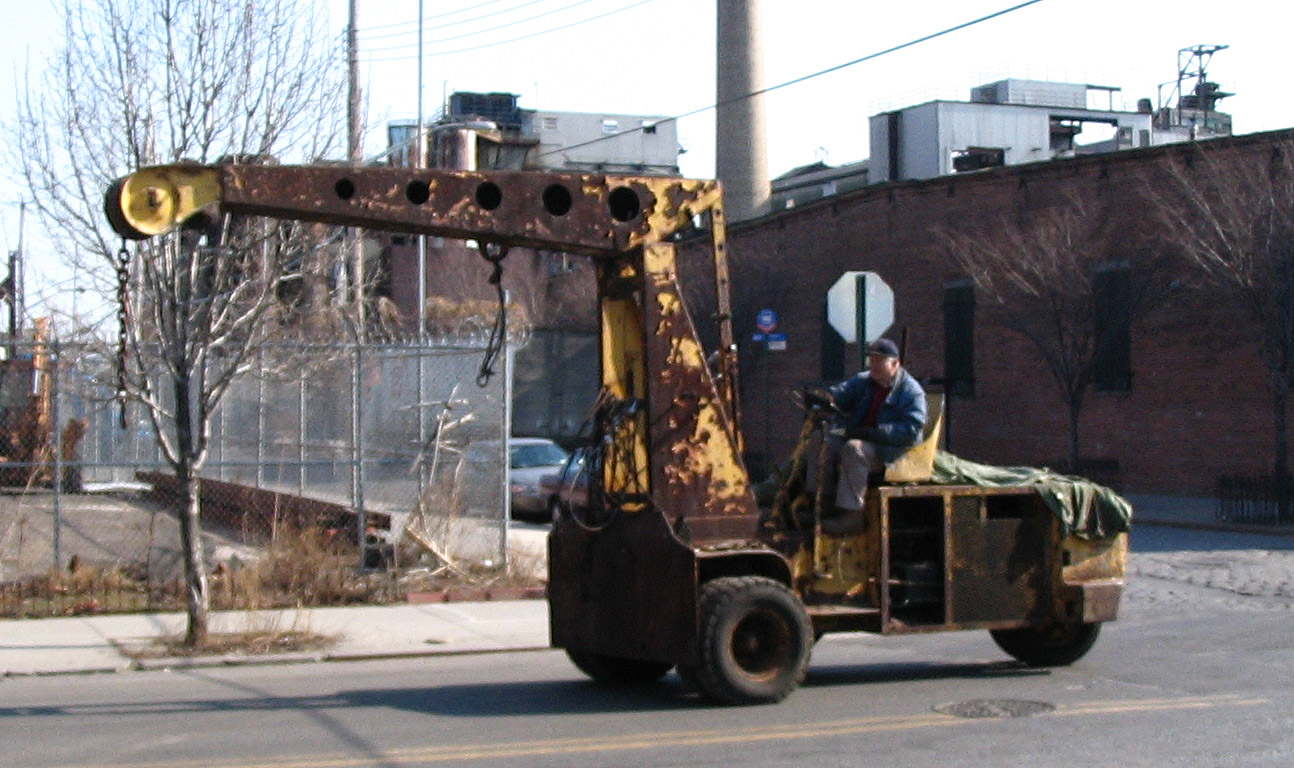
The “Karry Krane” name was first used July 14, 1941. PortSide’s Crane is from 1941. PortSide’s crane is both one of the original Karry Kranes made and, while once common, is now one of the last of its kind.

This crane type was developed by Hyster during WWII and was very significant to the war effort here and overseas. It was used in shipbuilding facilities, in ports for cargo handling and for rebuilding after the war effort. It was such a useful vehicle that Hyster produced it overseas when it opened its first plant outside the USA in 1951. It became an international workhorse. We find documentation that shows it was used in New Zealand in addition to Europe.

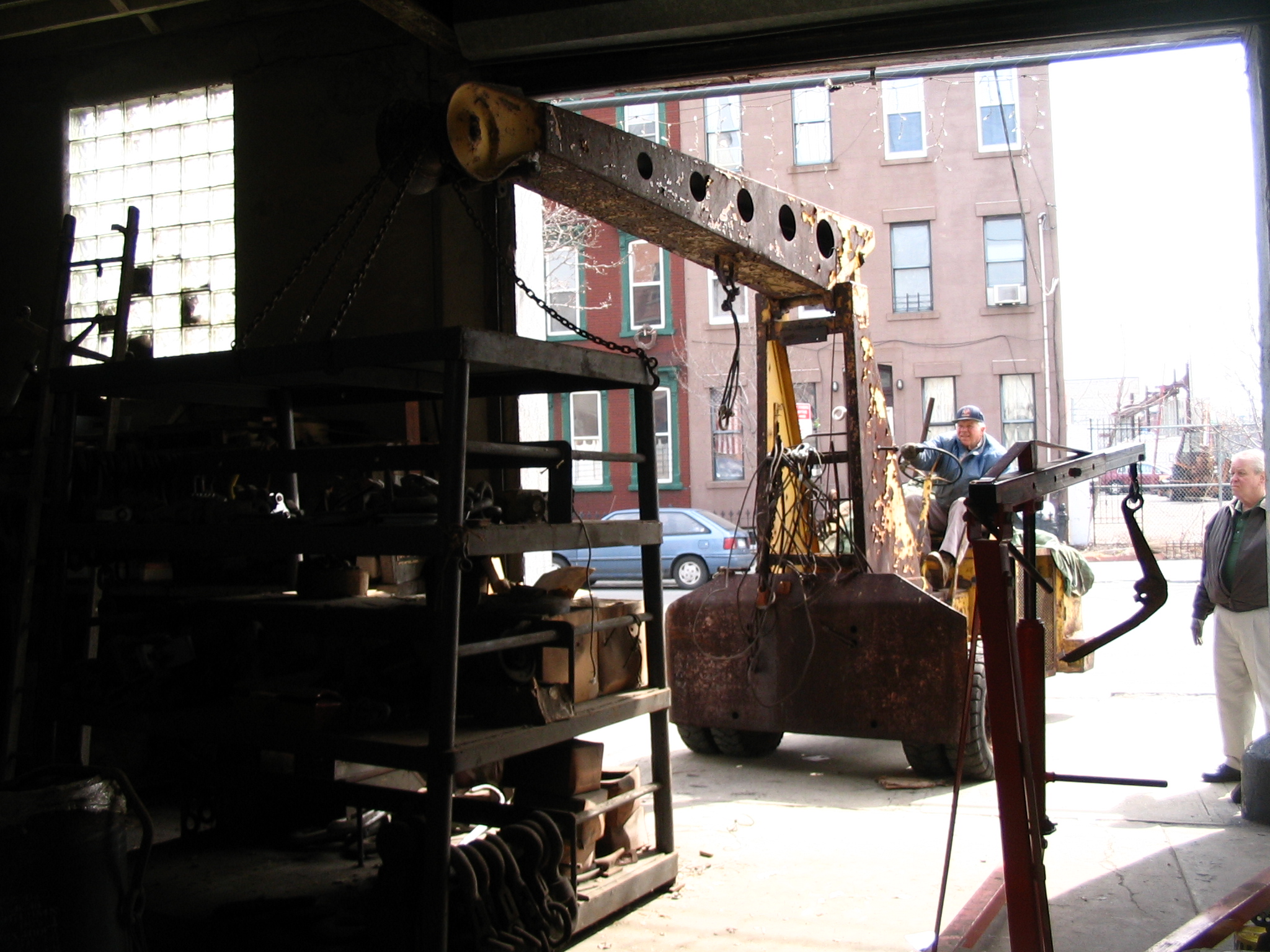
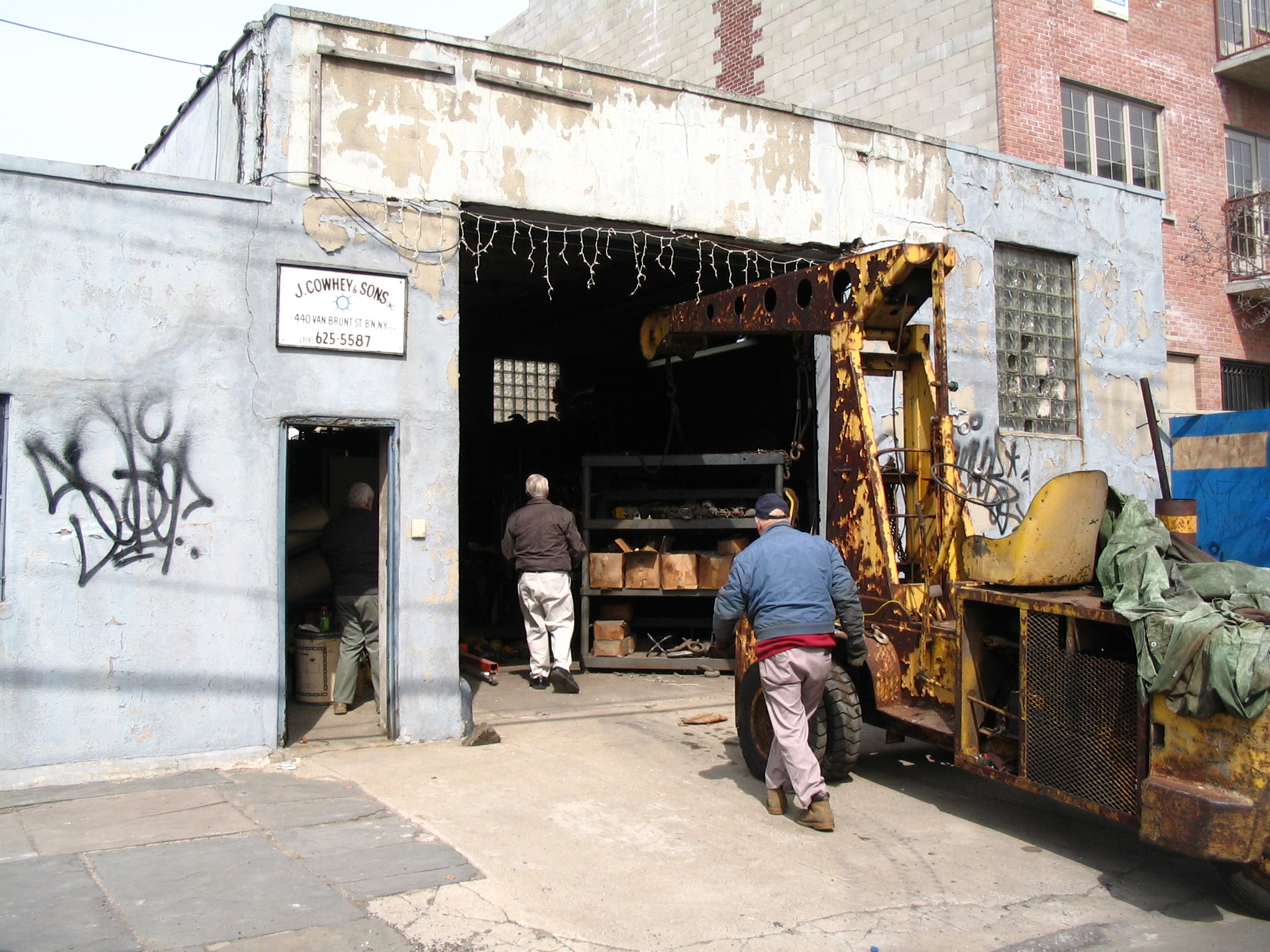
This particular Hyster crane was last used by Cowhey Brother Marine Hardware in Red Hook which closed in 2005 and donated their final inventory to PortSide NewYork. The Cowhey family was in several forms of maritime business in Red Hook for about 140 years when three Cowheys wound down the business.

Cowhey’s bought the crane from the Staten Island Bethlehem Steel shipyard when that closed in the 1960s. We presume that the crane was new when purchased by Bethlehem Steel when that yard boomed during the war effort.

Physical description of the crane

The crane dimensions are:

Body length 12’ 4”
Length of boom 10’ 1”
Overall length 22’ 3”
Height of body 3’ 3”
Height of boom 10’ 8”

1940: By experimental use of tractor frames, an advanced type of mobile crane is developed, later named the “Karry Krane."

1952: Hyster opens its first plant outside the USA, in Nijmegen, the Netherlands. The Hyster 40” and the Karry Krane are the first machines to be assembled there.
Criteria for evaluation.

This 1941 Hyster Karry Krane meets the following National Regsiter criteria:

(a) that are associated with history of a prominent Red Hook family and business. It is the last sizeable artifact of that business. It is related to a collection of other artifacts we have for that business. This particular crane is related to maritime history of NYC (two sites, one in Red Hook, one in Staten Island). And the crane model is particularly related to WWII history everywhere this crane became a major workhorse
(d) that have yielded, or may be likely to yield, information important in prehistory or history. It is a means to tell stories related to the Cowhey family and business in Red Hook, the Bethlehem Steel shipyard in Staten Island, WWII and reconstruction operations in civilian and military applications.

History of the Hyster company

This is a 2.5 ton Hyster,the most popular World War 2,dock, lift and carry crane.they first came over on lease lend in 1941.

COLLECTION HYSTER KARRY KRANE MOBILE CRANE USAF USNAVY WWII

Establishing Willamette Ersted Co.
The company that would be known as Hyster Co. was founded by E.G. Swigert in 1929 under the name Willamette Ersted Co.[2] Initially, this company was established to manufacture logging winches for the forestry market in the Pacific Northwest, with headquarters in Portland, Oregon.

The Early Products
1934 saw the development of the straddle carrier with forks, which was one of the company’s earliest forklifts. Following this was the development of the BT, a forklift with a cable hoist system, able to lift 6,600 pounds (3,000 kg).[3] By 1940, the company began to manufacture its first piece of mobile lifting equipment, a mobile crane on a tractor frame, first known as a Cranemobile, later to be renamed Karry Krane. The Karry Kranes would prove to be very profitable for the company, as these lift trucks were used for loading and unloading massive cargo ships for importing and exporting purposes. In 1941, Willamette Ersted began recognizing a need for a smaller lift truck, and designed a new smaller model known as the Handy Andy. The following year, the Jumbo was introduced as the company’s first product to use pneumatic tires and a telescoping mast.

Operations in Peoria
In the company’s early years, one of its prominent customers was Caterpillar Tractor Co. Caterpillar held an exclusive contract with the company, whereby Willamette Ersted Co. would manufacture specialized winches for Caterpillar’s logging tractors. In light of this, the company decided in 1936 to open a warehouse and distribution center in Peoria, Illinois, where Caterpillar was headquartered. By 1940, Willamette Ersted Co. had begun full-scale manufacturing of products at its Peoria location.

For more info check out...  http://www.ritchiewiki.com/wiki/index.php/Hyster_Co.


History of the Cowhey family and their business in Red Hook

The story of this business is a means to cover several topics: how an immigrant family rises in stature, the growth of a marine business from “speculator” (eg, the maritime version of the scrap collectors with shopping carts today, someone who collected scrap metal by going boat to boat in the harbor), to a purveyor of nautical antiquities to the wealthy, then a marine hardware supplier and the operator of a port in Albany.
The Cowhey family grew in prominence in Red Hook from their speculator days in the 1860s, and at the peak of the business, they owned most of a block in the vicinity of their final outpost at 440 Van Brunt Street.
In 2005, as the business wound down, the Cowhey family operated a terminal in Albany of Federal Marine Terminals http://www.fmtcargo.com/.
Chronology of Cowhey family in Red Hook (for more, see attached history about Michael Cowhey)

John Cowhey started his business about 1862 [1937 obit says business started about 75 years ago]

By the time his son Michael Cowhey was running it, the business, John Cowhey Sons at 400 Van Brunt was a ship wrecking and salvage firm. The company was well known to decorators looking for nautical articles.

John Cowhey was famous for purchasing in 1911 the RELIANCE a racing yacht which one the America’s cup, dismantling her and selling her fittings and scrapping her parts. The 110-foot mast went to the Federal Baseball League park.

Michael Cowhey. d. 1937 had a wife Regina [or Margret according to a different source], a daughter Regina and two sons Thomas and John.

Thomas M. Cowhey in 1990 was the title holder to 440 Van Brunt which was built c. 1931, altered in 1957.

A Brooklyn Daily Eagle, Jan. 20, 1931 article describes John Cowhey as "one of the influential citizens of Red Hook" in his day.

The same article tells that Michael had in his yard several large old church bells that he had bought for scrap but had decided to hold on to. The bells rang eerily in the night but:

"If some one suggested that the ghost of an old Bailing ship skipper might be behind the tolling, he would nod solemnly. Then he would ask if his questioner had ever heard how in 1880 the wind blew so hard that Red Hook was white with scales, blown clean off the harbor fish, and how all the houses on the Hook had to be held in place by anchors. And how once it was so cold that he, Michael Cowhey, was able to walk barefooted over the ice to Staten Island. "

Sandyversary-Red-Hook-events-Superstorm-Sandy-one-year-anniversary

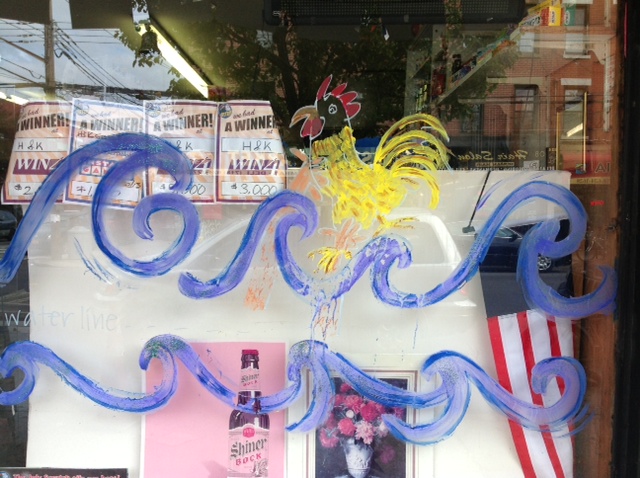
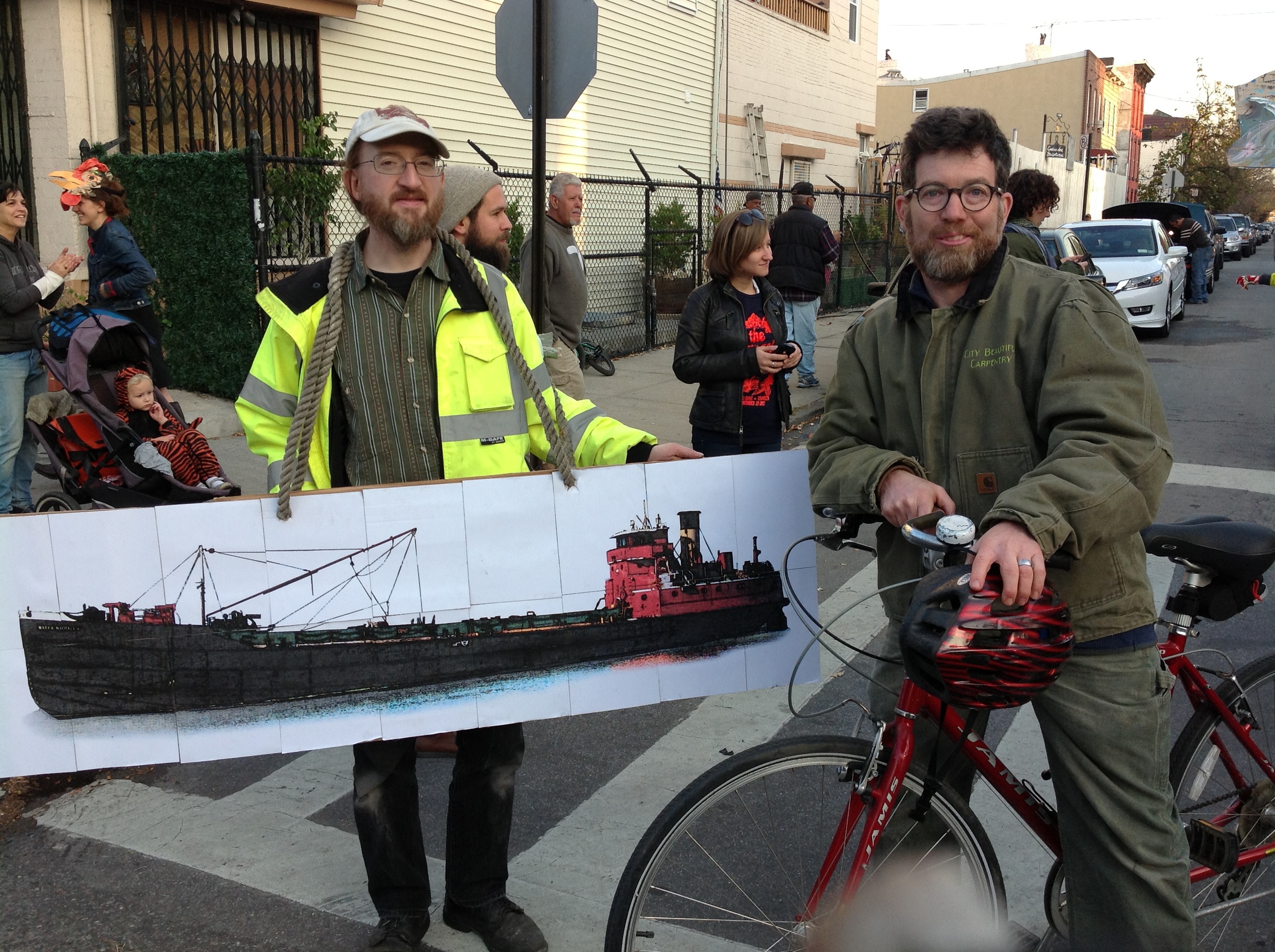
Red Hook got walloped by Sandy on 10/29/12, but the spirit that was most visible at the one-year anniversary, the Sandyversary, was moxie and mirth.  Cheeky illustrations popped up in a few places.   

Waterline with fish at the home of Chief Urban Designer of NYC's Department of City Planning. He is designing a way to flood-proof ground floors in the future.  

Waterline with fish at the home of Chief Urban Designer of NYC's Department of City Planning. He is designing a way to flood-proof ground floors in the future.  

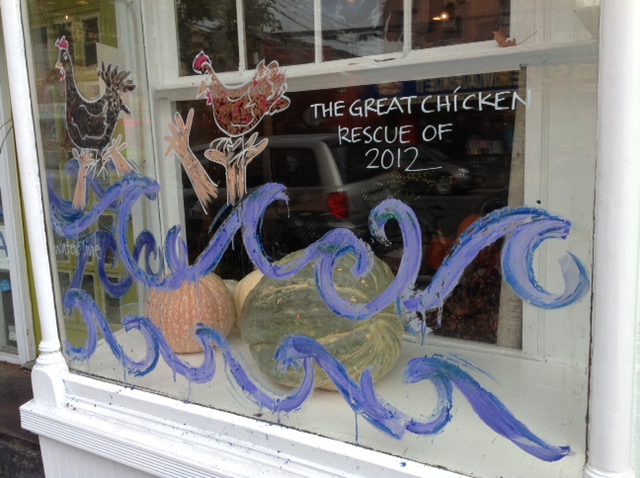
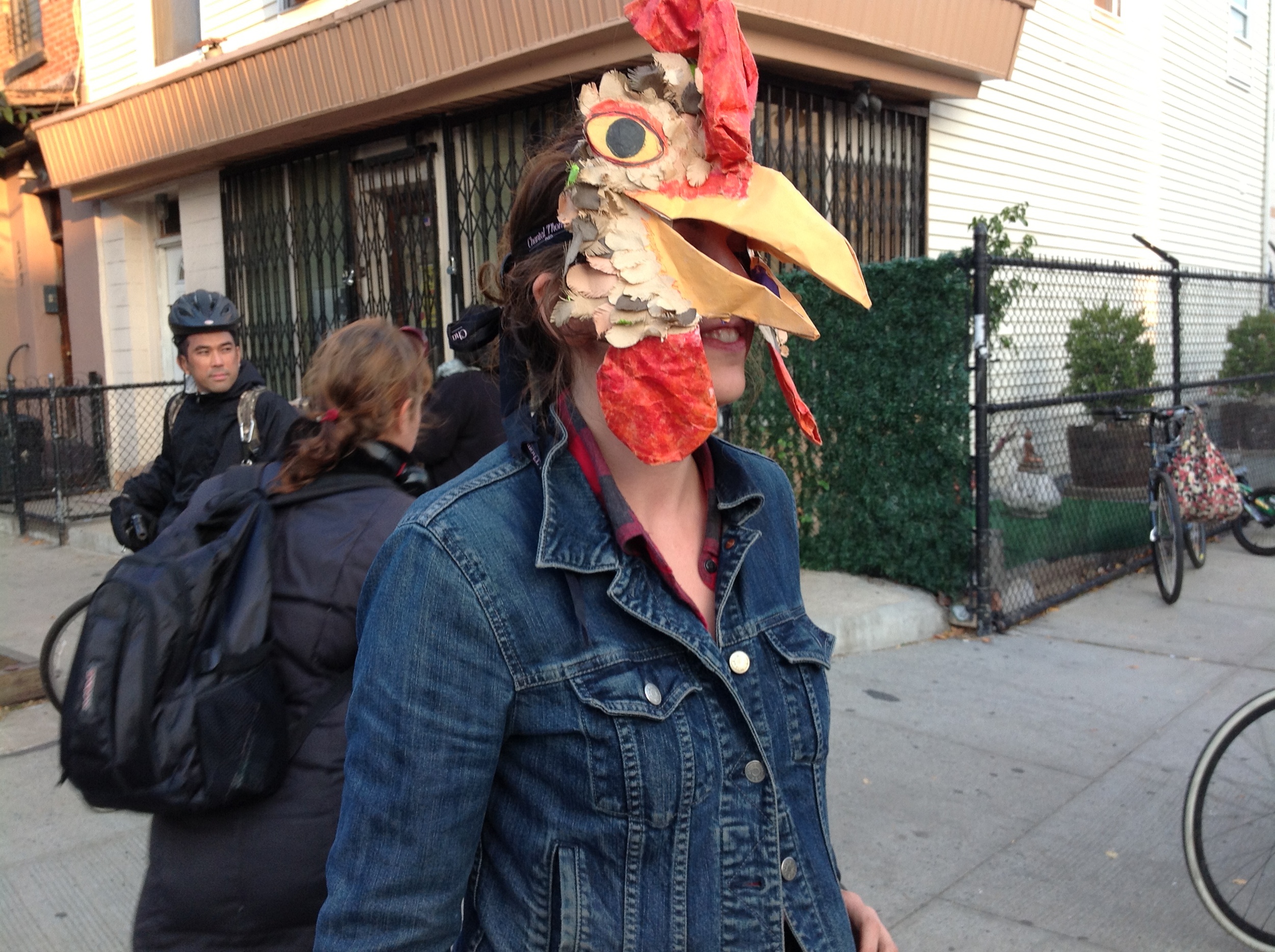
 There are a lot of chicken coops in Red Hook, and chicken jokes and costumes abounded.  References to the Great Chicken Rescue conducted by the gals of the winebar home/made, Monica Byrne and Leisah Swenson, appeared on their store window, on Heba Deli's next door, and the bartender’s costume at the Red Hook Volunteers Party.

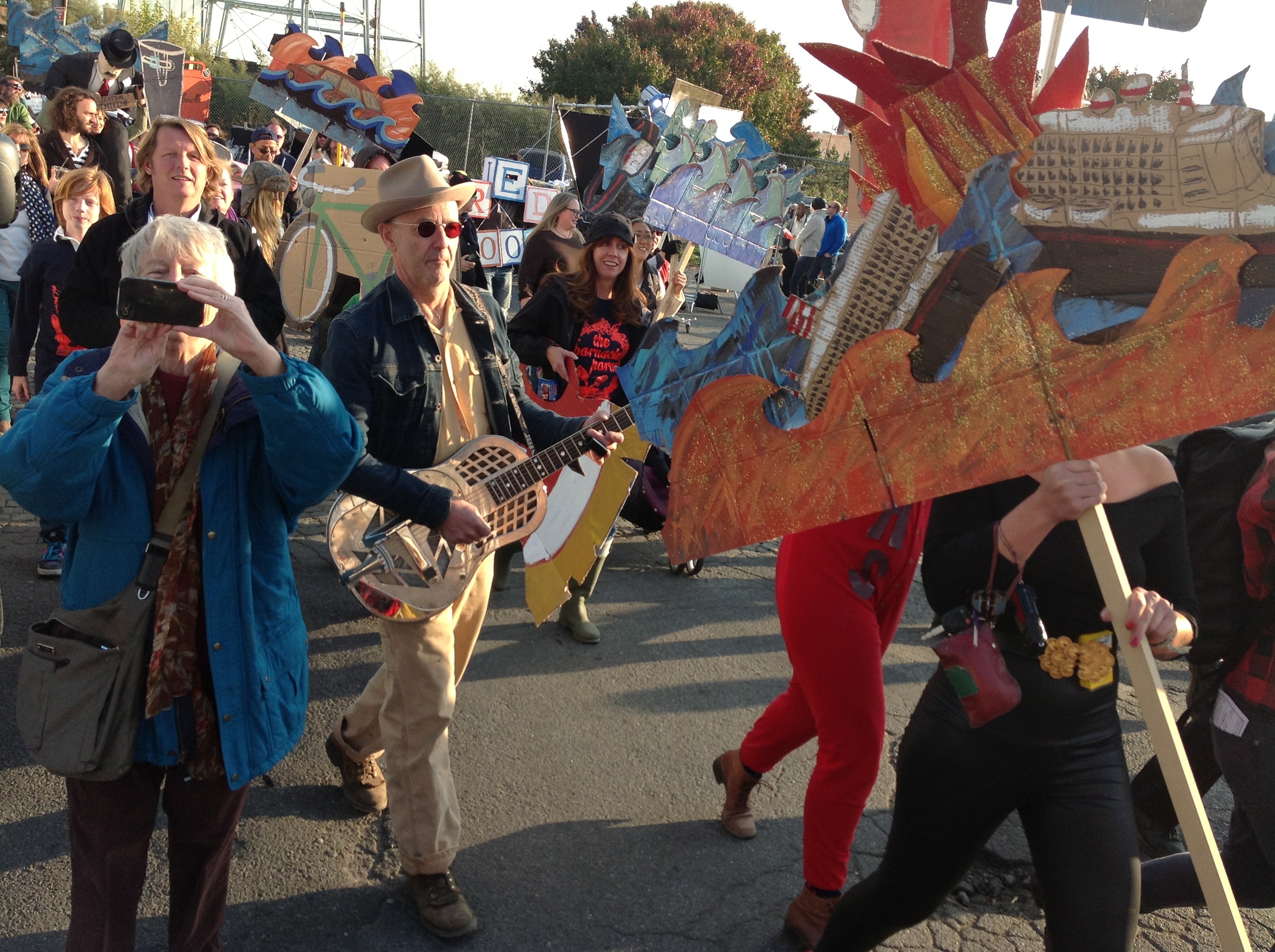
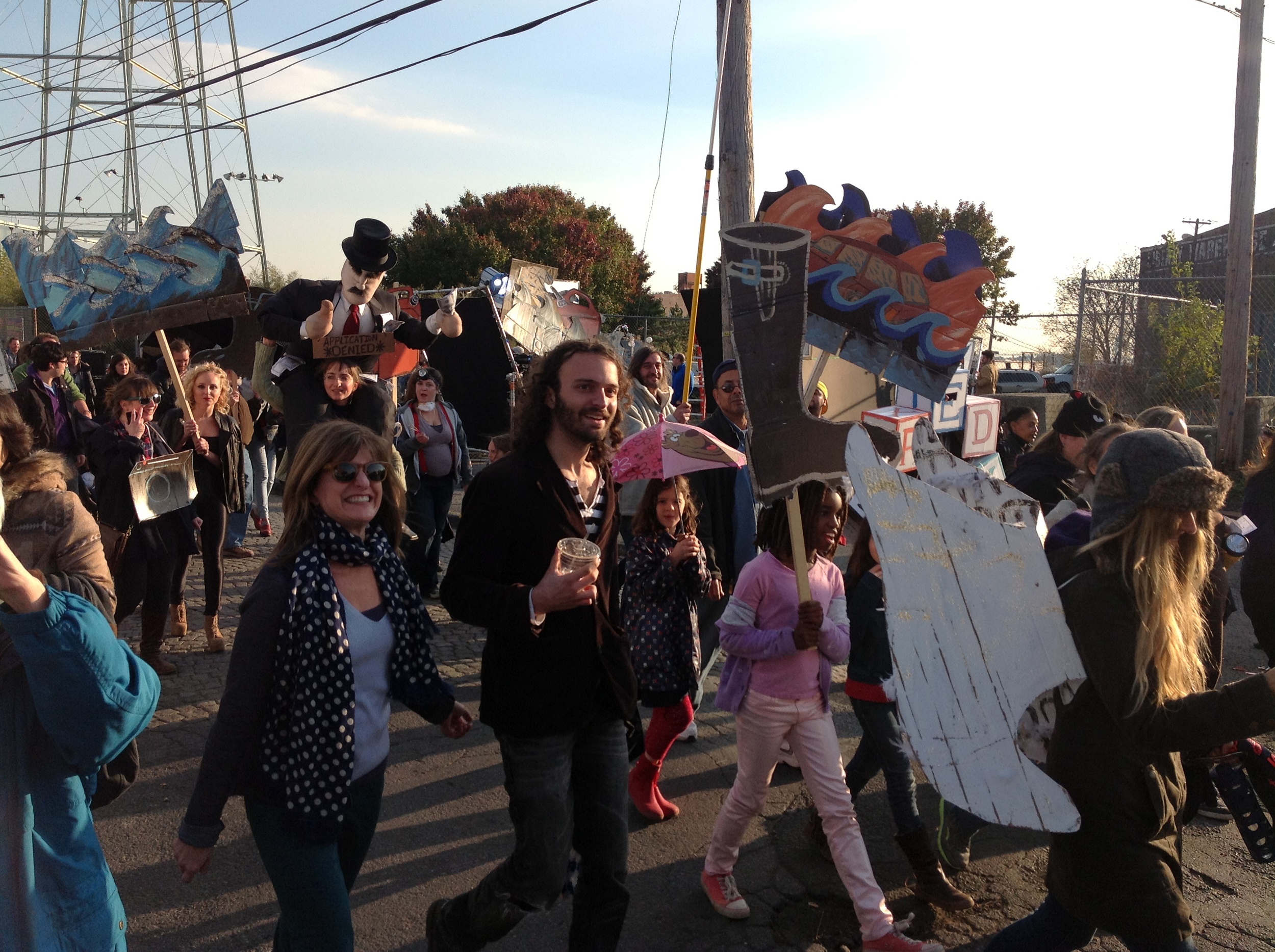
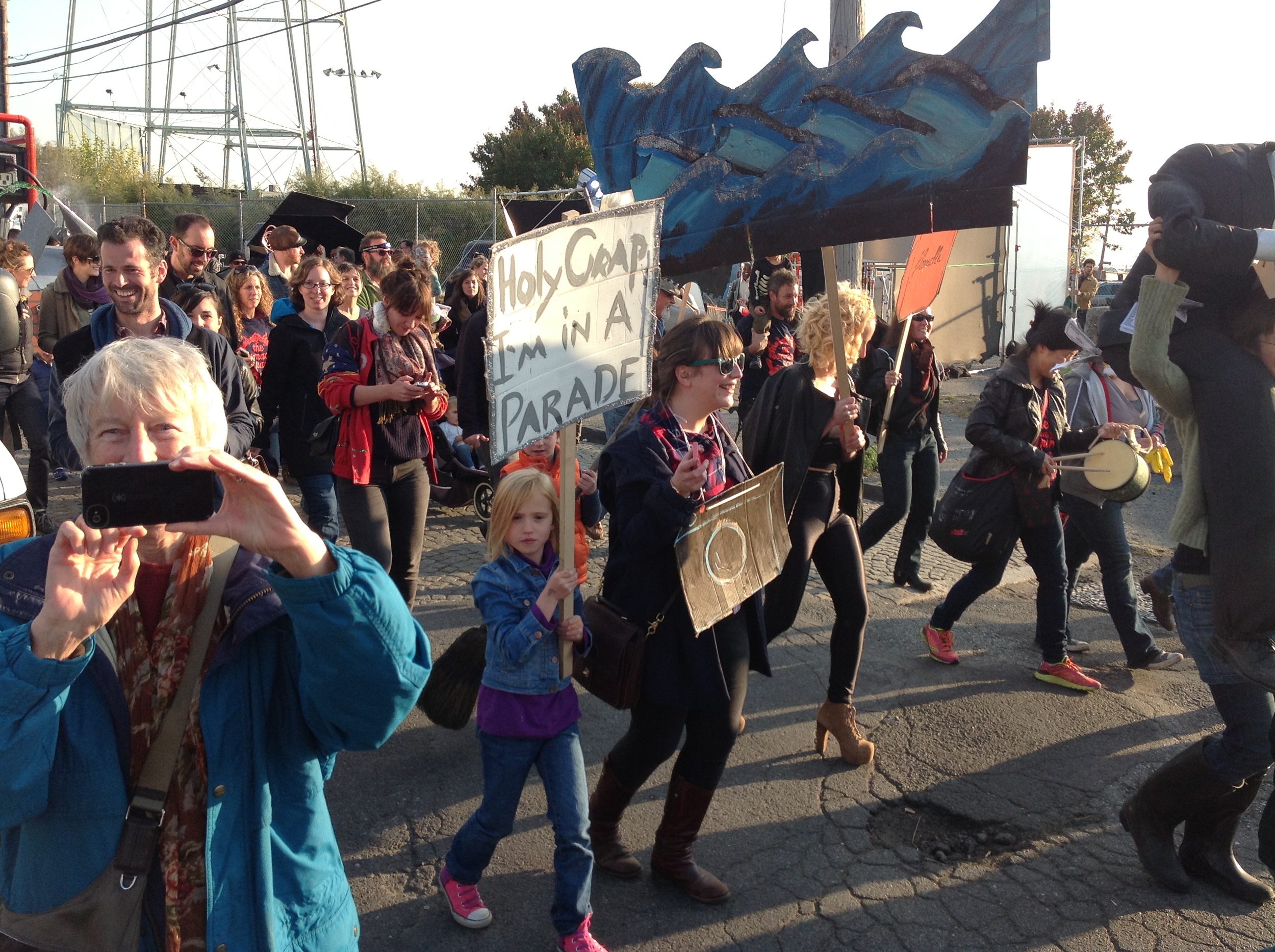
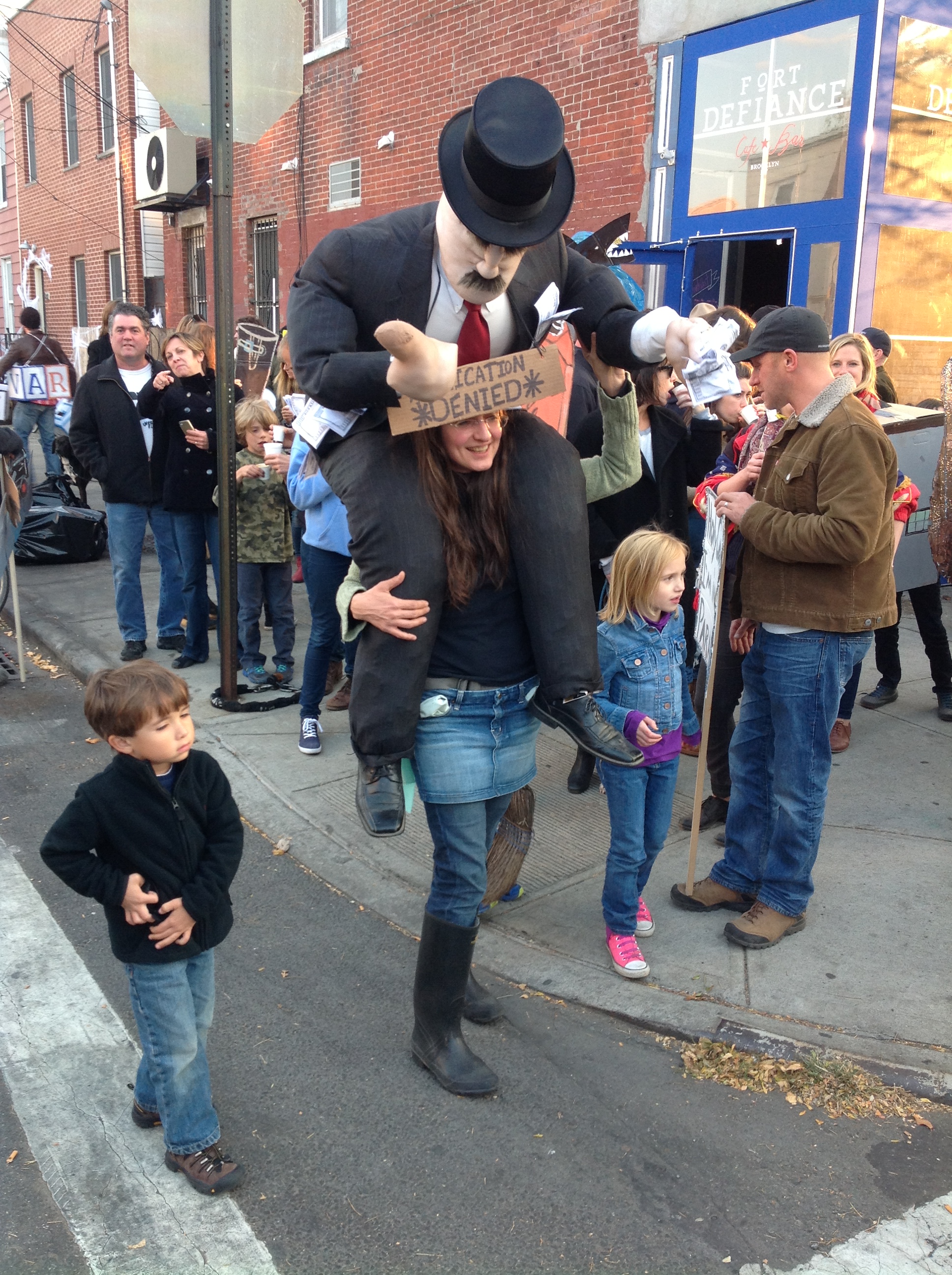
Barnacle Parade

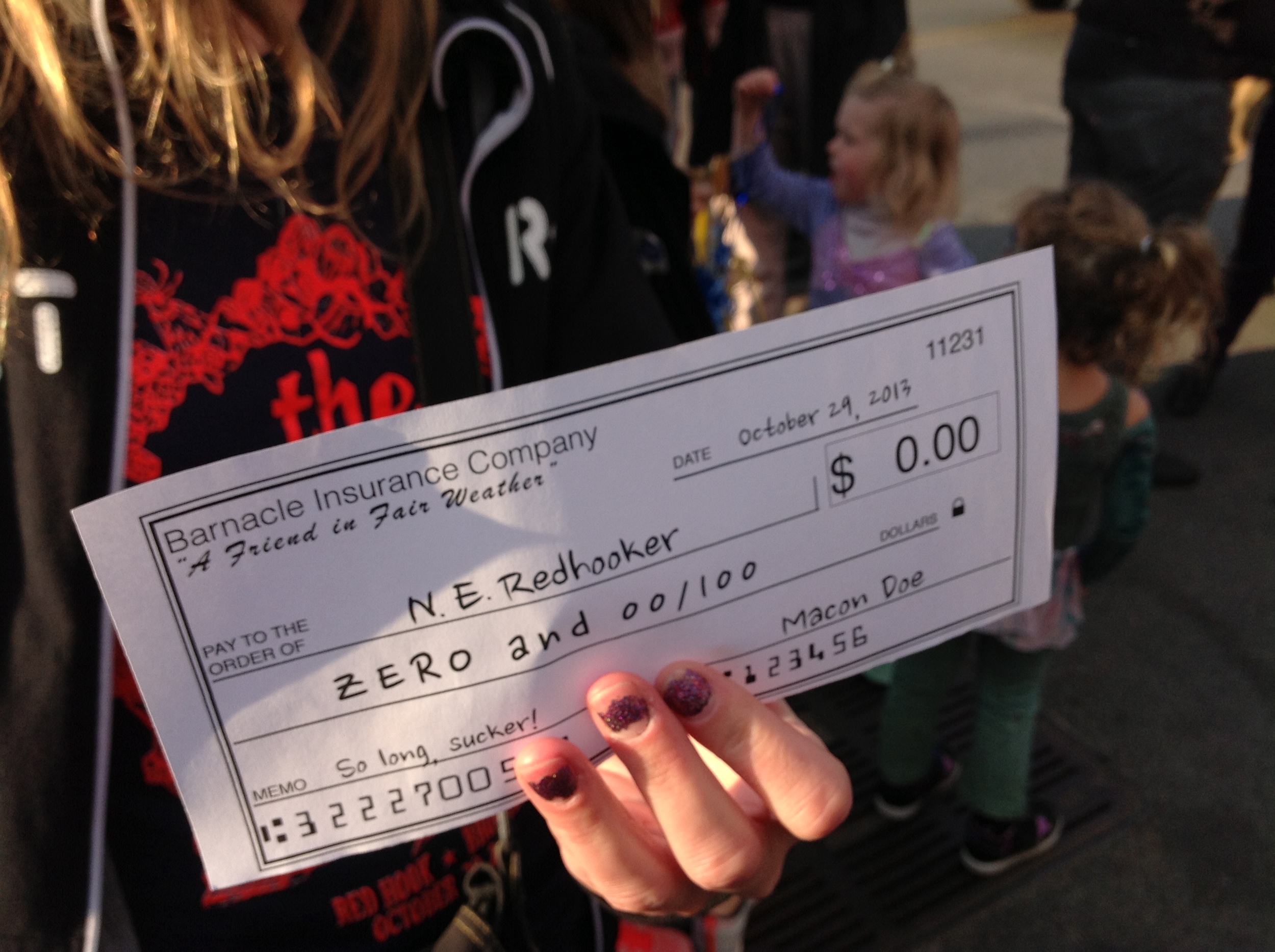
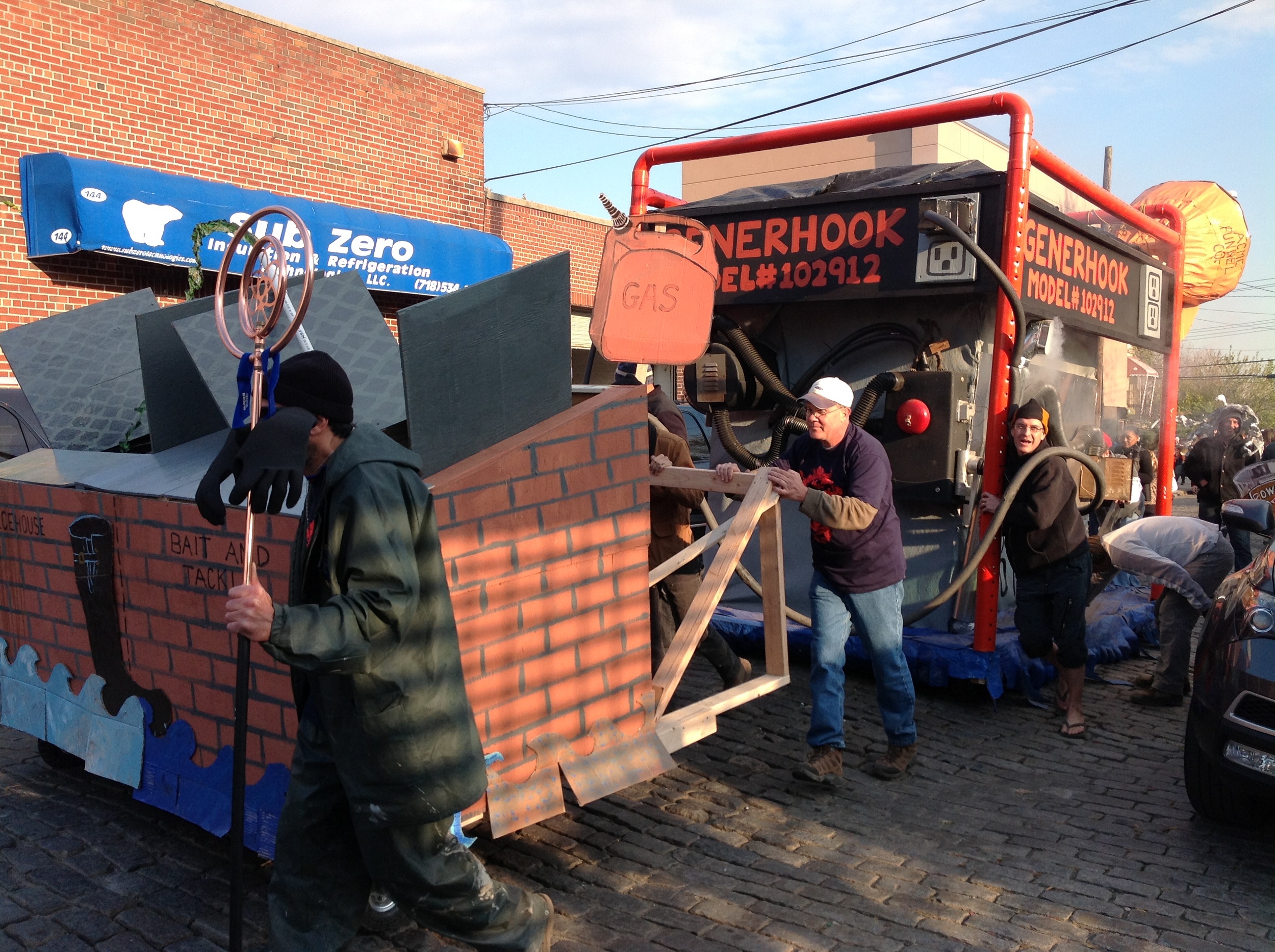
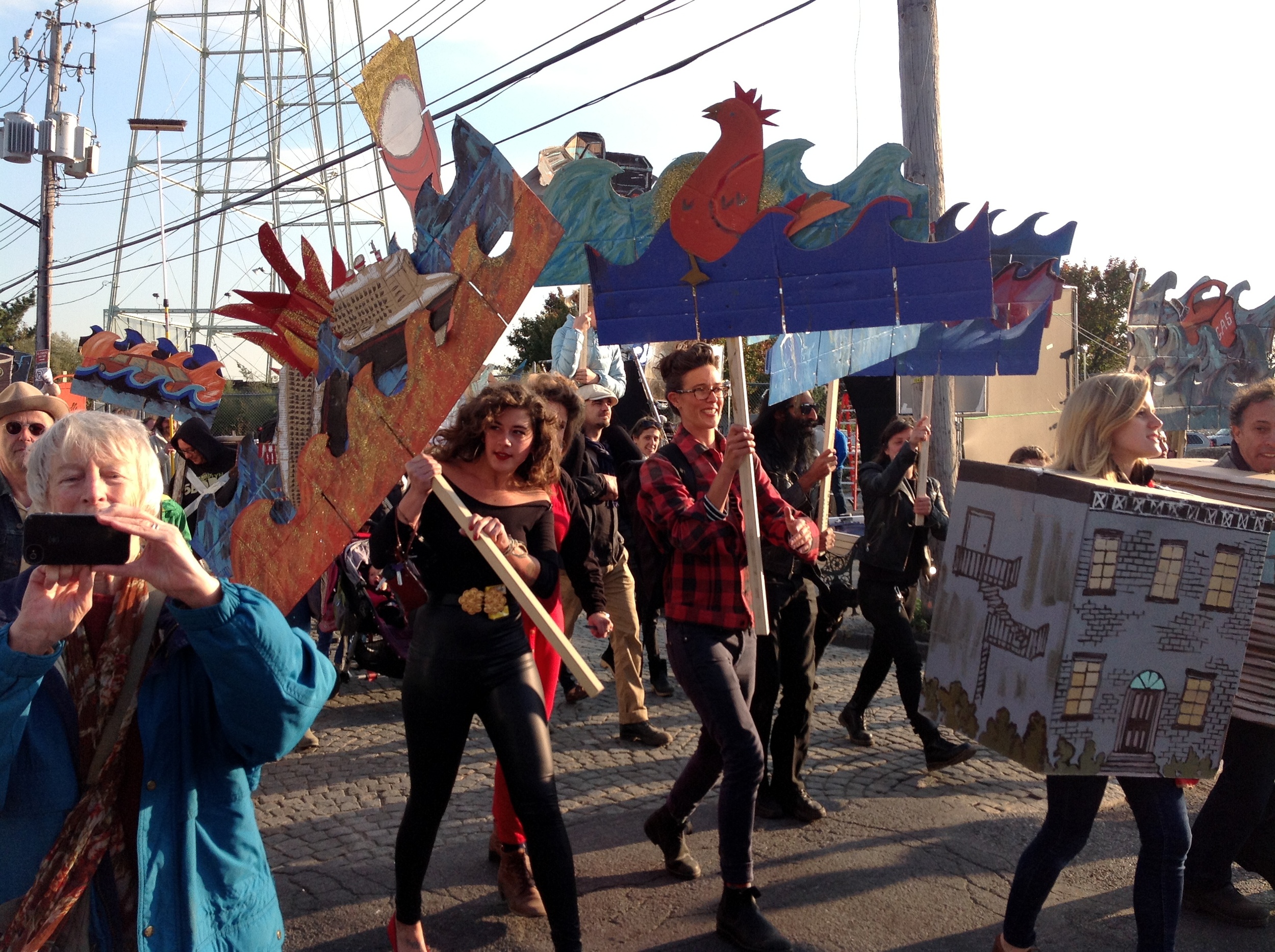
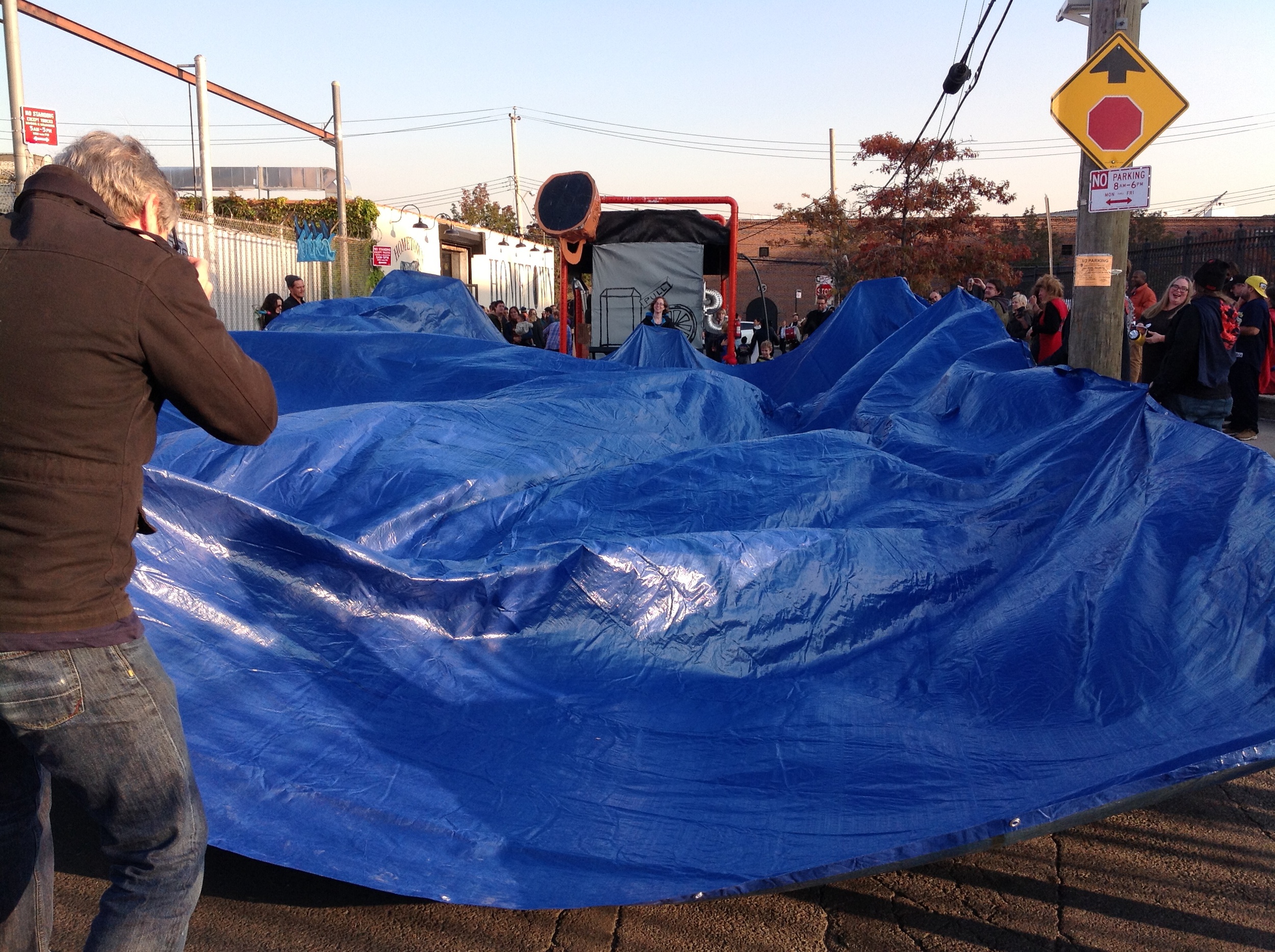
An underground parade, the Barnacle Parade, was organized on short notice. Satirical costumes ridiculed the insurance industry, referred to blown out transformers, jerry jugs, diesel oil spills, and Gowanus Canal overflow. A float depicting a generator loomed over it all. A huge, blue tarp, shaken by a dozen people, was a lo-fi illustration of Sandy’s flood waters. 


RHI - Sandy One Year Acknowledgement Anniversary Dinner

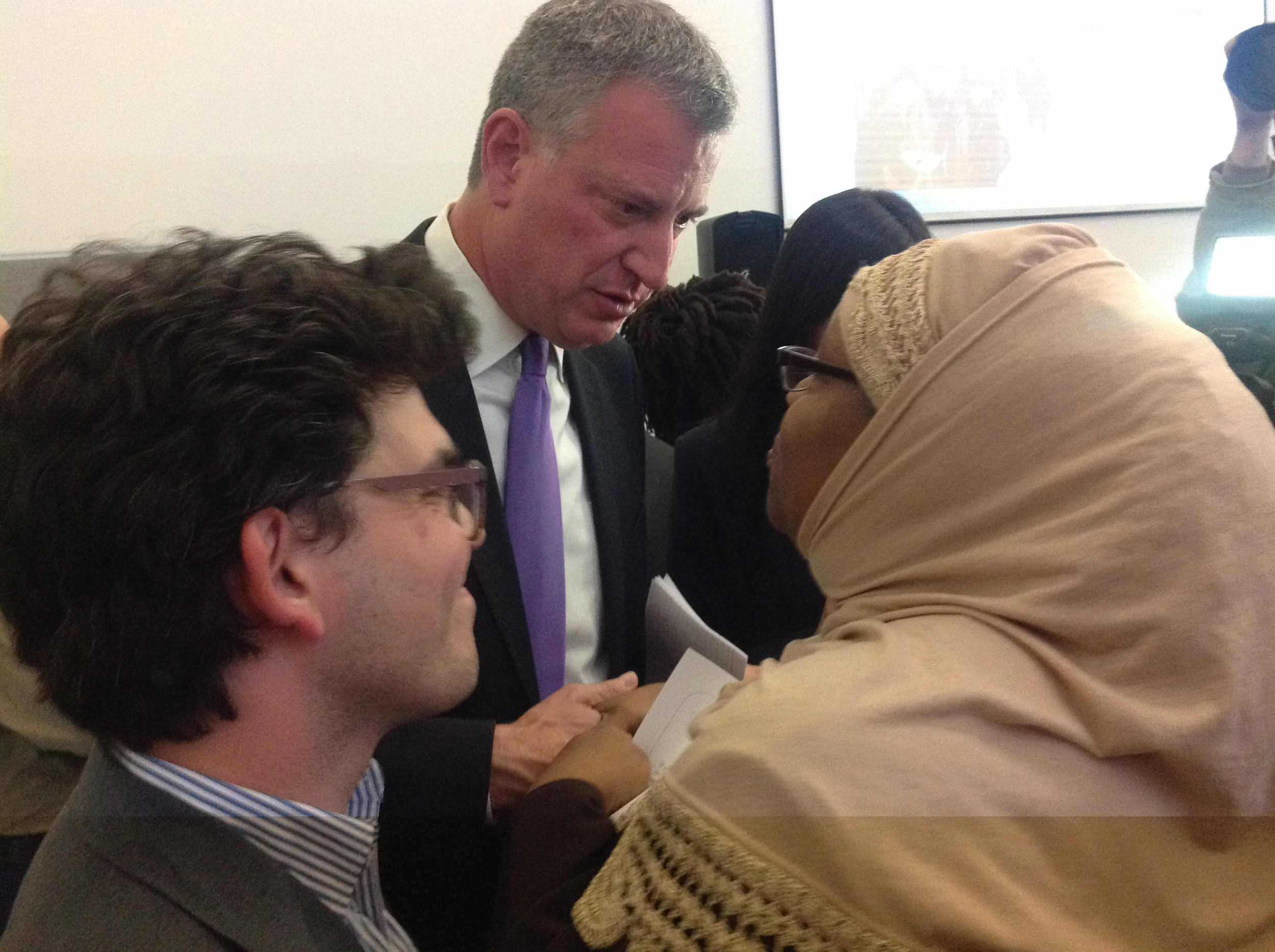
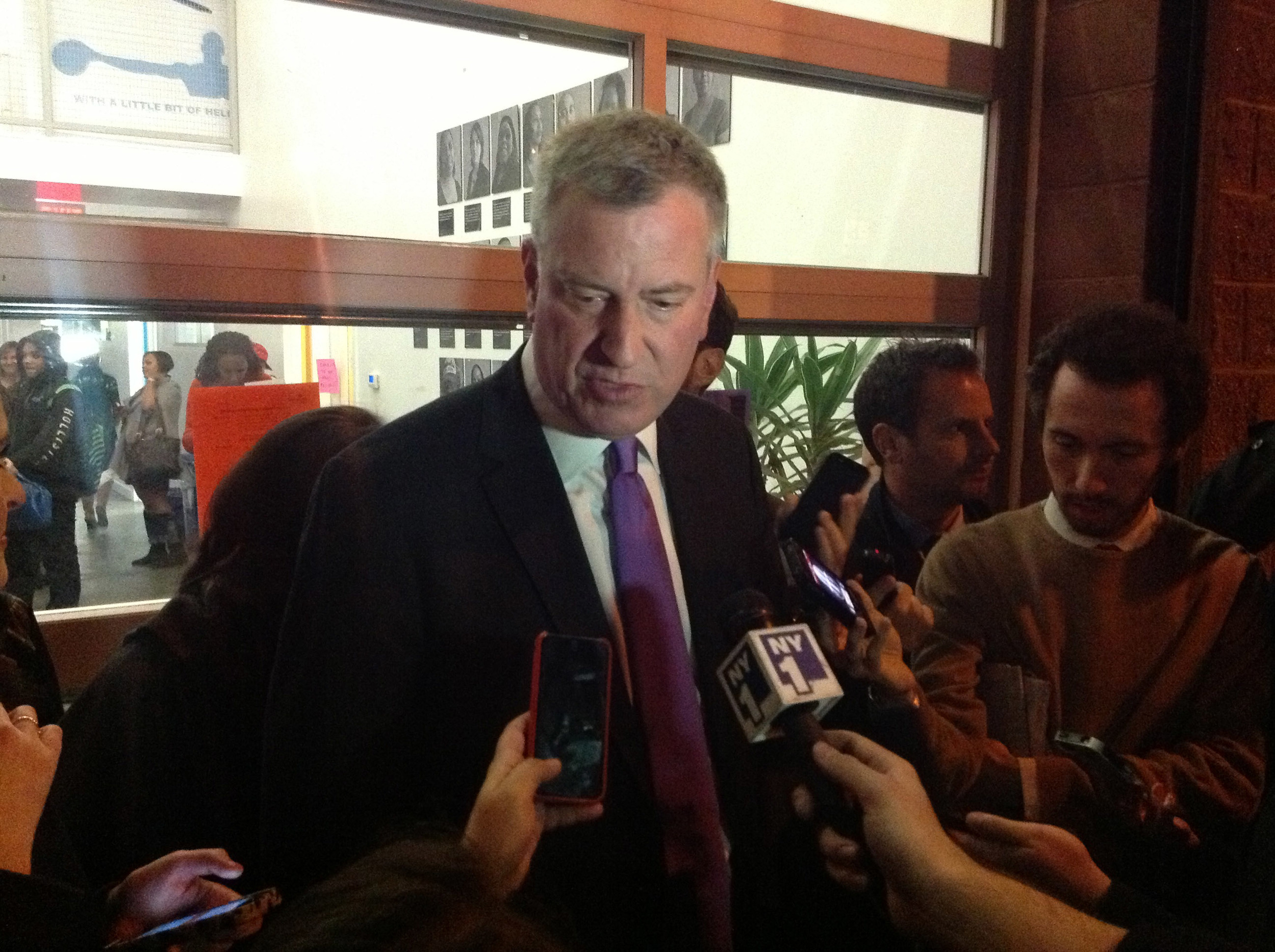
We were pretty busy with the parade and our role in the Light up the Shore, so we missed most of Red Hook Initiative's event. If anyone wants to send photos and copy our way, we'll post them!  The proceedings concluded with a visit by Bill de Blasio, now Mayor of New York City, who had a lot of media in tow.


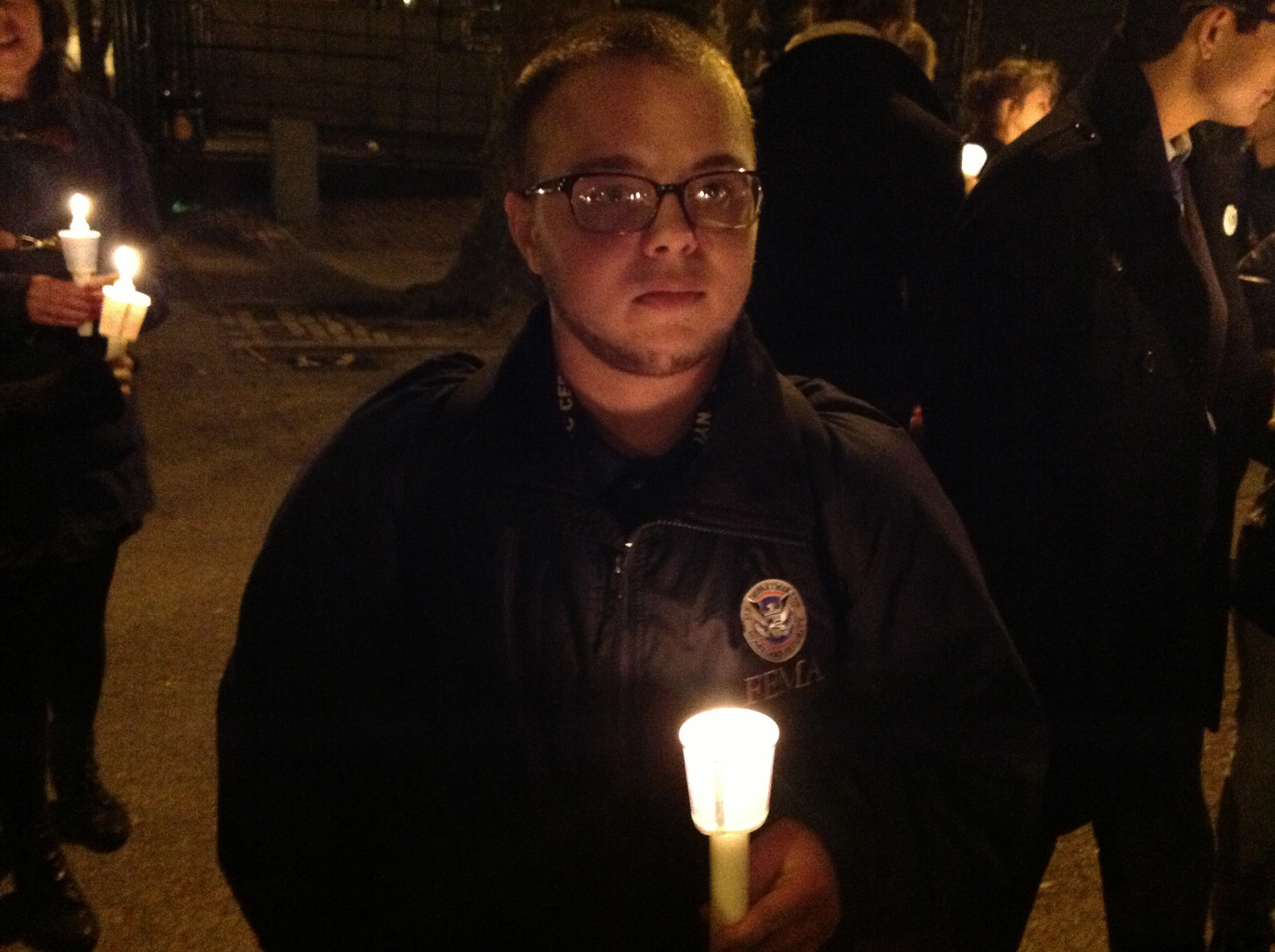
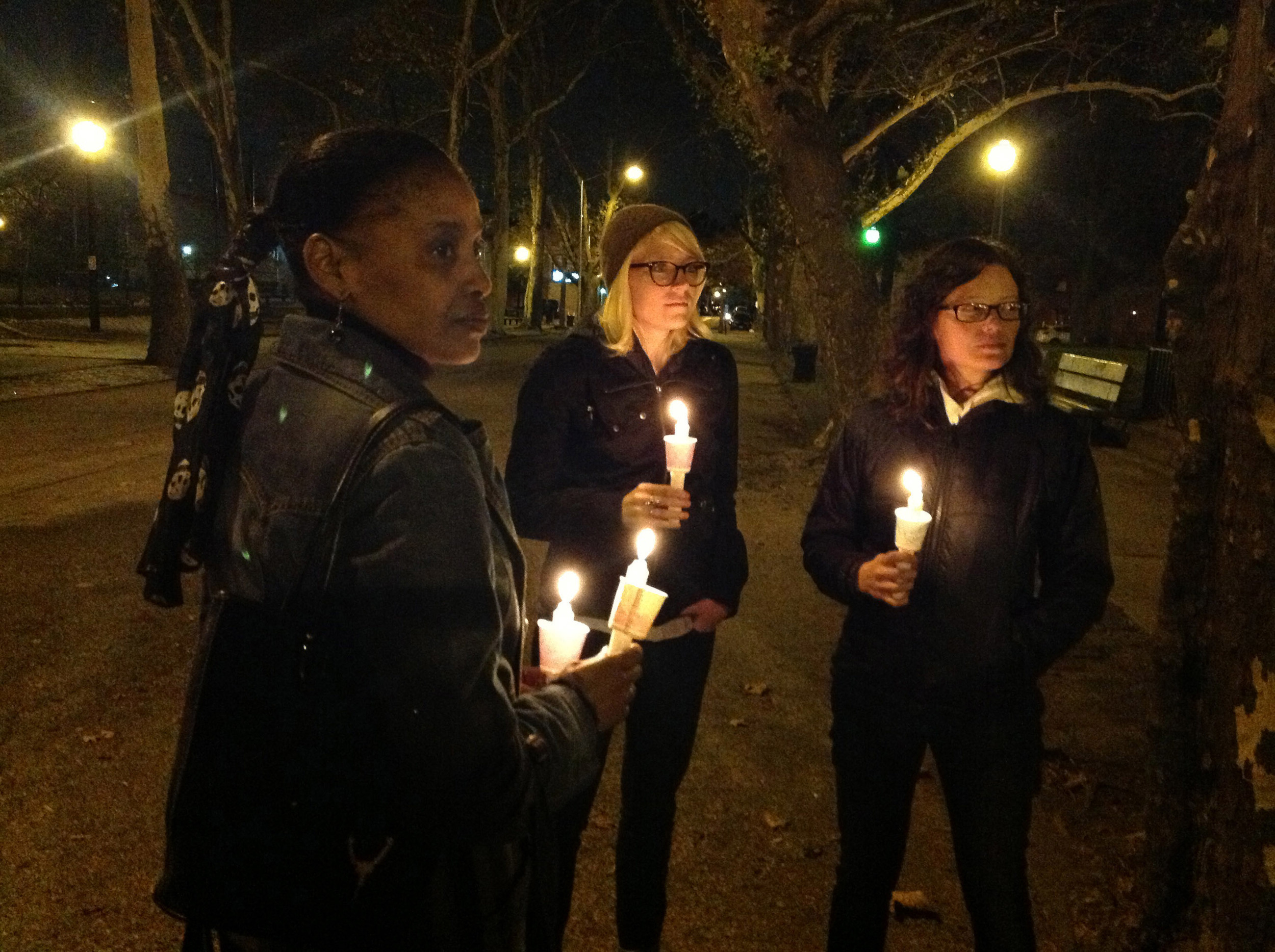
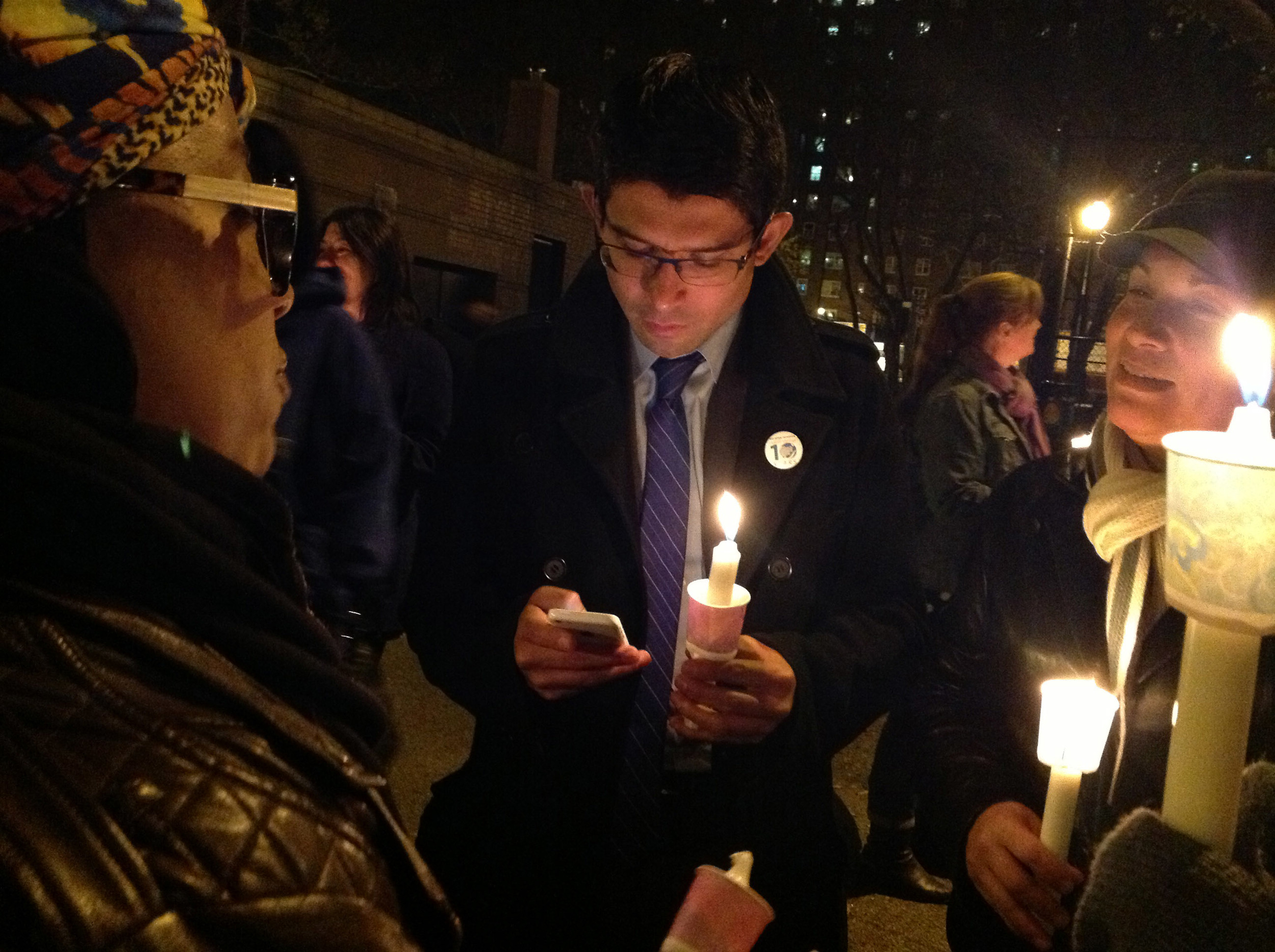
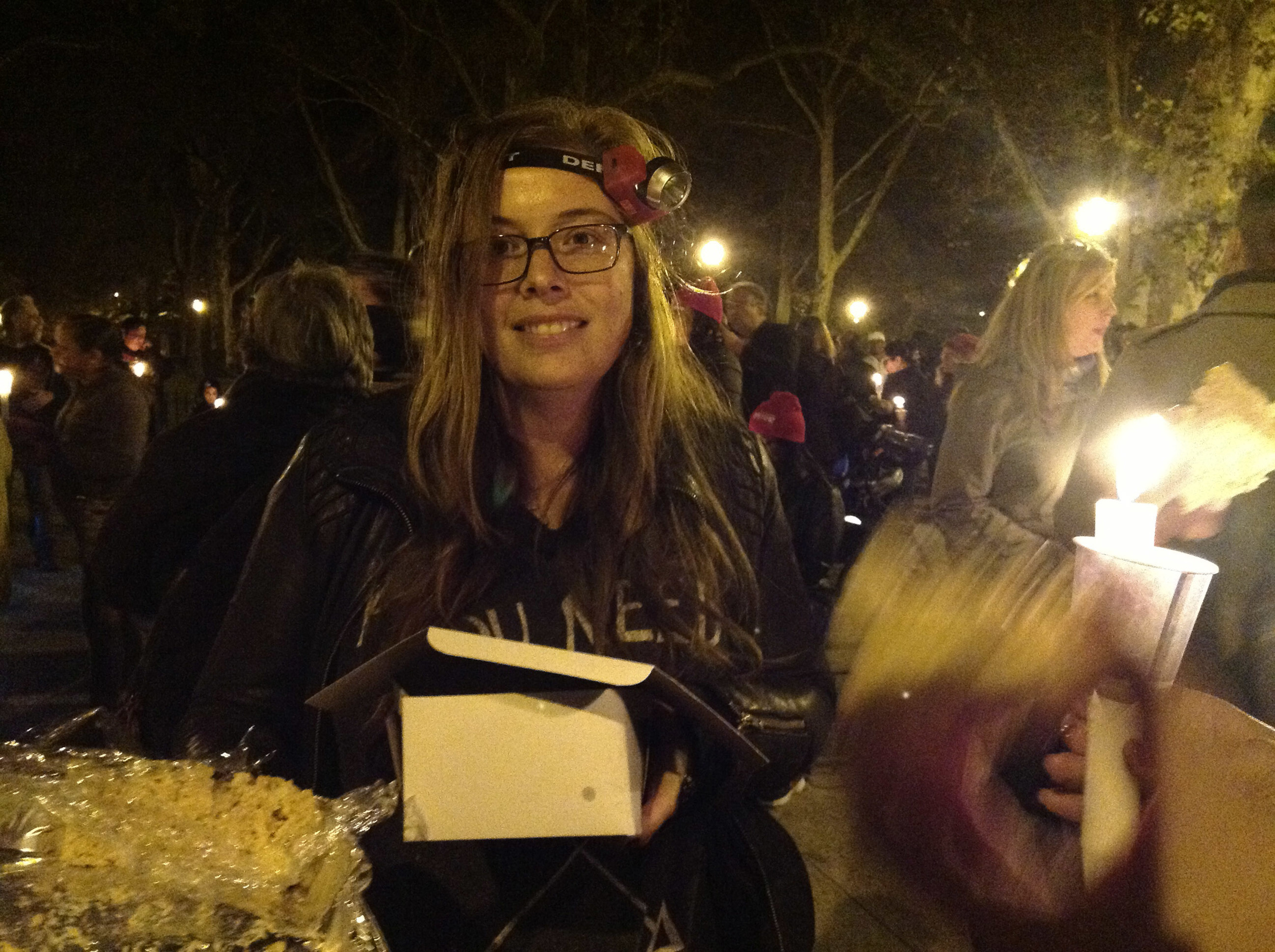
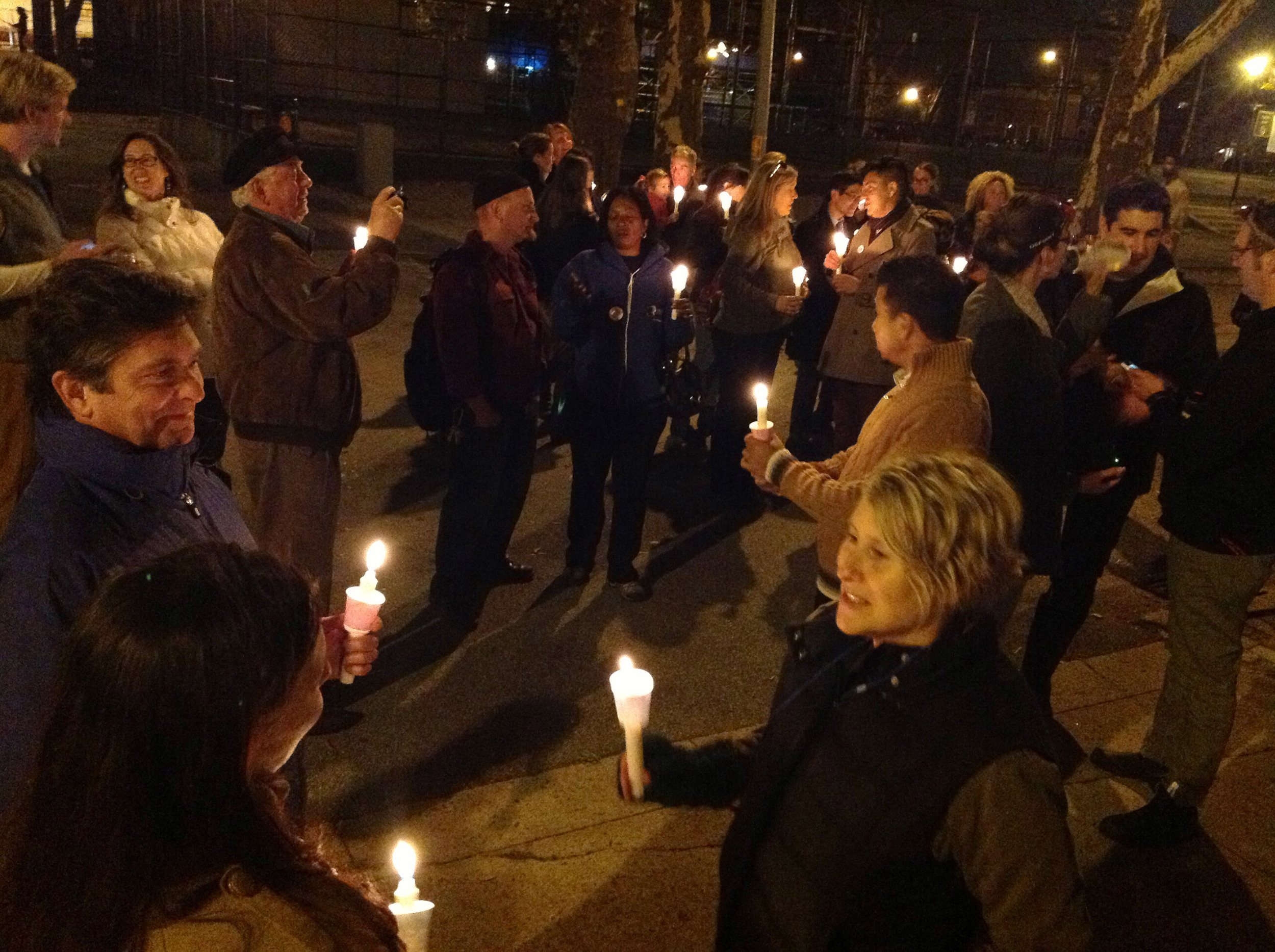
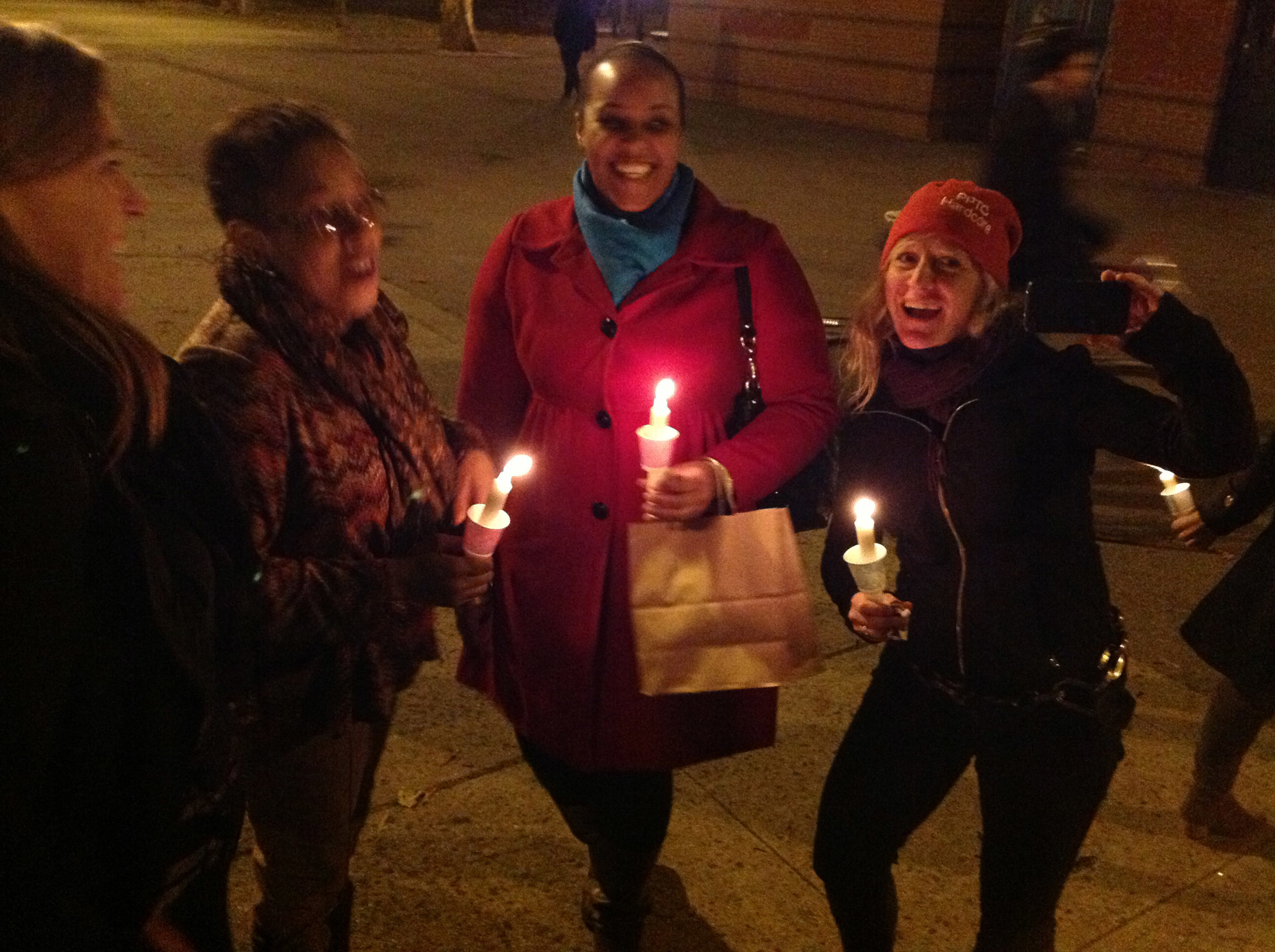
Coffey Park candlelight vigil

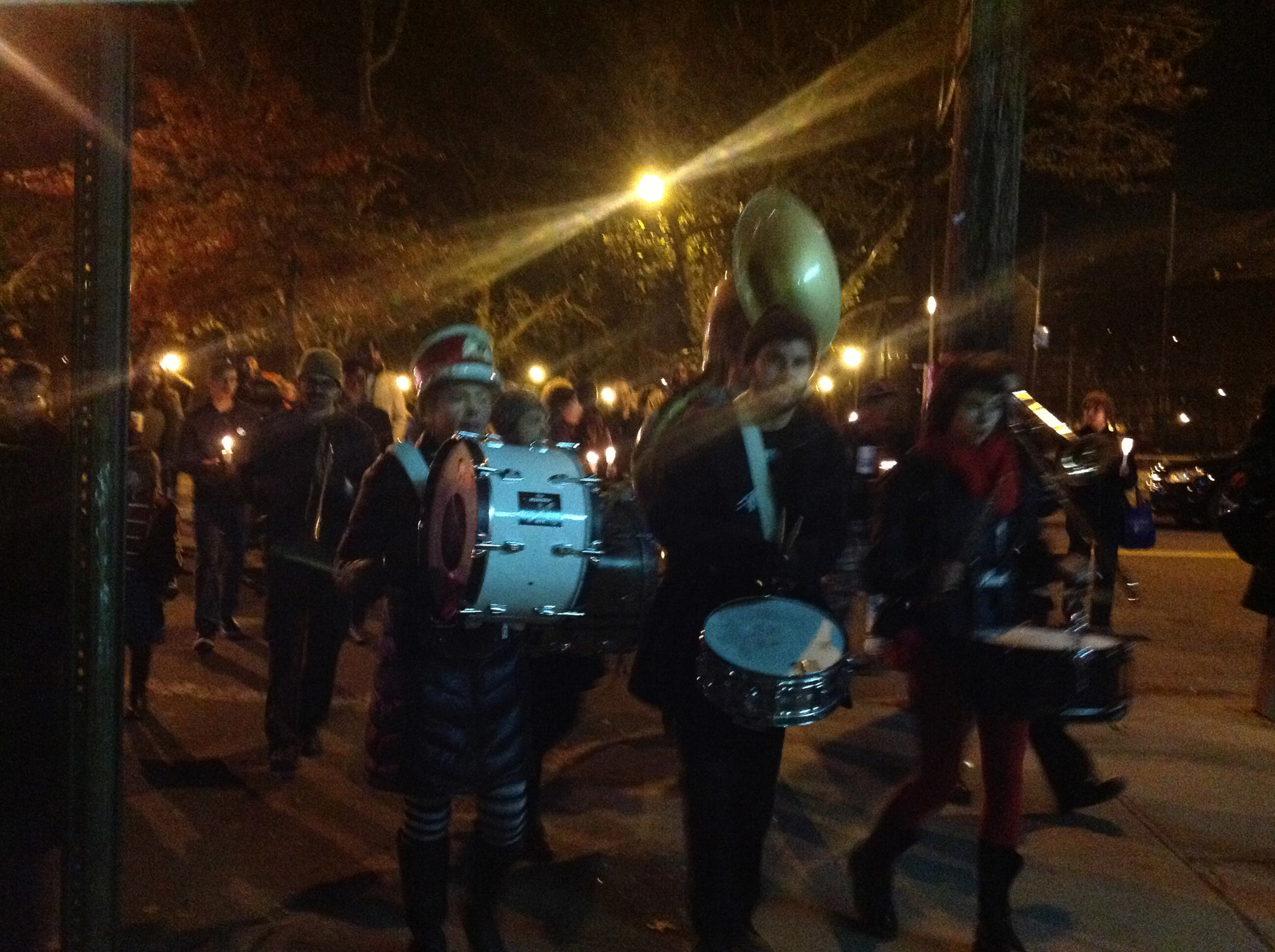
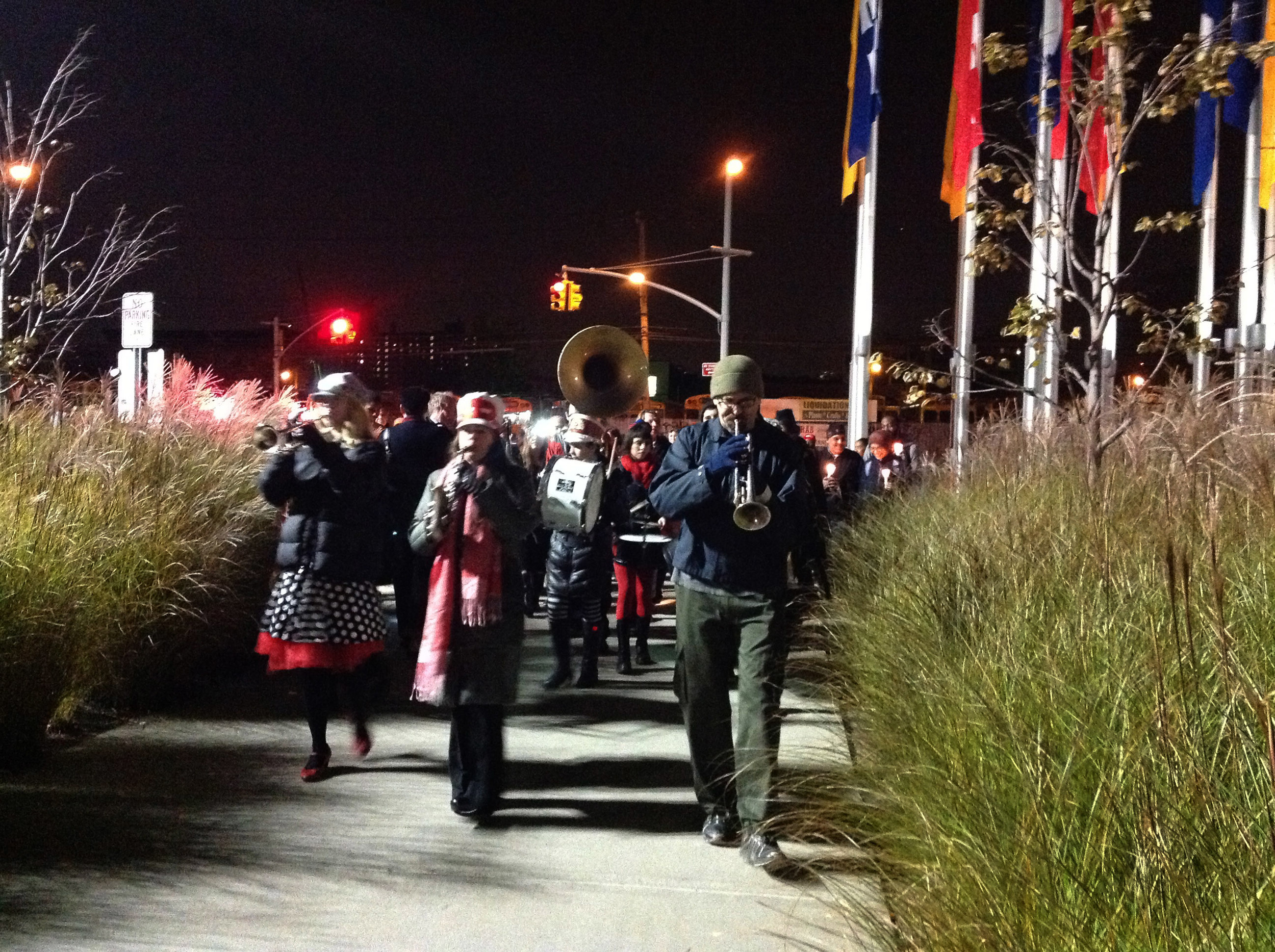
A vigil organized by Monica Byrne, Rachel Forsyth, Martha Bowers and others started near 7pm. A pleasant twenty minutes or so of chatting and candle-lighting occurred while the crowd gathered, some of them from RHI's event above. Reginald Flowers asked everyone to form a circle  ("this is a Red Hook circle," someone quipped looking at our misshapen round in the park) and to have a moment of silence. The silence ended when the Hungry March Band, invited by PortSide NewYork with the help of Dan Wiley of Congresswoman Nydia Velazquez office, struck up a tune and stepped out to head towards IKEA.


Light Up the Shore

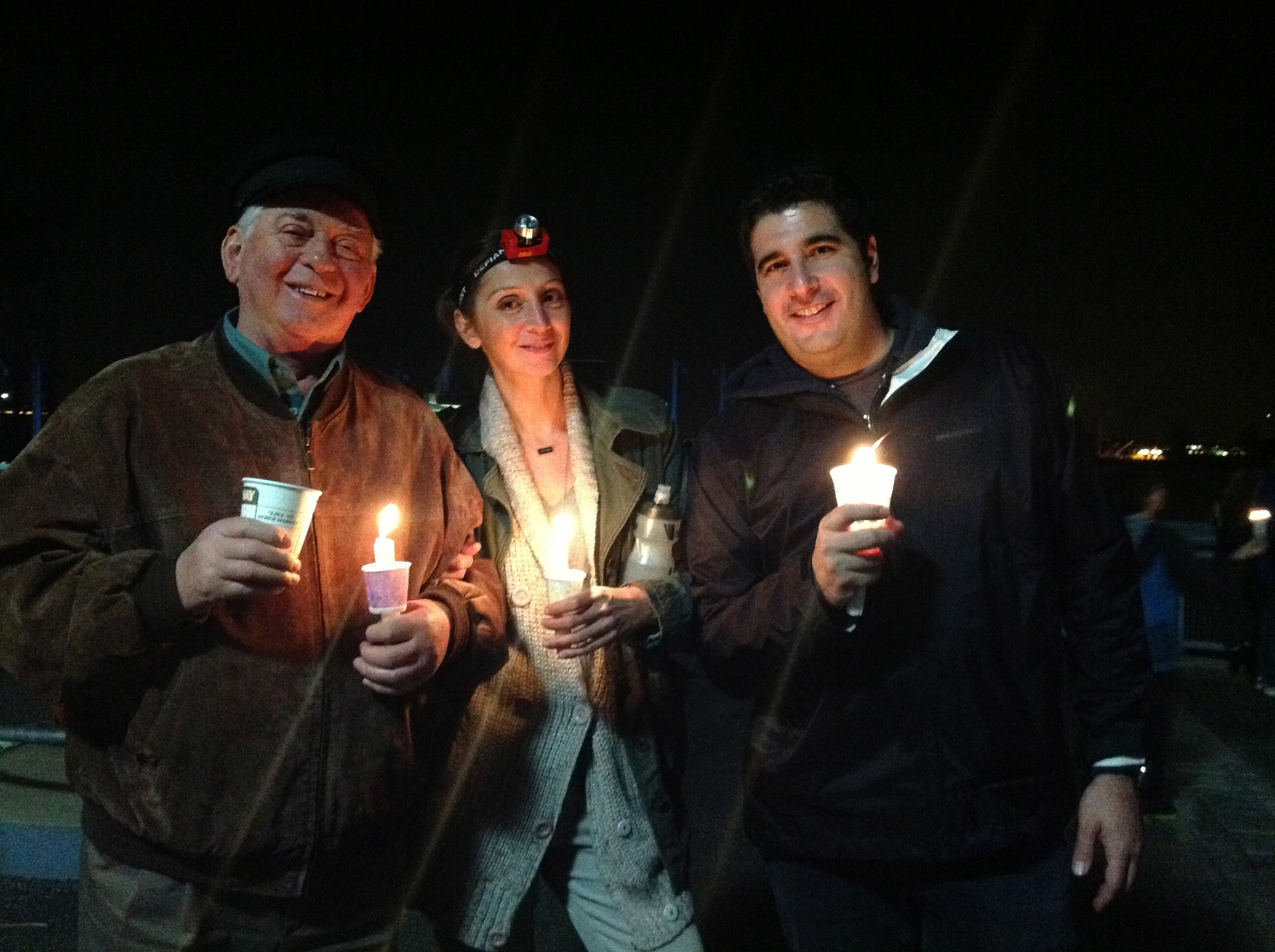
PortSide NewYork was the Red Hook organizer for Light up the Shore, a harborwide event including NY & NJ, where people lined up with candles and flashlights at 7:45pm, the hour the waters started hitting our city.  On this, we coordinated with The Brooklyn Long Term Recovery Group, who was helping to arrange gathering spots all over Brooklyn.

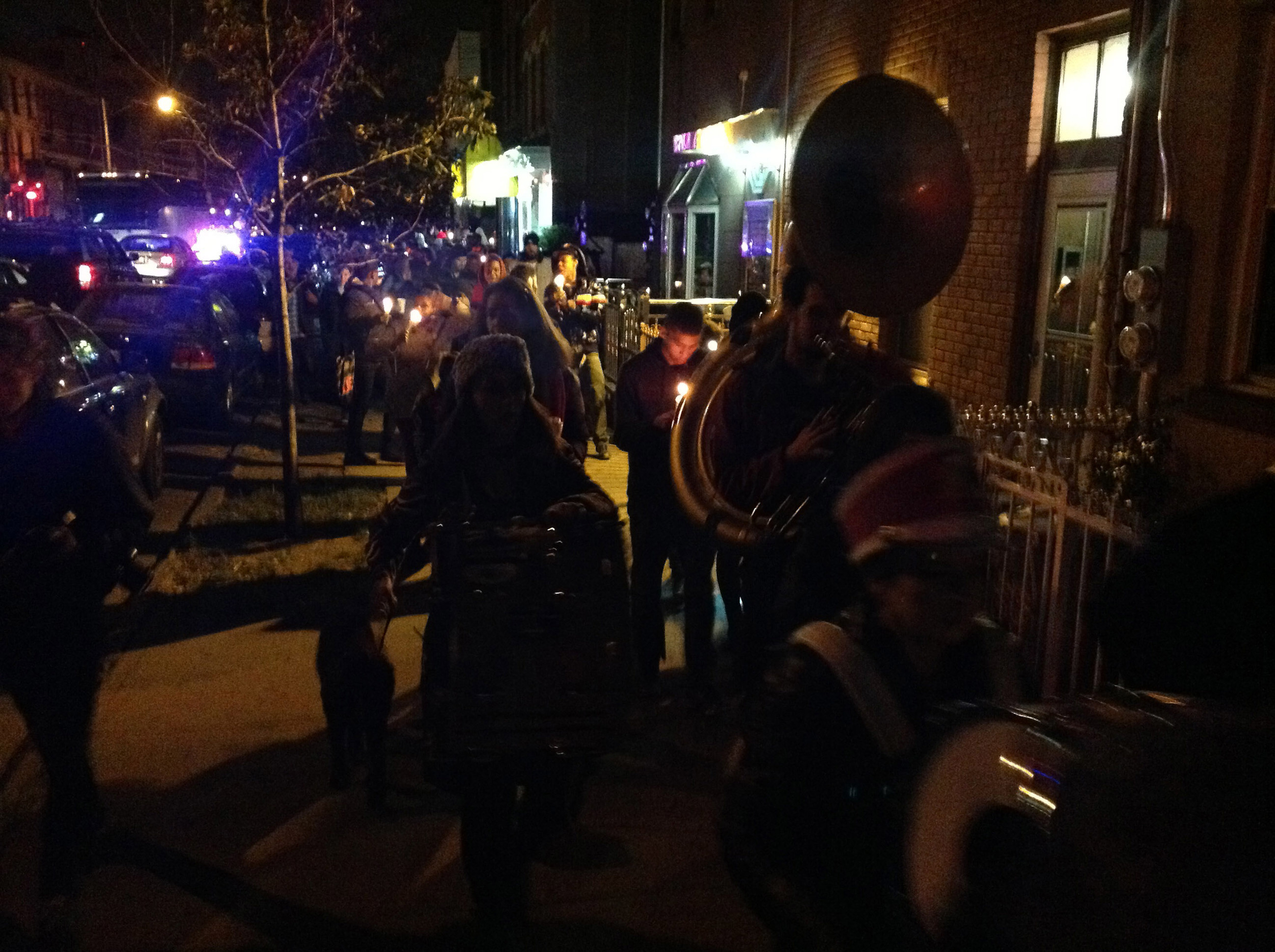
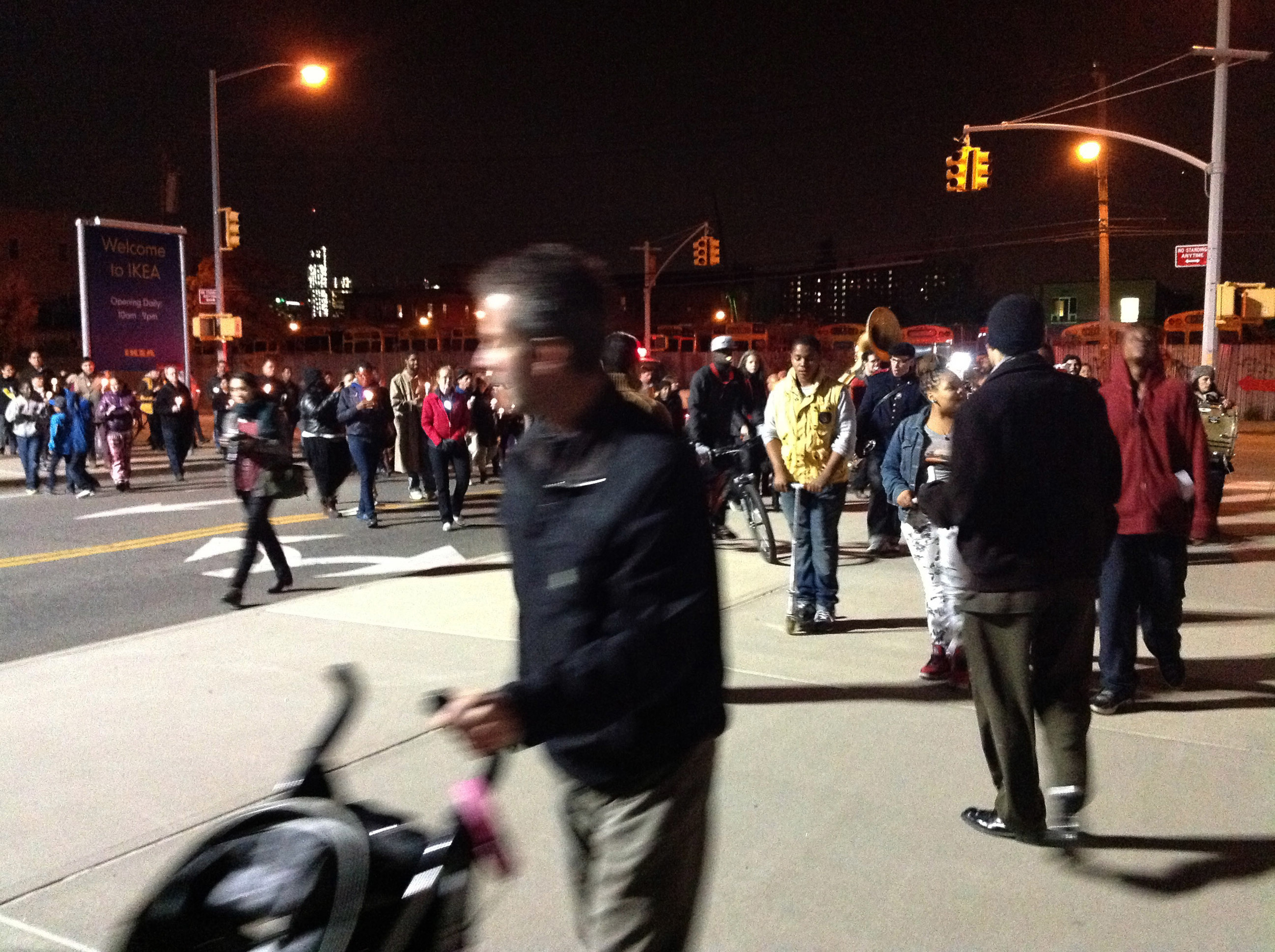
The Hungry March band led a group of about two hundred people, New Orleans style, towards the waterfront with teens on skateboards and bikes dancing and popping wheel out in the front.  As the throng turned on to Van Brunt Street at Pioneer, a big cheer erupted from the rump remains of the Barnacle Parade partying in front of Bait & Tackle

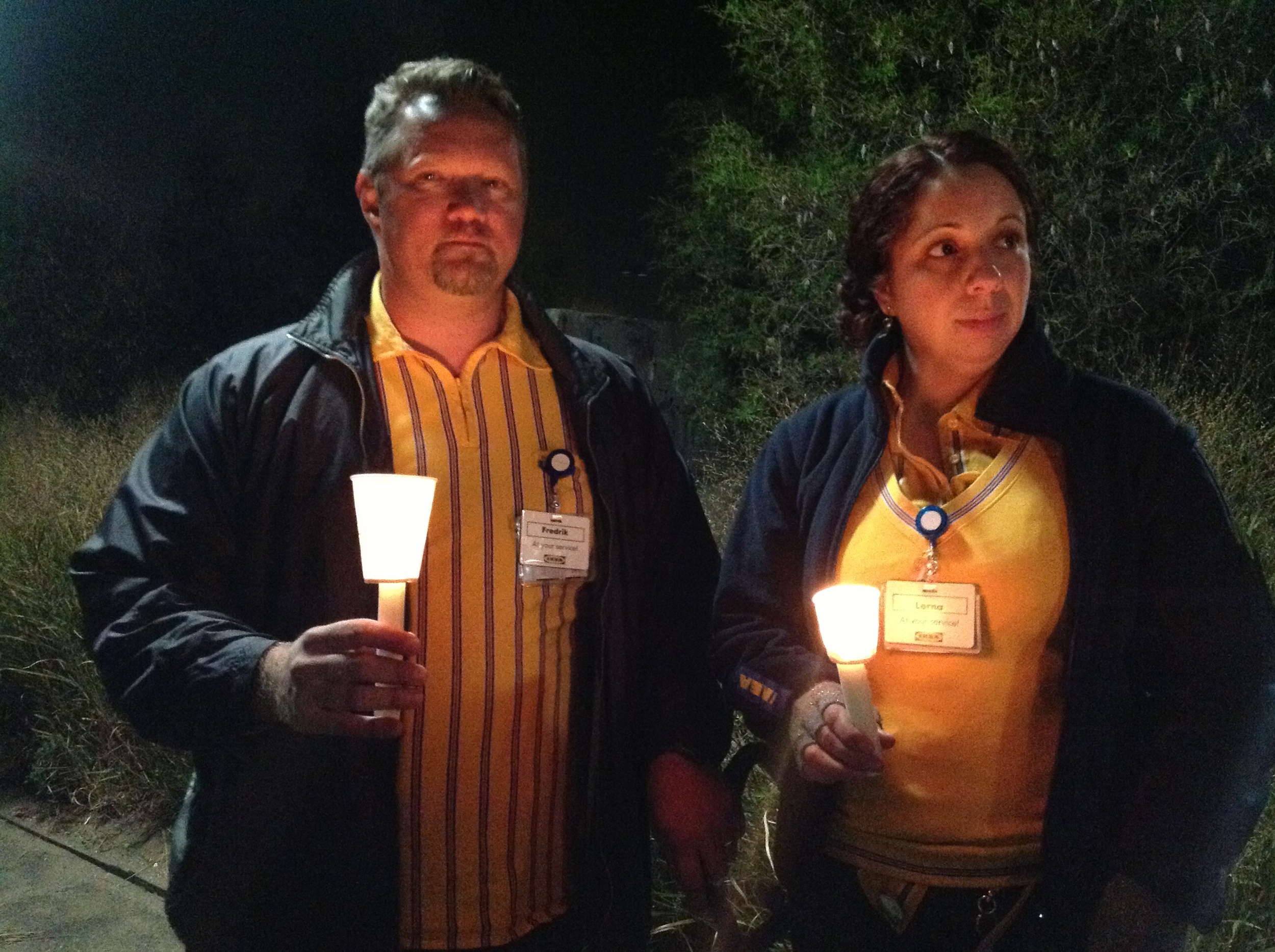
IKEA graciously invited the community to come to their waterfront and donated 200 candles, hot Glogg (a Swedish beverage that tastes a lot better than it sounds!) and cookies. Fairway donated hot cider and cookies. Father Claudio Antecini of Visitation Church spoke followed by Carlos Menchaca, now our Councilman.  Carolina Salguero of PortSide said "there is a request for group hug, hug someone you know and some one you don't," and after a bout of hugging and more chatting, the crowd filtered away into the night.


Red Hook Volunteer

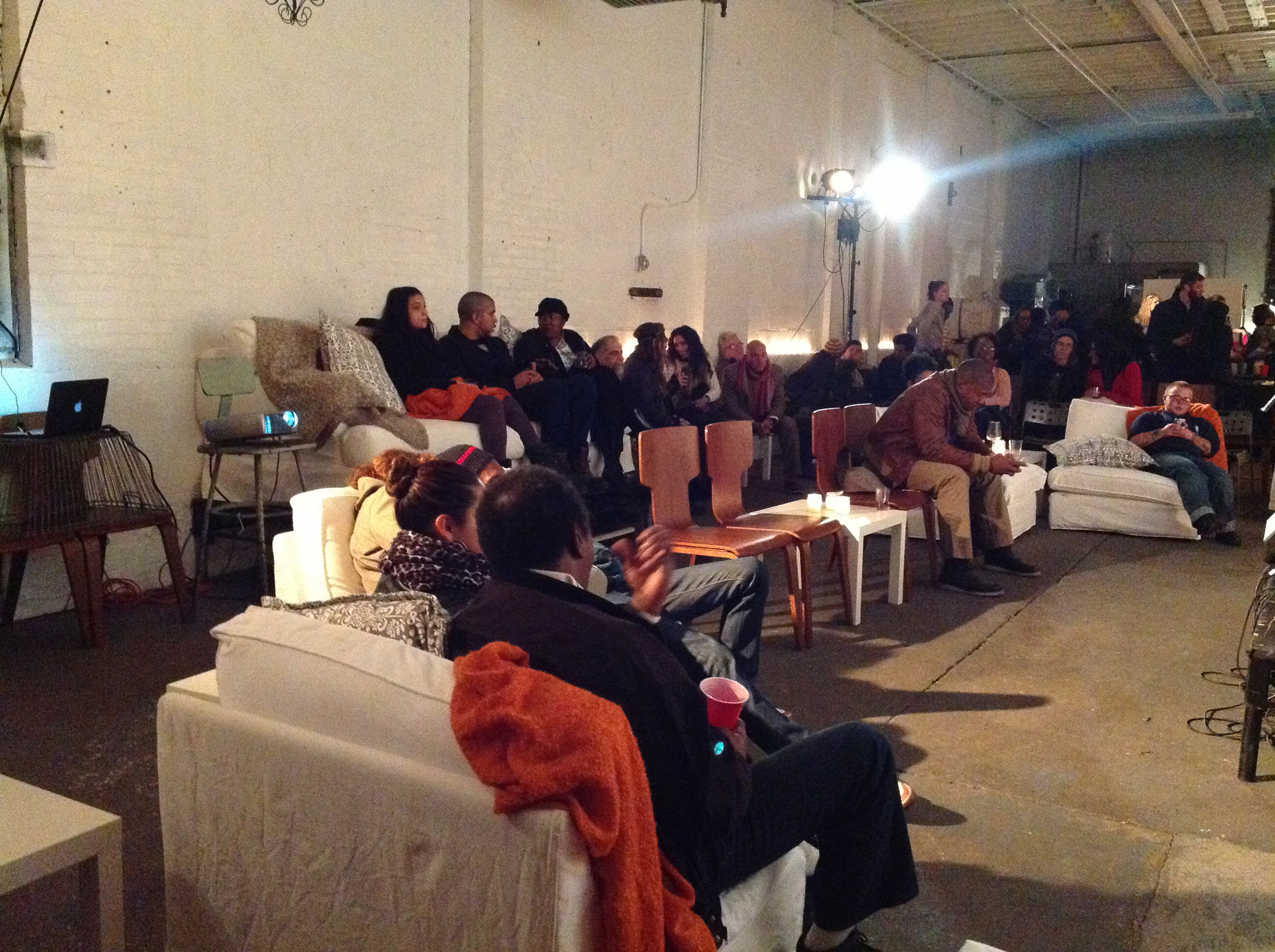
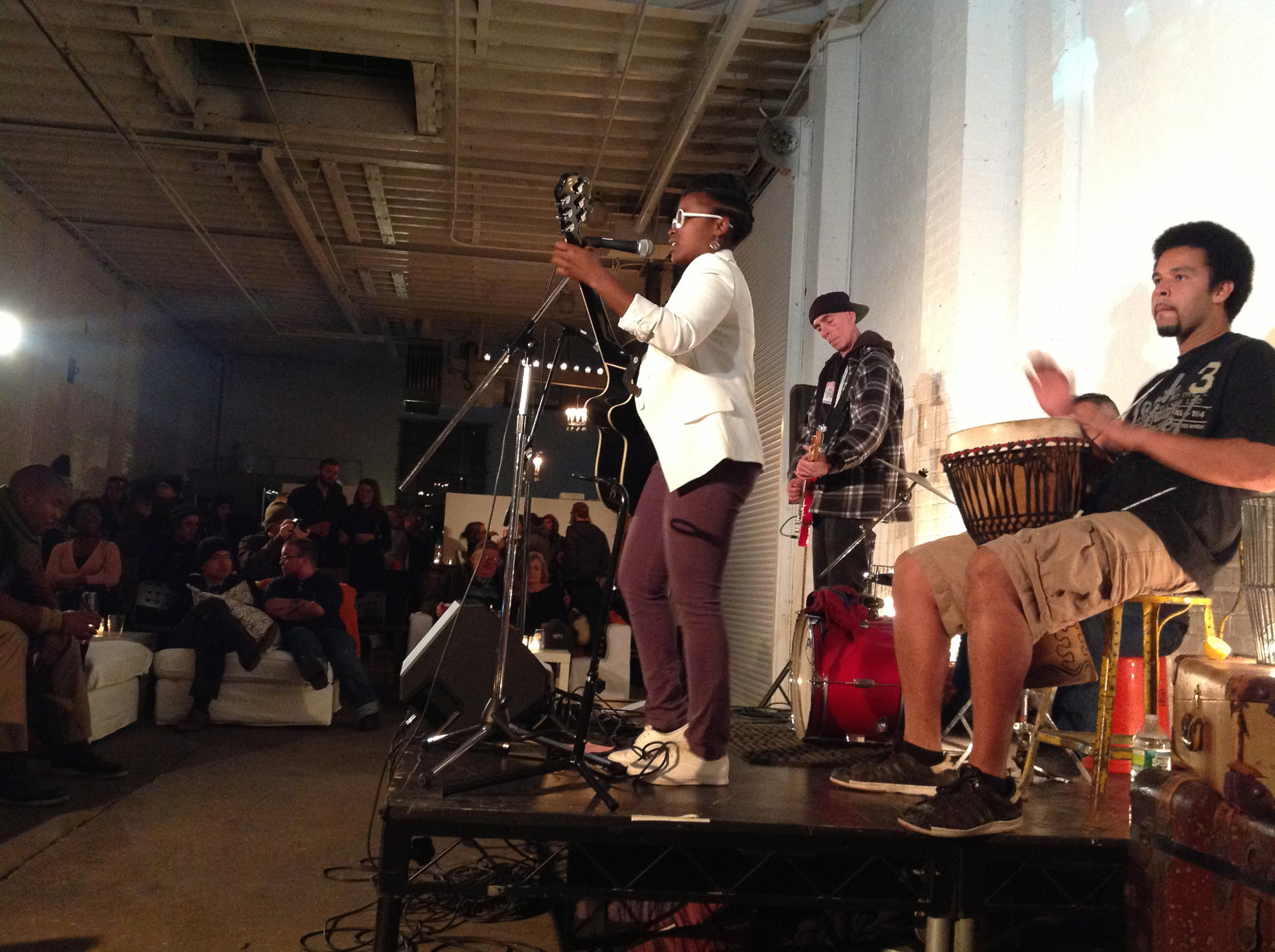
The dynamic duo of Monica and Leisah hosted a party at their new venue Atelier Roquette, to honor the recovery work of the Red Hook Volunteers and help them raise money. Over 50 attended what felt like the relaxed after party for a day of Sandyversary events, with some people shuttling back and forth between the Bait & Tackle party and the Volunteers.  The Mother Earth Band (made wholly or mostly of Volunteers) played.  Red Hook is truly blessed to have had this contingent of young people make their way to NYC after the storm and find Red Hook and stay to  help us out. Three cheers to the Red Hook Volunteers!


World-war-II-merchant-mariners-still-seek-recognition

Request to Veterans affairs Committees of Senate and House regarding bills HR 2189 & S 1361

Women, children and disabled WWII merchant mariners

Friday, 10/18/13, out of the blue, PortSide received an email from Don Horton looking for help acknowledging the work of women, children, and elderly handicapped seamen who he says served on tugs and barges along the coast under threat of attacks by German U-boats. Don Horton, a retired Director of Occupational Safety & Health for the Department of Defense, is seeking urgent support for two bills before the US Congress which would recognize the service of these mariners. Recognition honors recipients and gives them the status of US veteran with benefits limited to medals and burial benefits.

The Senate is likely to vote on October 30th, and the House could vote at any time.

[see 10/29 and 10/30 updates about Congressional votes and 11/2/13 MoveOn.org petition at bottom]

He seeks letters of support to the congressmen on the Veterans Affairs Committees. Horton says the seamen, whose records were destroyed by government order, are another category seeking recognition. Able-bodied, adult, male seamen were recognized in 1988. The Senate is likely to vote on October 30th, and the House could vote at any time. The extraordinary story of these mariners also shines a light on the waterfront history of Red Hook, of Brooklyn and of the port of New York as a whole.

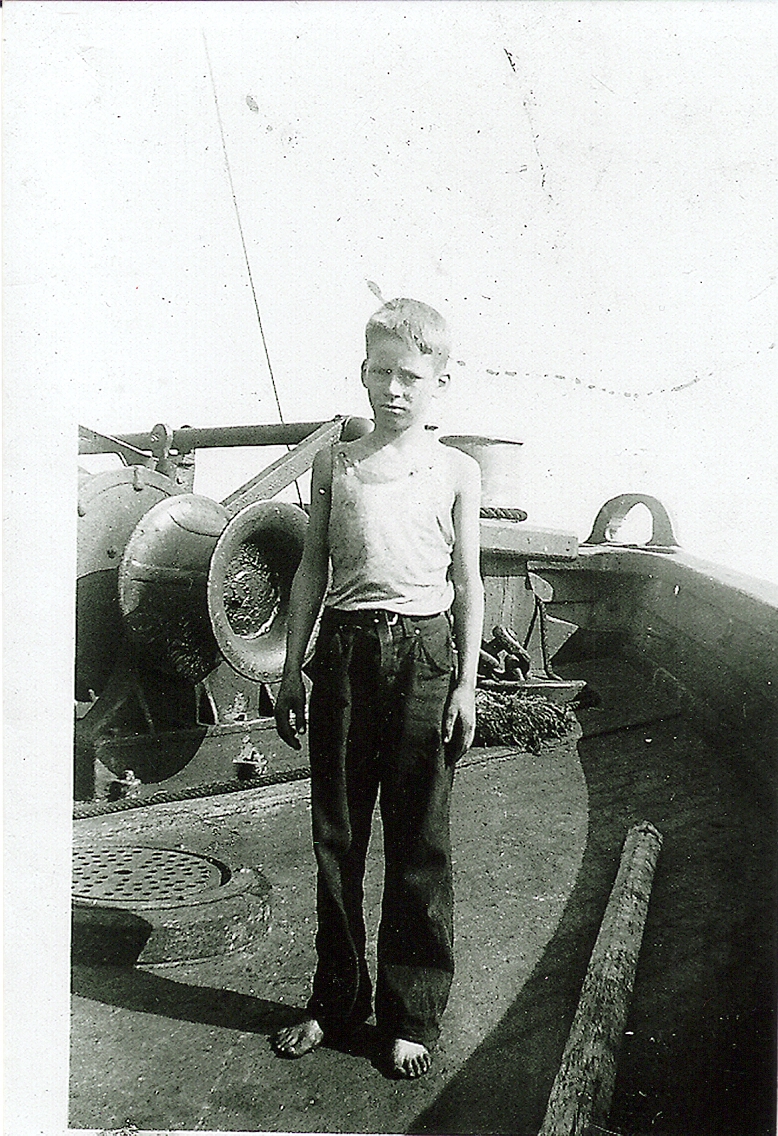
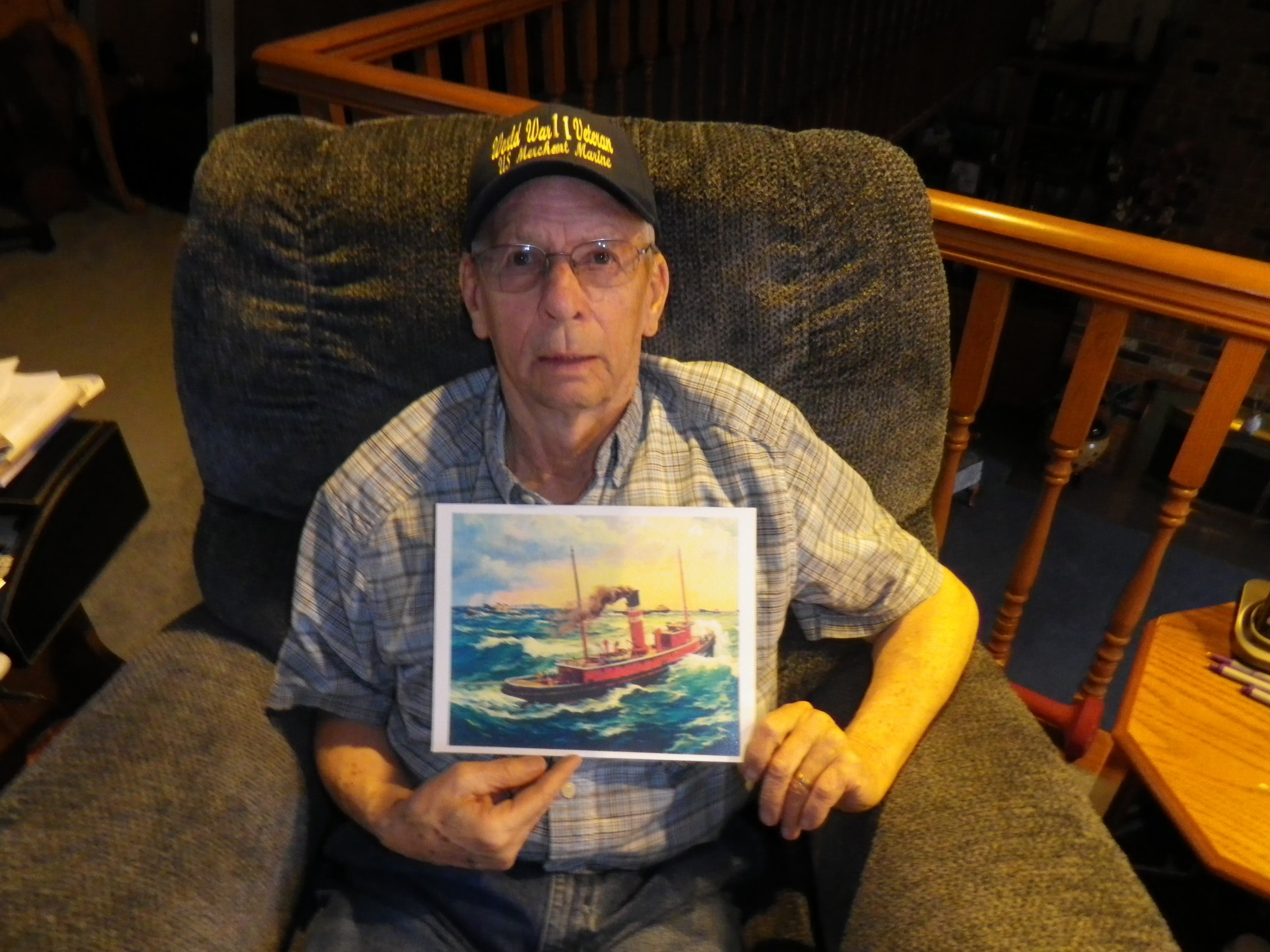
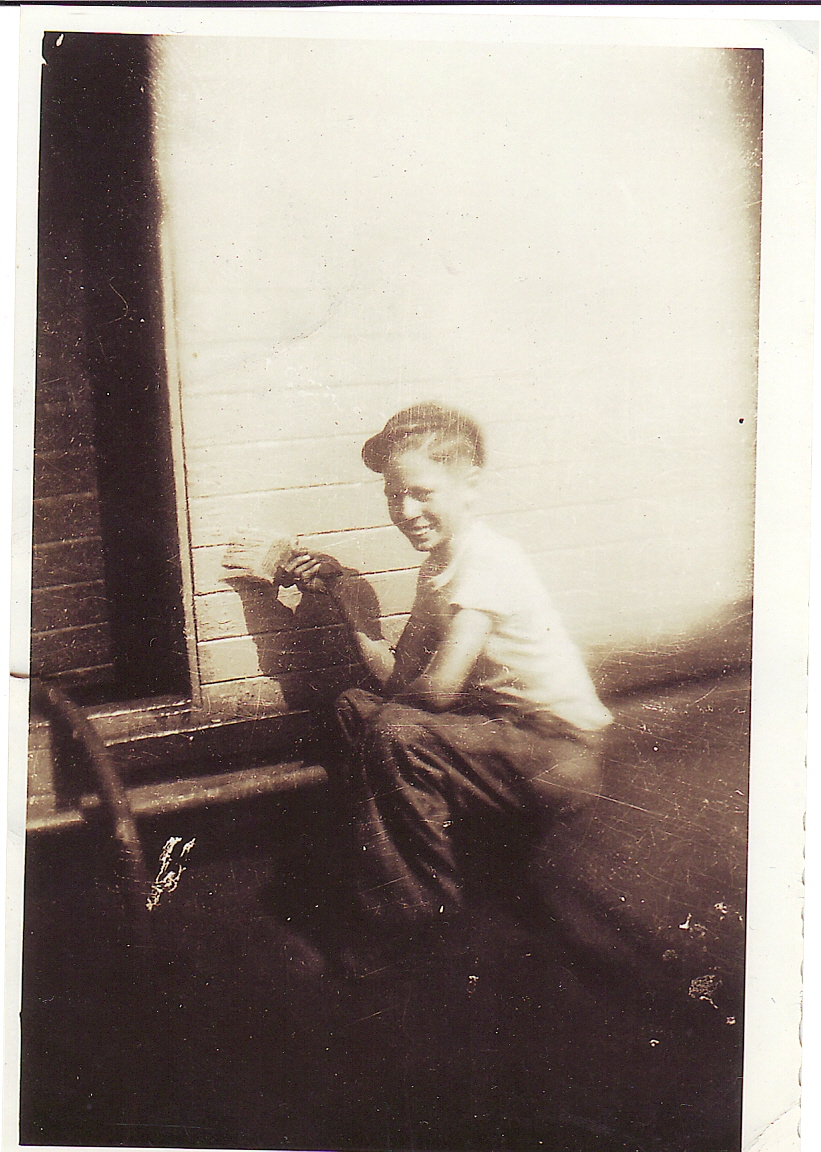
Horton was one of those children who served on tugs and barges along the coast under threat of attacks by German U-boats. Don Horton is originally from Pennsylvania and now lives in North Carolina.  He began working on a coastwise barge as a ten-year-old alongside his family in 1942; and his mother was one of those women.

Read Don Horton's vivid WWII memories of anchoring off Red Hook, Brooklyn and rowing into Erie Basin to shop on Van Brunt Street.

 Dear Fellow Mariners,

Once again I am reaching out to my fellow seafarers in hopes of finding some who may be interested in helping us find those few remaining mariners from WW II. Many of those mariners were women, some were schoolchildren that stood up for this country and also helped to lay the foundation for women seafarers around the world.
We now have a bill in both sides of congress.  It has taken over 5 years and three sessions of congress and this may be our last chance to bring recognition to these few remaining mariners.  The setup is rather complicated and far from me to truly understand.
 
If you recall we started out with a stand alone bill HR 1288 but during the process it was incorporated into another one 2086 headed up by Tina Titus of NV.  Within a week it was incorporated into still another HR 2189 that deals with problems within the VA.  This bill is headed up by Jeff Miller of FL who also is the Chair of the House Vets Committee and has cleared the subcommittee and is at the floor level waiting hearings. S-1361 is heading for hearing in the Committee late this month.  Both bills have few cosponsors and I have no idea if that is good or not.  I had 94 cosponsors on HR 1288 and was incorporated into 2086 that had only 12 and then into 2189 with only 4. I have added 4 more to 2189 but have hit a snag.  Seems that most of our leaders in congress may say they reach out across party lines but when it get down to doing it the lines grow silent.
 
In any case we are farther along than ever before but need some help.  As I recall in my email of last year I indicated we needed letters sent out to the various members of congress asking for their support either by cosponsoring these two bills or having the VSO write letters of support to the two committees saying the same.  We need similar help and I am again reaching out to you for help in helping those that came before you.  Will you help me? I have submitted some testimony to the Senate Committee on Veterans Affairs that provides some light on how I see picture and asked it be submitted for the record.  They have acknowledged receipt and mention they will review.  I have attached it to share with you in hopes you can find enough info to assist in sending some good ole letters or make some calls.
 
Will you help us?  The time is very short as the Senate meeting is scheduled for the last of this month.  The House vote can be at any time.  Please let me know if you can help.  Thanking you in Advance.
 
Good luck at your meeting also at the end of the Month.
 
My very Best Regards,
 
Don...

 
J. Don Horton,
President WWII Coastwise Merchant Mariners
104 Riverview Ave, Camden, NC 27921
252 336 5553

Peterson. BELOW: The tug “Margaret Sheridan”, of the D.T Sheridan Co., hauls a company tow eastward through Cap Cod Canal in the late 1940’s. The barges are empty with tow lines shortened up for the tow through the canal. The lead barge was undoubtedly at onetime a schooner barge and probably had three masts.
Photo courtesy of Roy Eliassen

Horton's older brother Billy was working on the tugboat Menominee when it was shelled and sunk nine miles off the coast of Virginia on 31 March, 1942 by German U-boat 754. 

Letters of support: 

Association of the United States Navy 

Disabled American Veterans Department of North Carolina 

Italian American War Veterans of the U.S 

Military Officers Association of America 

U.S.N Armed Guard WWII Veterans Association 

U.S Department of Veterans Affairs 

11/2/13 MoveOn.org petition


0/30 update from Don Horton

RESULTS FROM US SENATE VETERANS AFFAIRS COMMITTEE HEARING ON 30 OCT. 2013 for S-1361 "WW II Merchant Mariners Service Act"

Military Officers of America Association: Supports S 1361

Disabled American Veterans: DAV does not have a resolution on this issue and takes no position on 1361. Note NC DAV approved a state resolution but National turned it down, essentially turning its back on WW I merchant mariners.

Department of Veterans Affairs: VA defers to the Views of the DHS regarding Section 3 of this bill.

Vietnam Veterans of America: VVA has favored such legislation conferring full veteran status on these individuals for almost thirty years, and now urges swift passage of this measure before all of them of dead and gone.

Veteran of Foreign Wars: Did not make a statement on S-1361.

NEXT STEP IS UNKNOWN. WILL ADVISE ALL WHEN APPRISED.


October 29 update from Don Horton

Dear F/B fans. Yesterday we were successful in having the US House vote and pass HR 2189. This bill had an amendment within, HR 1288 “WW II Merchant Mariners Service Act. It received an overwhelming majority vote of 404 to 1 in favor and the bill is now on its way to the Senate.

The next step is: tomorrow the US Senate will conduct Hearings on S 1361 “WW II Merchant Mariners Service Act”, an identical bill to HR 1288 that was amended into HR 2189. It is scheduled for 2 PM and can be viewed on C-span if anyone desires to watch. We have come a long way to correct a travesty ongoing for over 70 years.

Many thanks to all the cosponsors of HR 1288 for staying the course and seeing this bill through the House and on to the Senate. I owe you a debt of gratitude.

Let’s keep our fingers crossed to see this one also hit out of the park. Thanks for all your help.


City-Planning-Red-Hook-Resiliency-Transportation-Study

Tues, 9/17/13 at 6:00 pm
Miccio Community Center
110 West 9th Street, Brooklyn, NY
(between Henry Street and Clinton Street in Red Hook) 

The Department of City Planning, Transportation Division, is running a Red Hook Transportation Study. This study seeks to improve the neighborhood’s transportation network and bolster its resiliency in the face of future weather events. Everyone is invited to the kick-off meeting on the evening of September 17 at the Miccio Community Center in Red Hook. This will be a participatory meeting where they seek input from community members.

Flyer 

Contact & RSVP:

Conor Clarke
NYC Department of City Planning
Transportation Division
2 Lafayette Street Suite 1200
New York, NY 10007
T: 212-442-4721; F: 212-442-4724


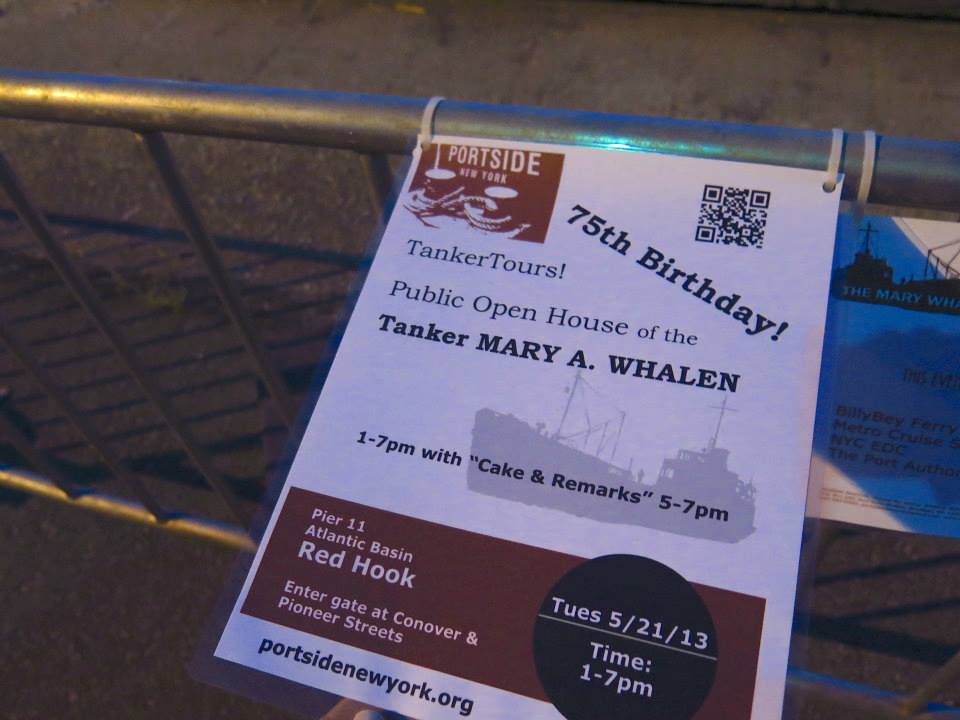
MARY A. WHALEN's 75th Birthday... some time in Atlantic Basin

Exciting 5 Days in Atlantic Basin & NY Harbor

What a whirlwind!  In just over a month, PortSide NewYork received a White House award for our Sandy recovery work, had our Founder & Director Carolina Salguero receive a National Maritime Historical Society (NMHS) award, and we were able to open the tanker MARY A. WHALEN to the public for the first time in almost three years!!!

News of that NMHS award facilitated PortSide’s being able to move the tanker into Atlantic Basin, which is how, on very short notice, we could to open the tanker MARY A. WHALEN for her 75th birthday.

Friday 5/17/13, some eighty NMHS members came to the MARY A. WHALEN on a NY Waterways ferry as part of a harbor tour of historic ships.  Our Director Carolina Salguero spent the rest of the weekend with NMHS during their 50th anniversary celebrations and annual meeting.

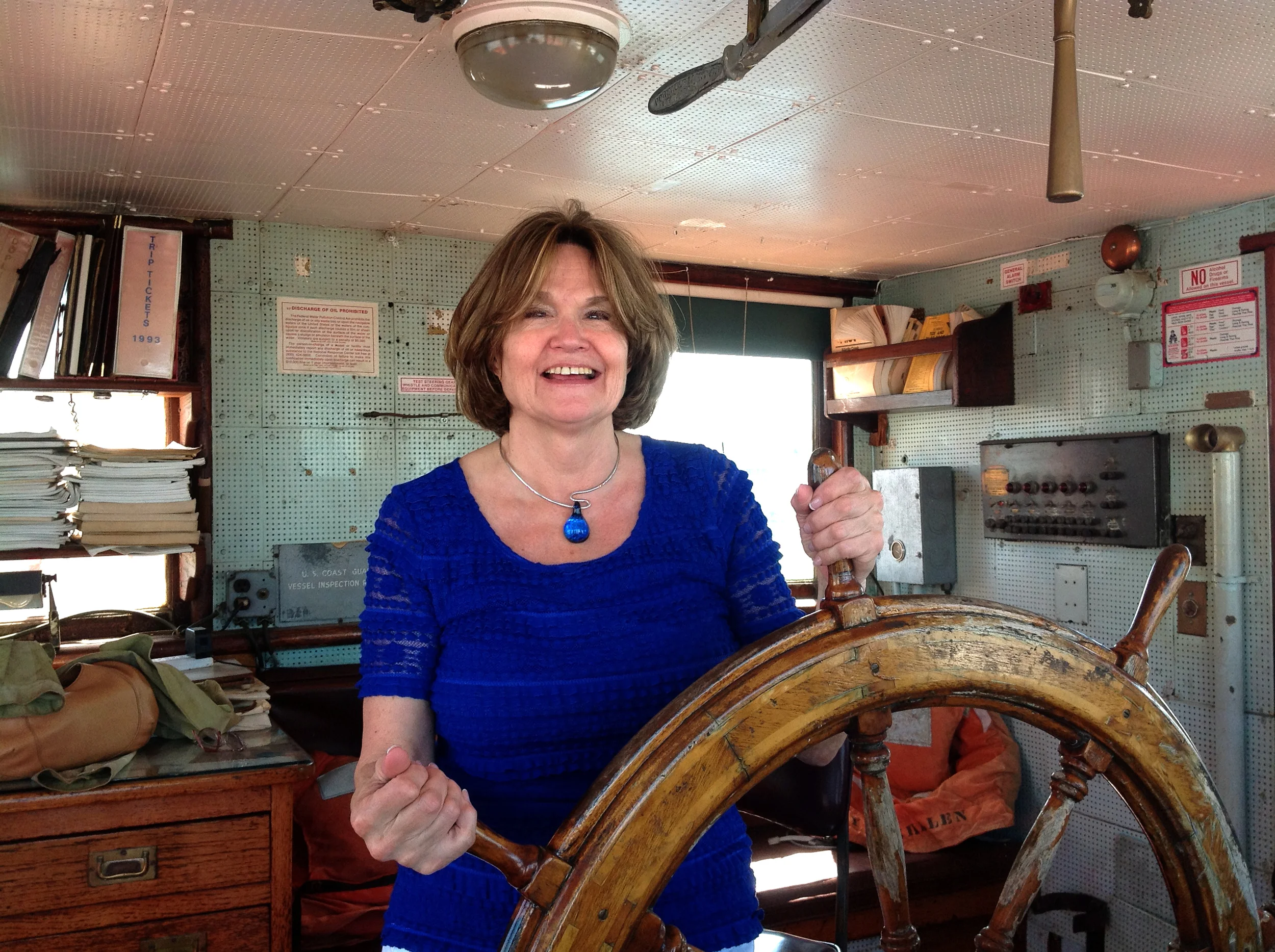
Burchenal Green, President of the National Maritime Historical Society, at the helm of the MARY. 

Burchenal Green, President of the National Maritime Historical Society, at the helm of the MARY. 

For inspiration about how to think of using our harbor, take a look at the National Maritime Historical Society 50th Anniversary weekend events to see how maritime people connect far flung venues - by boat!  The itinerary harkens back to the “Chain of Ships” we once proposed, a series of NYC maritime destinations connected by boat.

With the tanker in Atlantic Basin for the NMHS visit, we asked if we could stay two more days, which is how the ship was suddenly able to be open to the public on Tuesday, 5/21/13, the tanker's actual 75th birthday.


Party report!

The MARY A. WHALEN was open for public tours during a hot Tuesday afternoon, followed by a public party with “cake and remarks” from 5-7pm, with an evening after-party capping it all off.

TankerTour visitors included the great surprise of crew descendants: Hans Hansen, son of the engineer Hans Hansen who worked with Alf Dyrland, the Captain for 20 years, brought the engineer’s granddaughter Ingrid Hansen for the first time since 1968. She was about 9 when she last visited and remembered that women were not welcome aboard at the time. Some things have changed!

We also received visitors from PS 29, the school for whose Super Science Saturday fair we created our simple “Simple Machine” machine and installation, a highly interactive exhibit we would like to bring other schools and public events. (School staff & parents, please get in touch to help shape programs for the next year!). 

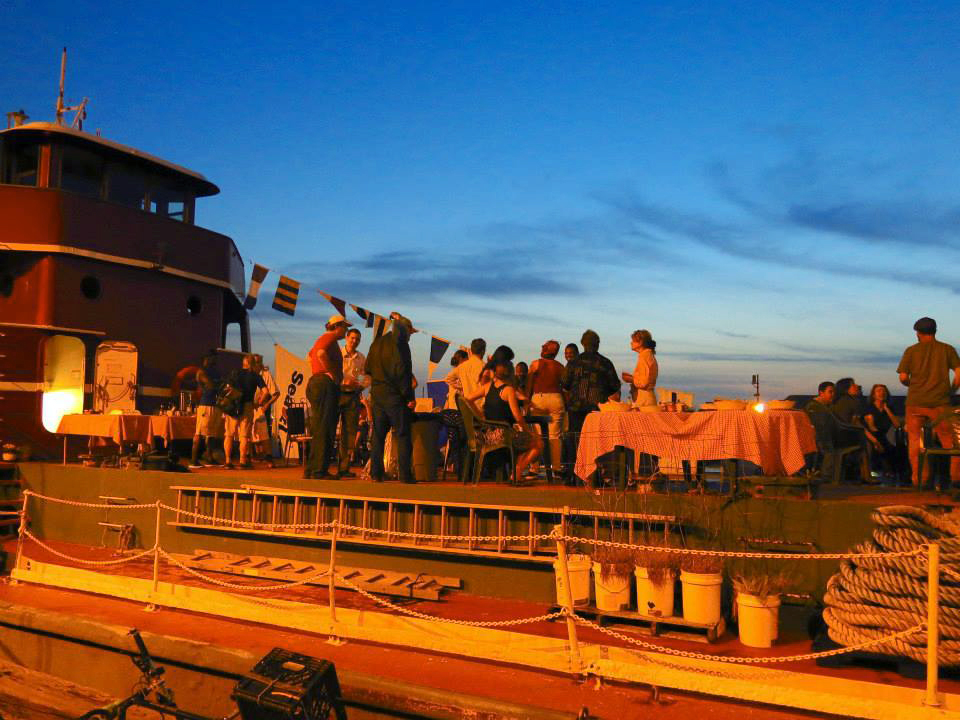
PortSide use of the tanker as a social mixer to bring maritime and inland people together was sure evident during the party!  

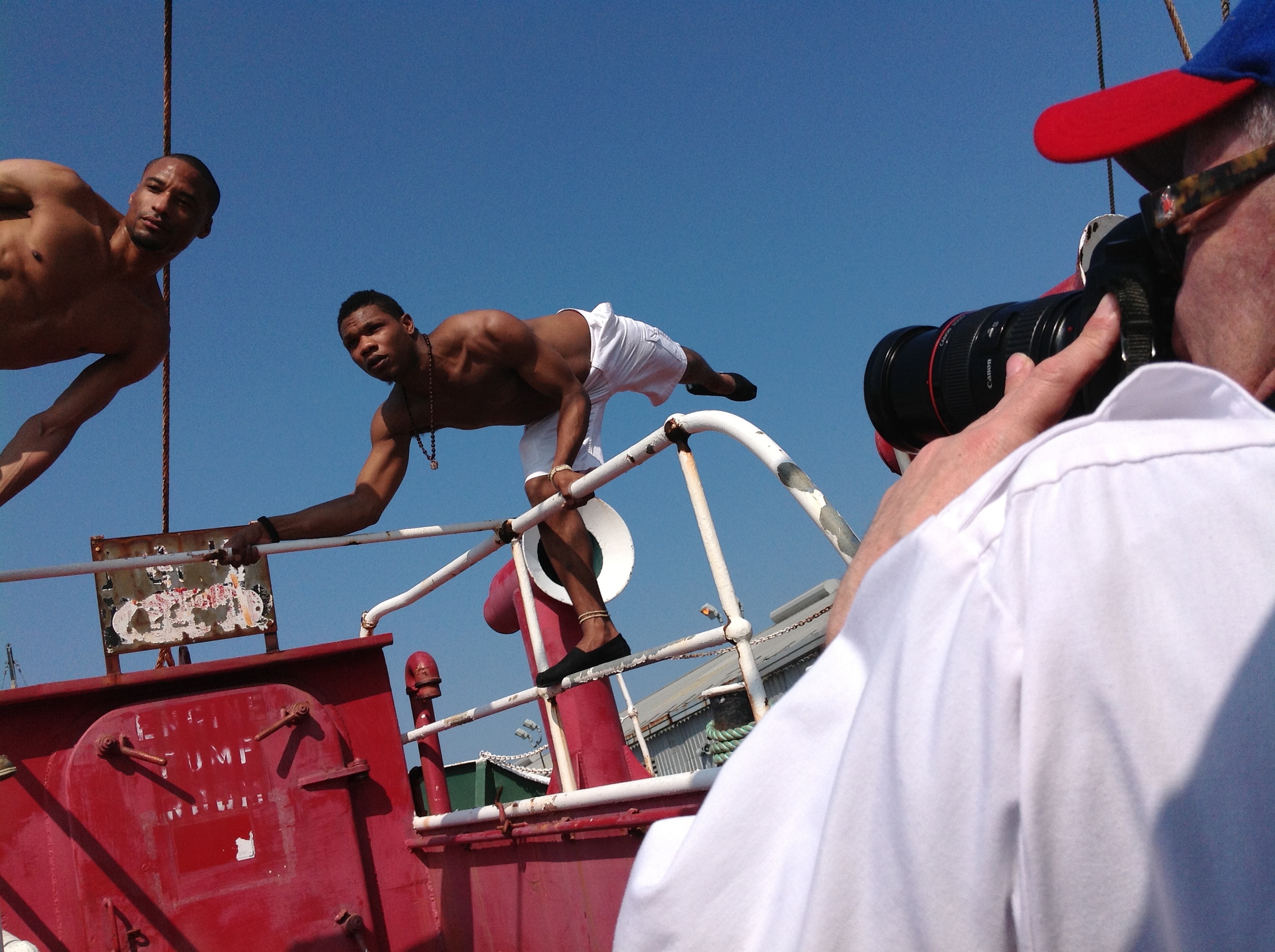
Hip Hop dancer Ze Motion as photographed near the stack of the MARY A. WHALEN by Jonathan Atkin

Hip Hop dancer Ze Motion as photographed near the stack of the MARY A. WHALEN by Jonathan Atkin

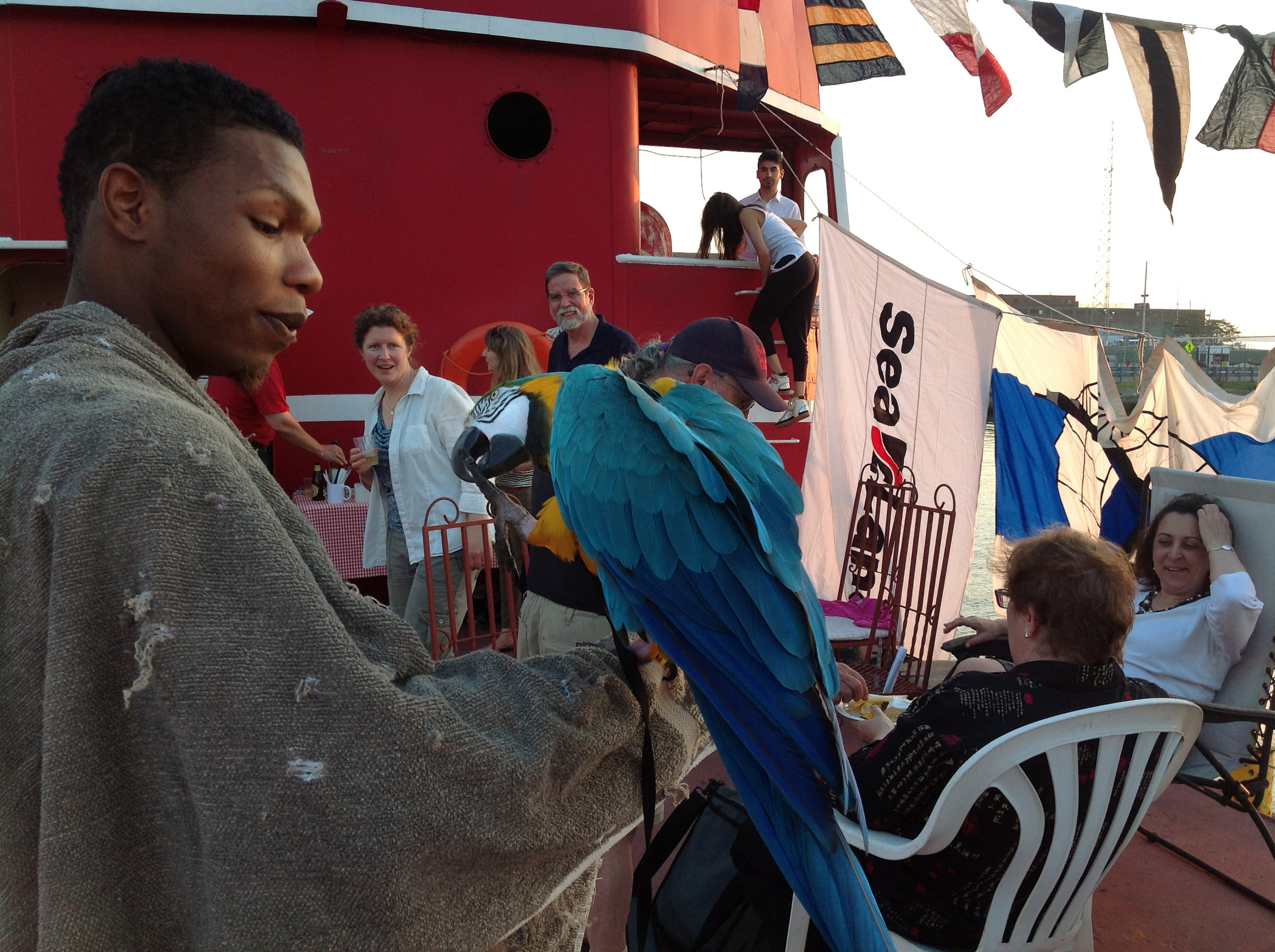
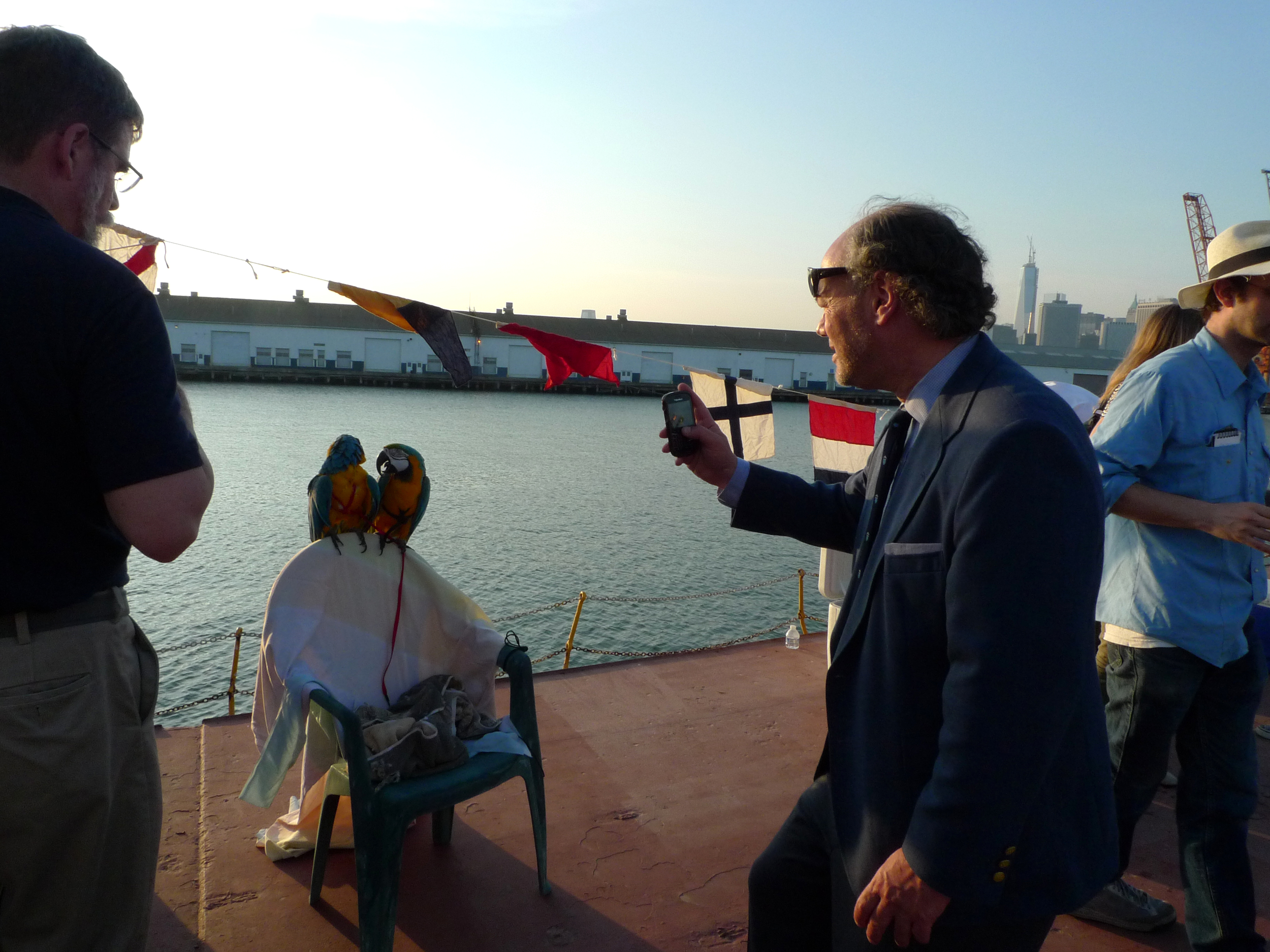
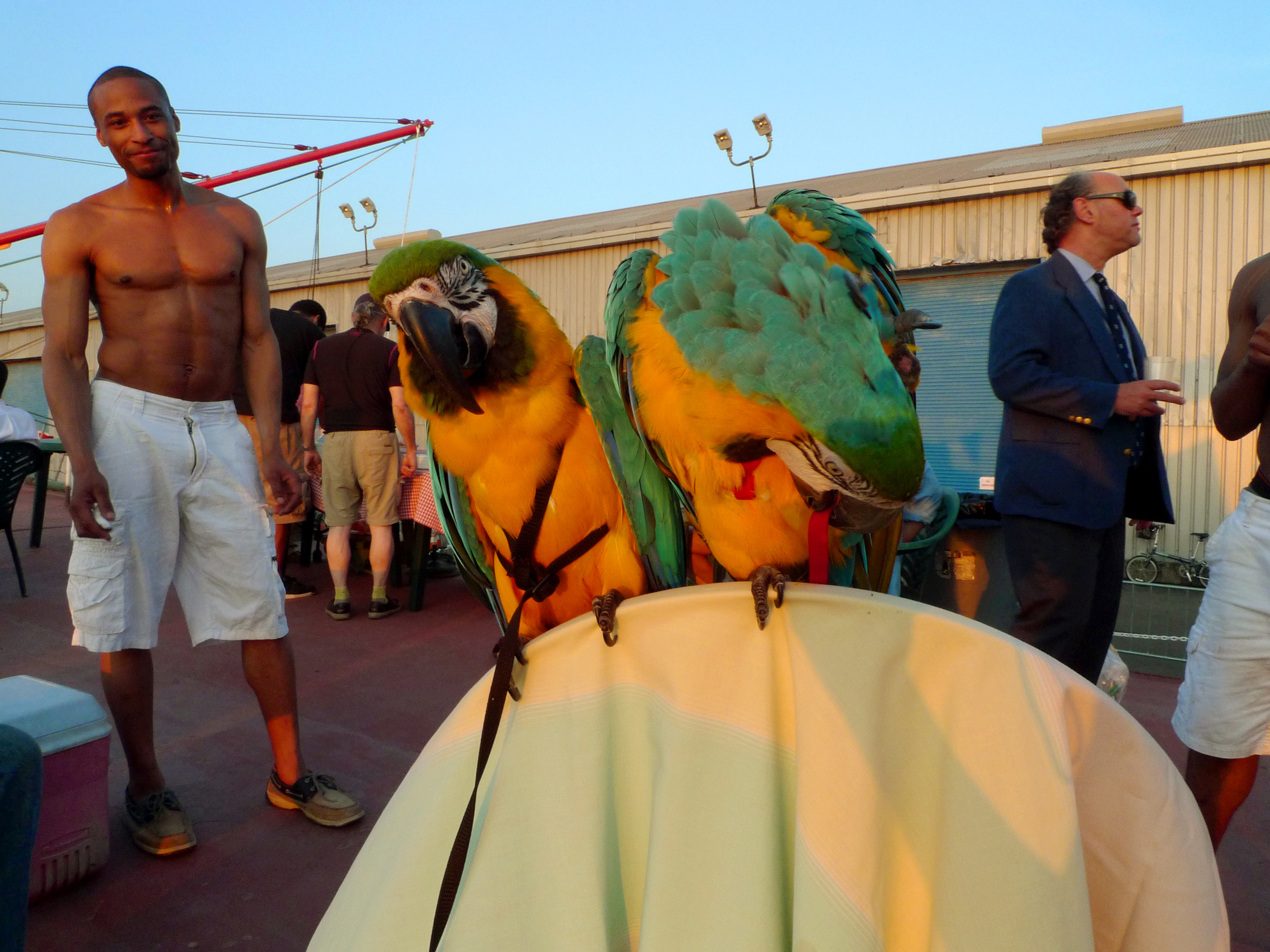
We had the maritime consultants, authors and artists Barry Parker, Rick Spilman & Frank Hanavan, along with community members, families with kids, and Ian Danic, a board member of River Project, with his pet giant macaws. 

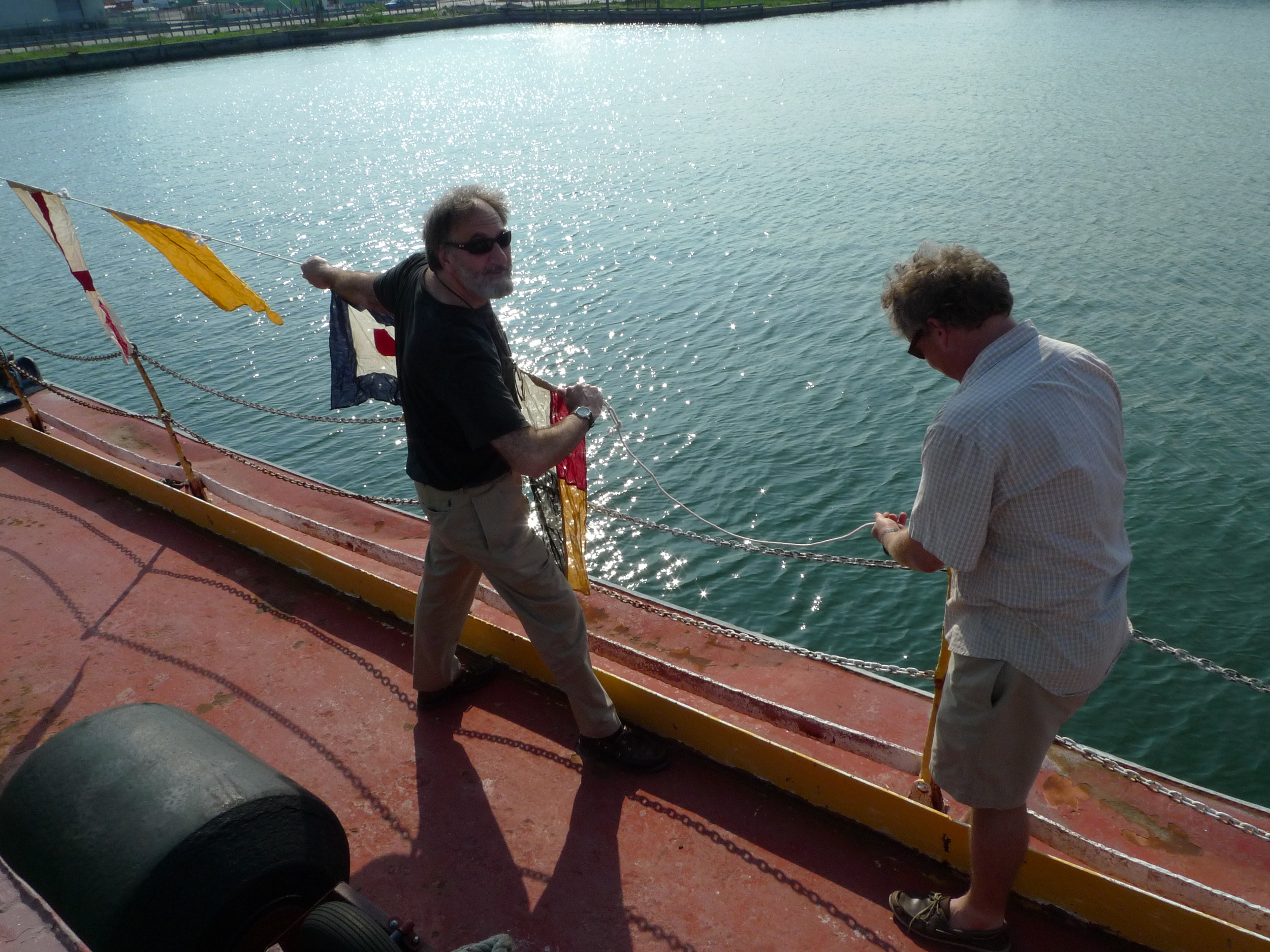
Frank Hanavan did some turkshead bombing of our gangway rail and strung up ship flags to great effect, assisted by architect and Museum Designer Paul Alter, who peered into the cargo tanks and expressed an interest in being the man to redesign them for exhibit and function space when we're ready to do that.

Also attending was the Federal Disaster Recovery Coordination team involved with New York State's Sandy recovery.  We met them thanks to winning the White House award and are talking to them about how to bring resiliency preparedness resources to Red Hook. 

Roland Lewis lead a contingent from the Metropolitan Waterfront Alliance. Dan Wiley from US Congresswoman Nydia Velazquez' office and Jim Vogel from NYS Senator Velmanette Montgomery spent a long time with us, and we were glad to have our prospective landlord John Quadrozzi of GBX-Gowanus Bay Terminal aboard with his wife Xiomara.

As if the macaws were not visual enough, maritime photographer Jonathan Atkin provided more eye candy by running a photo shoot with three magnificent dancers.

Access limitations at our normal berth in the Red Hook containerport had prevented Atkin from getting dancers to the tanker for weeks; so with just two days notice, he assembled three of them to further his Hero Project, an inspired photo concept he created to use dancers to bring attention to the cause of historic ships.

After the party shoot, one dancer tackled his bird phobia with one of Ian's macaws – the MARY A. WHALEN is consistently a place where extraodinarly things happen - and the hip hop dancer Ze Motion, who dances for Madonna and major sponsors, offered to donate a dance performance to PortSide. 


What's in a name

The tanker’s 75th, and our new website, are the occasion to introduce the new way we will refer to the tanker.

We’ve been calling her “the Whalen” for short since that was what our Director Carolina Salguero first heard her called in 2001; but we have learned that all former crew members call her “the MAR,Y” and so from here on in, so shall we.

That's a good lead in to note just how rare and precious the MARY A. WHALEN is as well as what PortSide has done with her.

According to Norman Brouwer, a noted maritime historian, the MARY A. WHALEN is the only oil tanker in the world re-purposed as an educational and cultural center. Once the Sandy-damaged tanker JOHN B CADDELL is scrapped next month, Norman says the MARY A. WHALEN will be the last surviving coastal oil tanker in the USA.

What was a sizeable fleet of coastal oil tankers, a type of vessel type which was significant to the war effort during WWII, was destroyed in the course of duty, sunk as artificial reefs, scrapped or , years ago, exported to third world countries.


Some behind the scenes photos - what's involved in moving the MARY

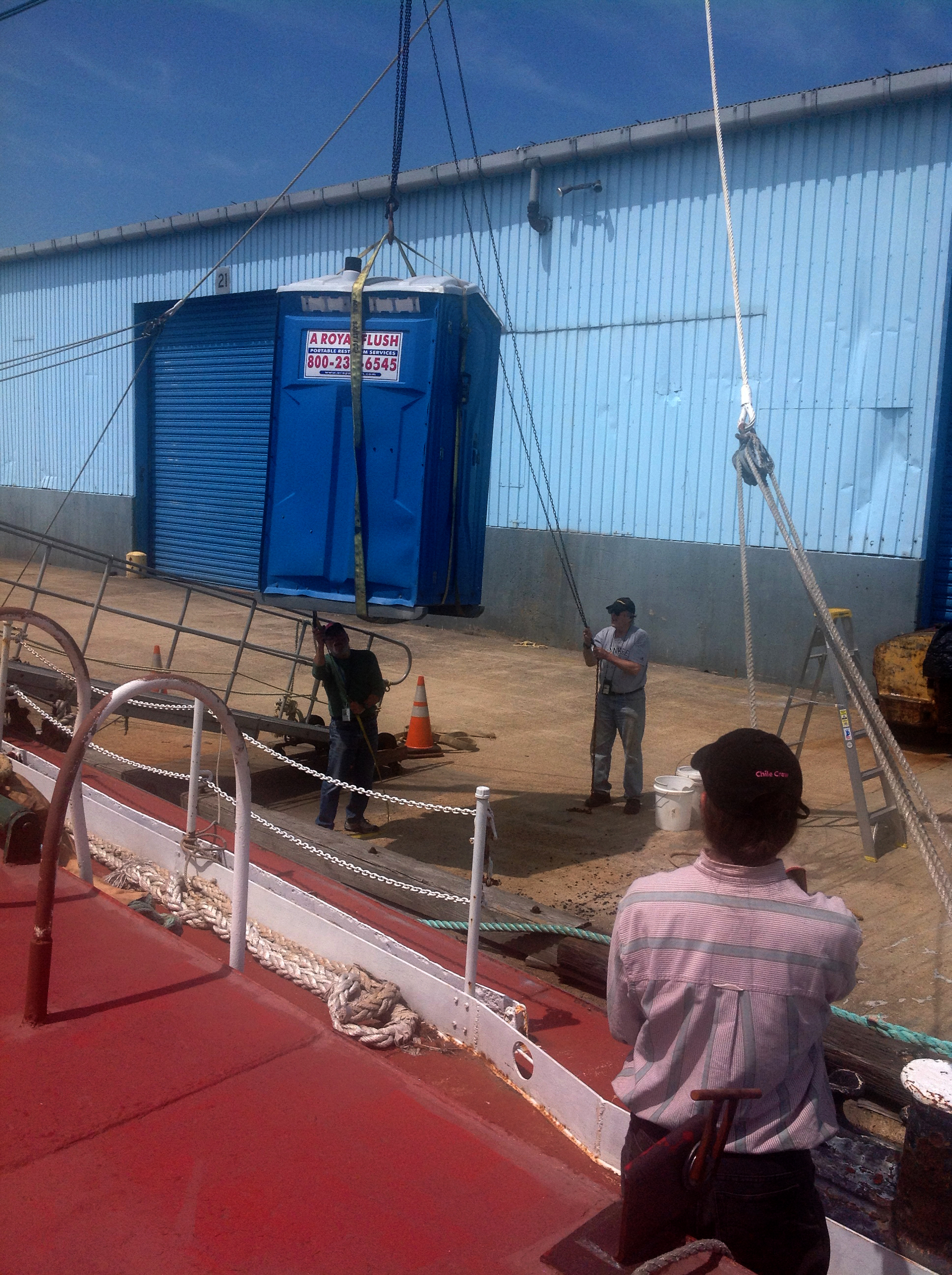
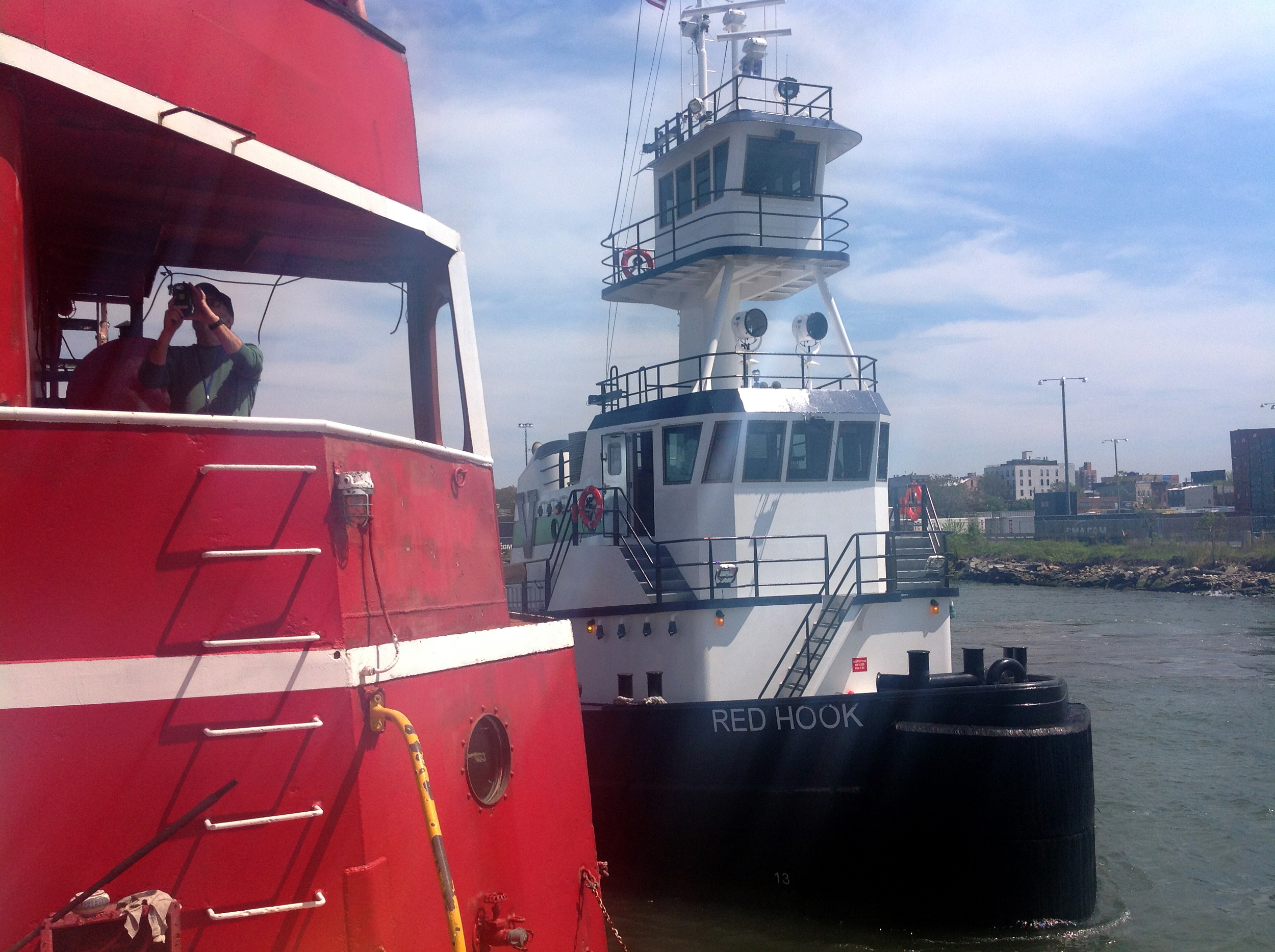
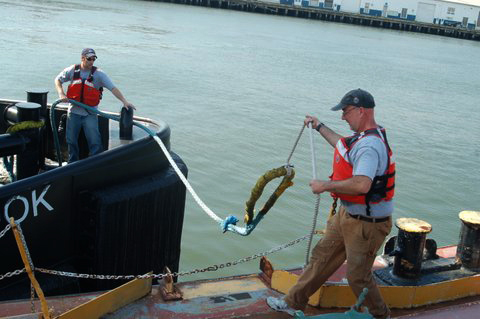
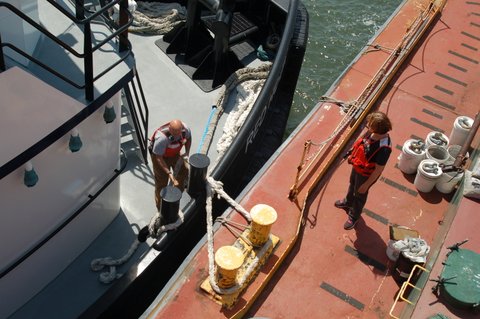
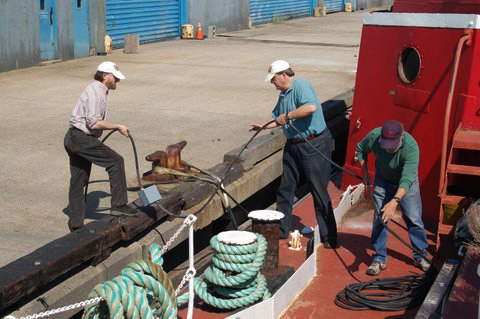
It's great to be a tanker!  We could use our own boom to lift aboard a portasan and take it with us, sparing us the cost and hassle of having Royal Flush deliver. The tug RED HOOK approaches, makes up the tow, we haul in our shorepower cord, we pass the container ship pier of the Red Hook Marine Terminal, MV Cape Race as we enter Atlantic Basin, John Weaver attaches the shorepower cord adapter for Atlantic Basin, coming back home at dusk with Red Hook Volunteer Mike Elders on deck, crew of tug SASSAFRAS docking the MARY.

Special thanks

Profuse thanks to the Port Authority, EDC & BillyBey for greenlighting our stay in Atlantic Basin within days.  At this time, we would also like to welcome BillyBey to Red Hook as the new operator of Atlantic Basin. Our visit was their first vessel call in Atlantic Basin, and it was an auspicious start!  Thanks also to Metro Cruise Services, the operators of the Brooklyn Cruise Terminal, for their help with the fencing we used during the TankerTours and tanker birthday party.

Thanks to the Red Hook Volunteers for providing essential set-up and break-down labor. If you want to help Red Hook’s Sandy recovery, please come volunteer with them!  Sandy-damaged businesses, home owners, tenants and NYCHA residents are still being helped by them.

We only recently learned the MARY A. WHALEN's actual launch date was May 21 due to research by noted maritime historian Norman Brouwer, the man who basically wrote THE guides to historic ships and some of our national preservation standards for them. Thank you, Norman!  

Vane Brothers tugboat RED HOOK

Vane Brothers tugboat RED HOOK

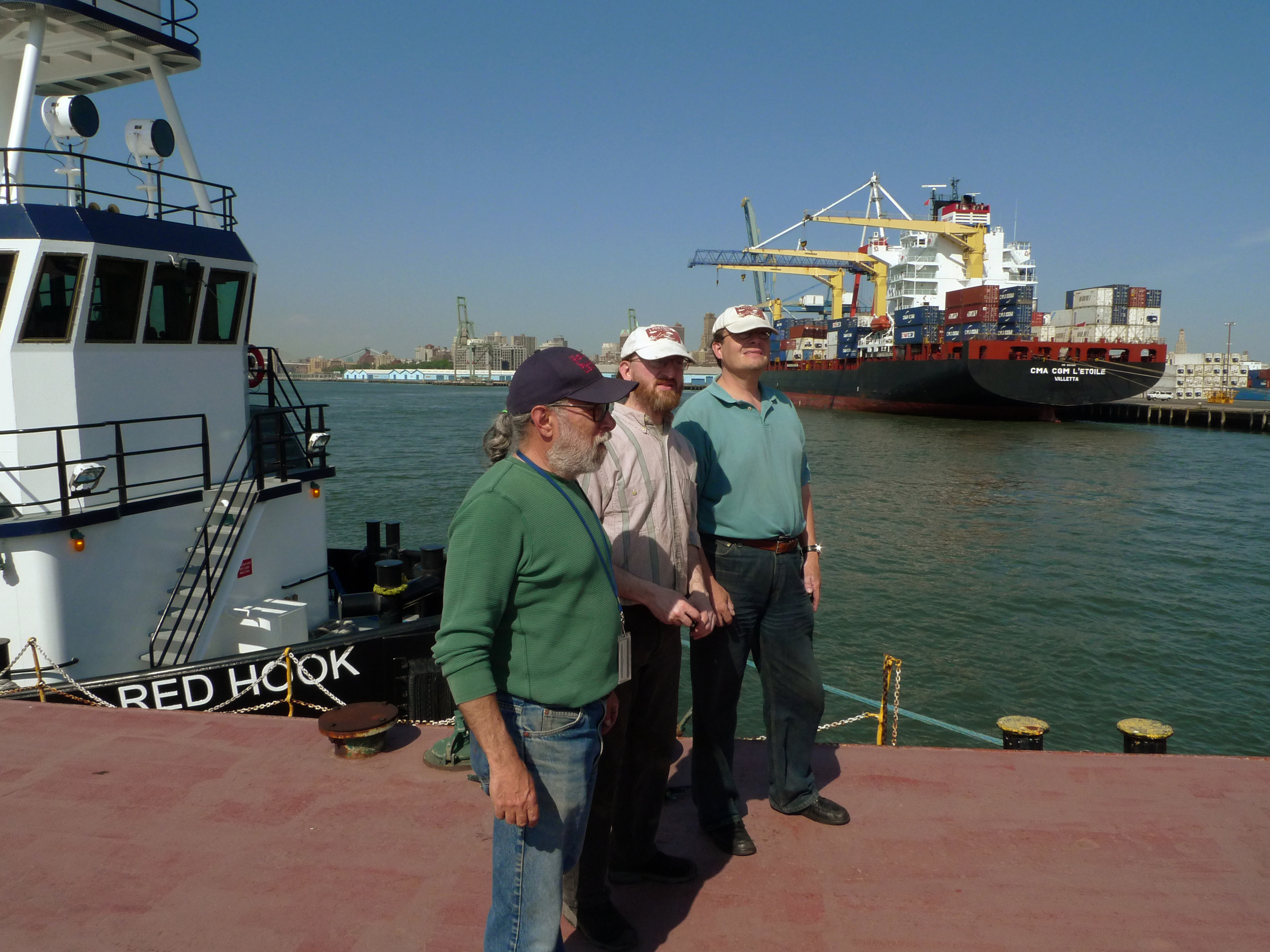
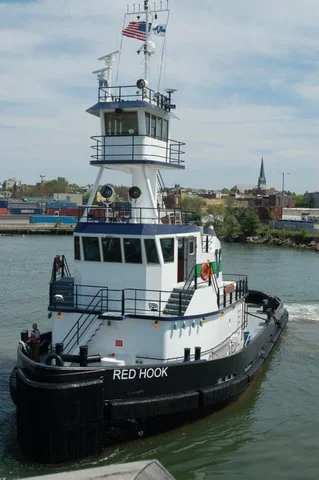
Special thanks to Vane Brothers for donating the tow between our current berth in the containerport and Atlantic Basin!!!  We were very excited to be towed to Atlantic Basin by their brand new tug, the RED HOOK, named in honor of our favorite neigborhood.  Vane's NYC operations are based at the former site of Ira S. Bushey's in Red Hook where the MARY A. WHALEN first began her working life, which provides a great reminder of how the working waterfront in Red Hook has a long, and living, history - and we are part of it!


Monthly Red Hook Sandy Survivor gatherings

Red Hook Sandy Survivor Gathering

Sun 6/30 4-7pm 

351 Van Brunt

 Flyer

Another monthly Red Hook Sandy Survivor gathering will occur at "351" where PortSide had our Sandy aid station, a space donated by Realty Collective.  The plan is to continue these gatherings on the the last Sunday of every month so long as there is interest.  To offer help or RSVP sandy6mo@gmail.com

What this is about

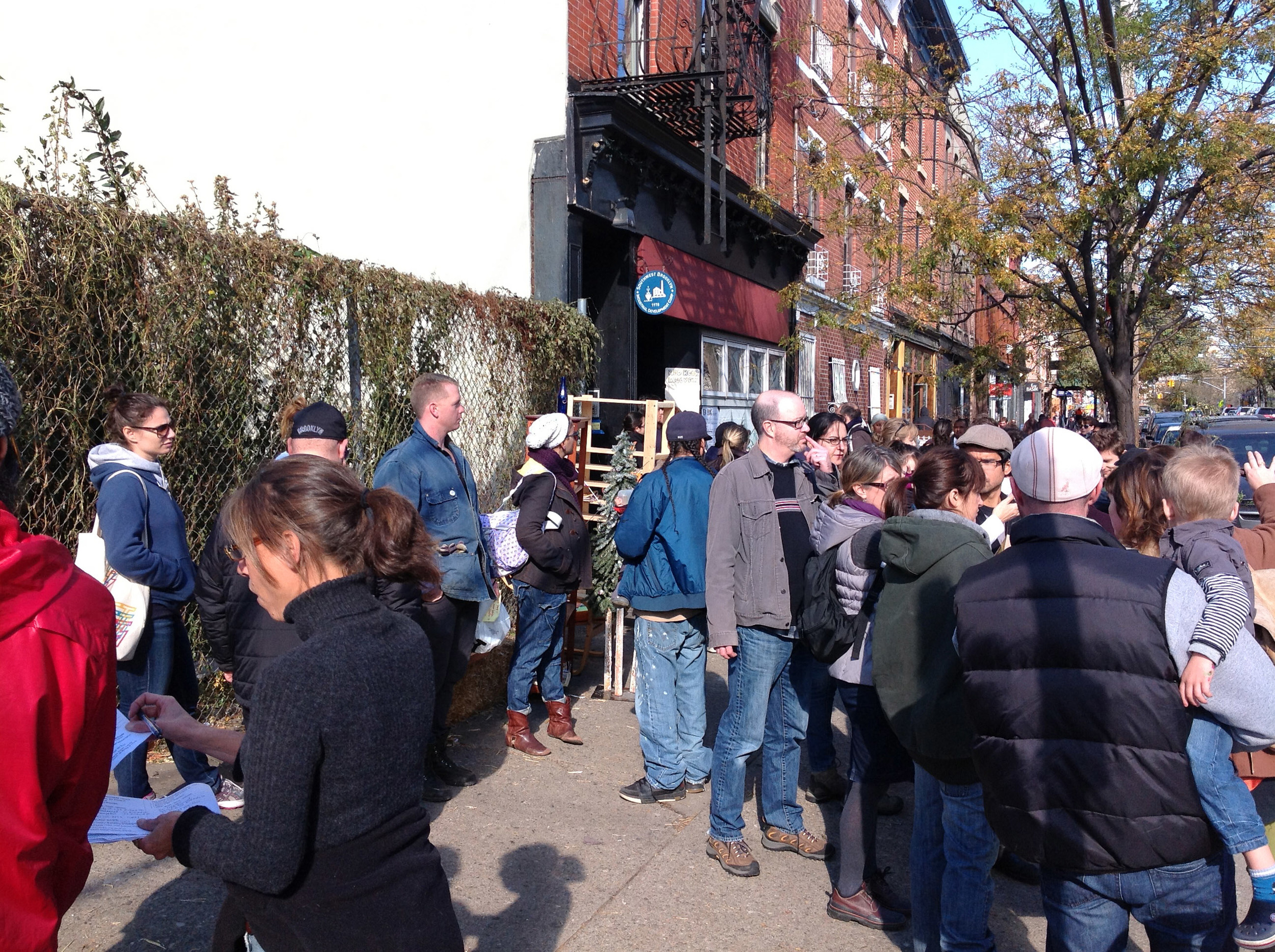
A Sandy+6 months gathering in late April was organized by PortSide NewYork, Victoria Hagman of Realty Collective, Kerry Quade and Maria Pagano (president of the Carroll Gardens Neighborhood Association, a new PortSide friend). The idea was to get people talking and reconnected in the way the community was in the early days after the storm when so many of us were on the street or in public meetings.

How it went

Some 60 people came over 3 hours, and people really liked the event.  Many asked for us to do it monthly. The organizers agreed to do so and to do this the last Sunday of every month to provide a predictable date that would be easier for people to remember.

We dropped the ball last month and missed doing it!   PortSide will take the blame for that, there was a lot going on at PortSide what with last minute news which opened up the permit doors to getting the MARY WHALEN out of the port for the first time in almost 3 years; but hey, May's last Sunday was also Memorial Day weekend :-)

At the event, the organizers provided cake and coffee, Felicitas Oefelein donated wine, and Fairway donated cheese platters.  home/made lent the coffee urns, SBIDC helped get the food donated from Fairway, Realty Collective covered the cost of cakes etc.  Some people brought food.  There was very relaxed vibe, lots of talk, many people talking to people they didn’t know. No agenda, no speakers.  Attendees included home owners, renters, people from NYCHA.

Looking ahead

To make this happen regularly, we need some help.  Plus, the idea is that this is a community thing, not some organizers doing for you; so if you want these monthly gatherings, step up and make them happen!

Help would be:

  • designing a flyer
  • distributing flyers (to be most inclusive, info can't just be shared digitally)
  • small donations to support photocopying of flyers, cake and coffee. Very small, sheetcakes at Costco are wicked cheap.
  • driving to Costco to get said cakes…
  • setting up tables and food, breaking down the tables and collecting the garbage 
  • Several NYCHA residents said there should be better flyering in the houses; can anyone here help with this?
  • Some of the NYCHA residents also said it would be good to have a venue closer to the Houses, which sounds like a good idea.  Can someone work on that idea?  Would such a thing be possible at the Library?  351 Van Brunt is easy to use because Victoria Hagman of Realty Collective has the lease, and so there are no permit issues, no costs, etc.
  • other ideas you suggest… 

We’re going to keep it simple this time and offer less food (though we won’t stop you from bringing any!) since people seemed most interested in talking, and we want to make this easy enough to do.

Please forward this widely!  Best of luck with your recovery process!

PortSide NewYork wins White House "Champions of Change" Sandy recovery award

PortSide NewYork is honored to have won a White House "Champions of Change" award for our work during and after hurricane Sandy. We hope the award will allow us to continue our Sandy-aid work, launch new resilience training programs, and attract more assistance to Red Hook. Things look promising; the phone has started to ring.  Until we finish the blogpost about Part II of our Sandy story, we've added photos to a press release below to tell that story. Part I of the story, how we protected the MARY A. WHALEN from Sandy, can be read here.


PortSide's Story Ashore

PortSide is based on a historic ship, the tanker MARY A. WHALEN, which the organization succeeded in getting listed on the National Register of Historic Places just days before the storm.  In the face of Sandy, PortSide’s first responsibility was to protect the MARY from damage, and to prevent her from damaging the property of others.  The sad fate of the tanker JOHN B. CADDELL, which went aground during Sandy, is an example of what can happen to an untended ship this size. PortSide assembled a crew of volunteers to prepare the MARY over five days before the surge and to ride out the storm on the vessel.

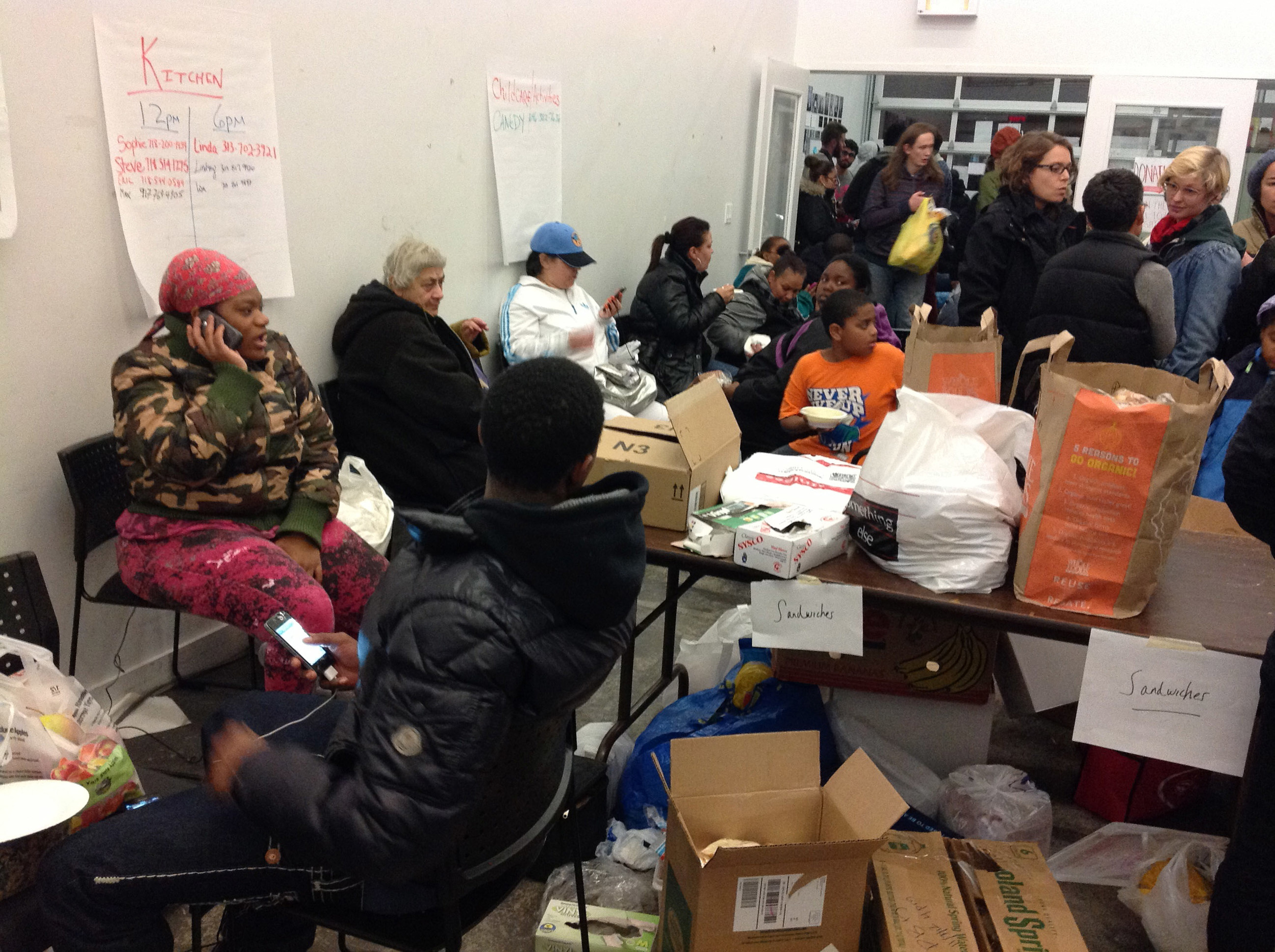
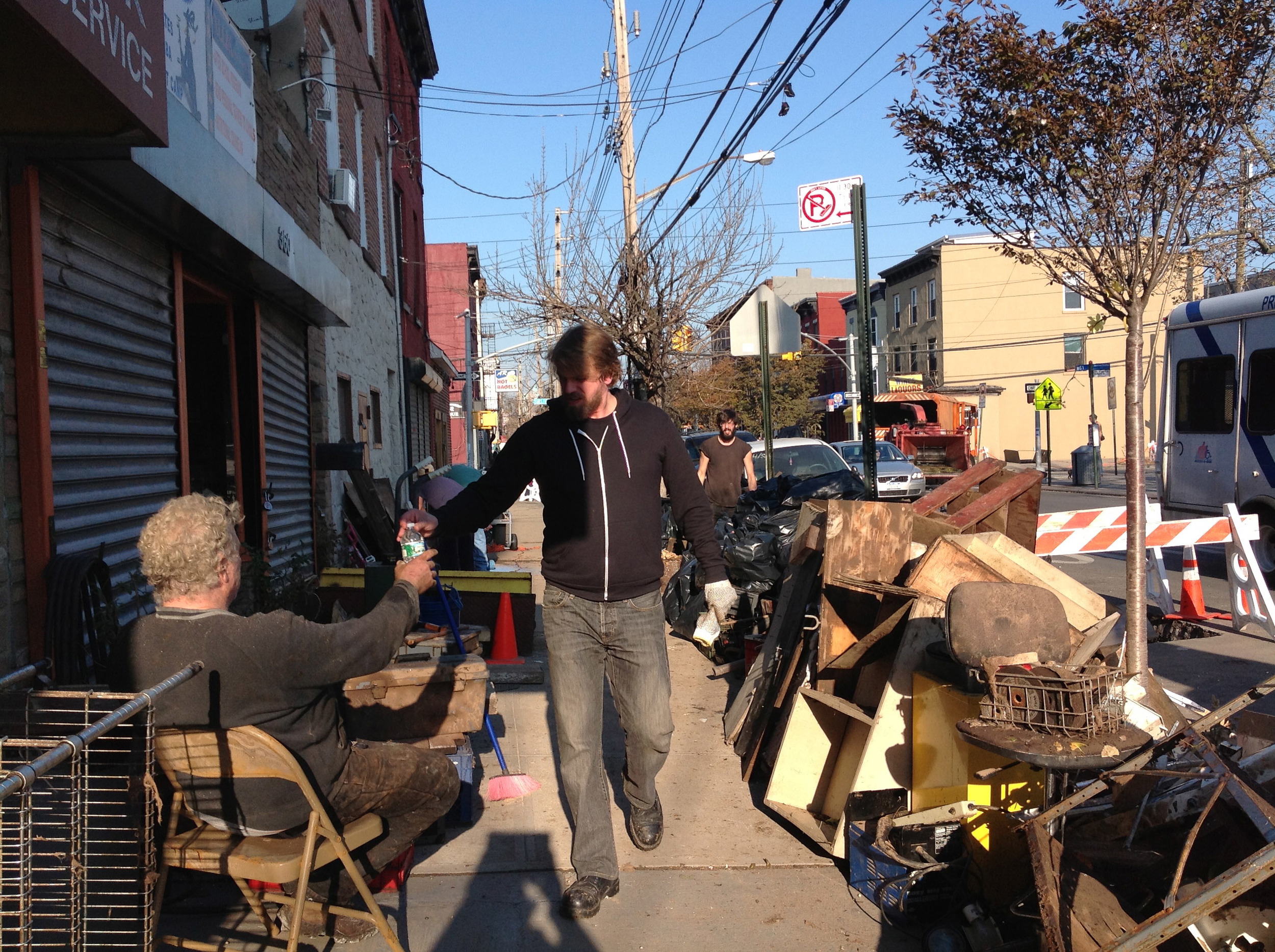
After assessing the damage to their archive of historic papers and artifacts stored in the shed, the PortSide crew entered Red Hook on Wednesday afternoon to find that the community had not fared as well. PortSide made an immediate decision to drop their own issues, decamp from the ship, and offer to help. The result was the Sandy aid station "351". 

Craig Hammerman, District Manager of Brooklyn, Community Board 6, in his nomination of PortSide for the “Champions For Change” Award, said “PortSide NewYork’s innovative approach was to apply their experience with cultural pop-ups to create an immediate, inventive community-based Sandy aid station that continually changed services in response to needs and opportunities.  PortSide deployed a deep knowledge of the community to pull it all off.”

Essential to the PortSide effort was the ability to rapidly identify partners and forge agreements. On Thursday night, PortSide Director Carolina Salguero began assessing what other groups were already doing, and where PortSide could best use its capabilities. Salguero worked with Realty Collective, a community-minded real estate brokerage with offices in the Columbia Waterfront District and Red Hook neighborhoods of Brooklyn. Realty Collective donated a storefront at 351 Van Brunt Street in Red Hook, complete with free electricity, internet and a phone line, despite the fact that their principal Victoria Hagman was herself a Sandy victim whose Red Hook home was flooded.

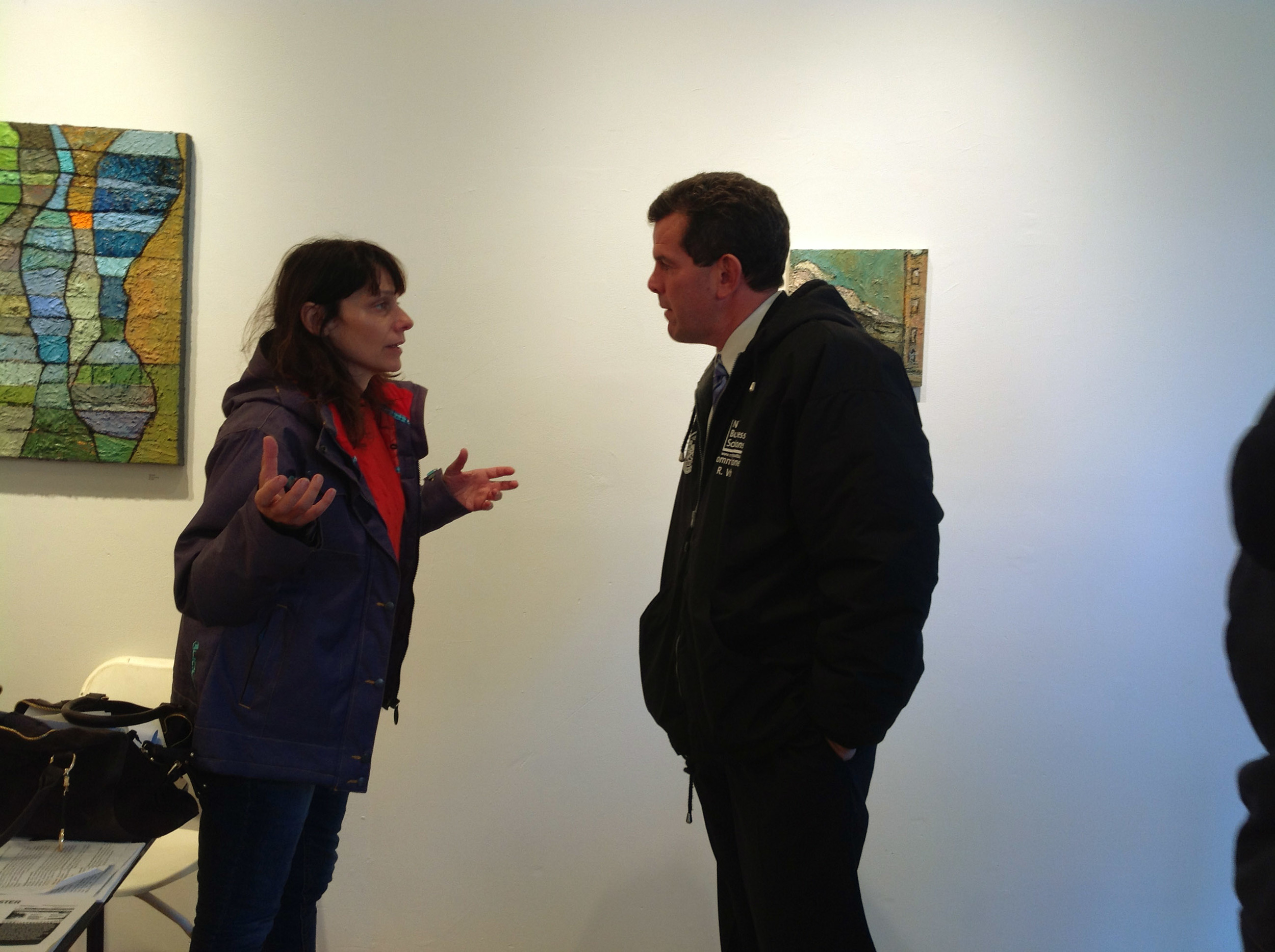
Over Thursday night, Realty Collective and PortSide secured the co-operation of Gallery Brooklyn, who shares the storefront with the brokerage.  The result was an only-in-Red-Hook blend: an aid station run by a maritime organization in a real estate office that was also an art gallery. 

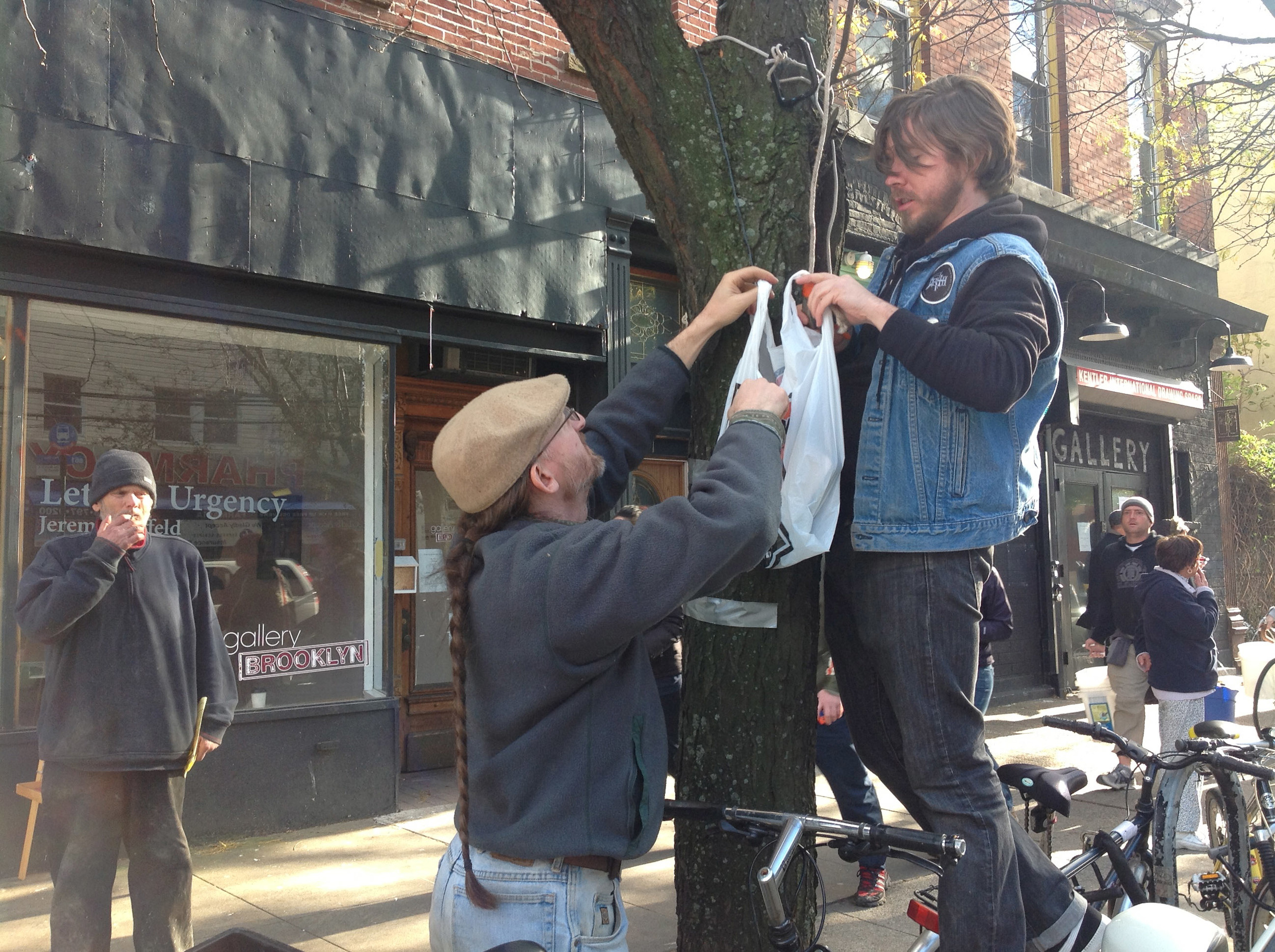
PortSide gathered volunteers off the street to get six computer workstations, office furniture and equipment from PortSide’s offices on the tanker to set up at “351”. The internet was down, so PortSide volunteer and museum curator Rothenberg ran a Clear wireless hub up a tree for two days until a PortSide contact at the Port Authority, who had previously worked to establish the cellphone network in the northeast, helped get Red Hook’s Verizon internet and cellphone service reconnected.

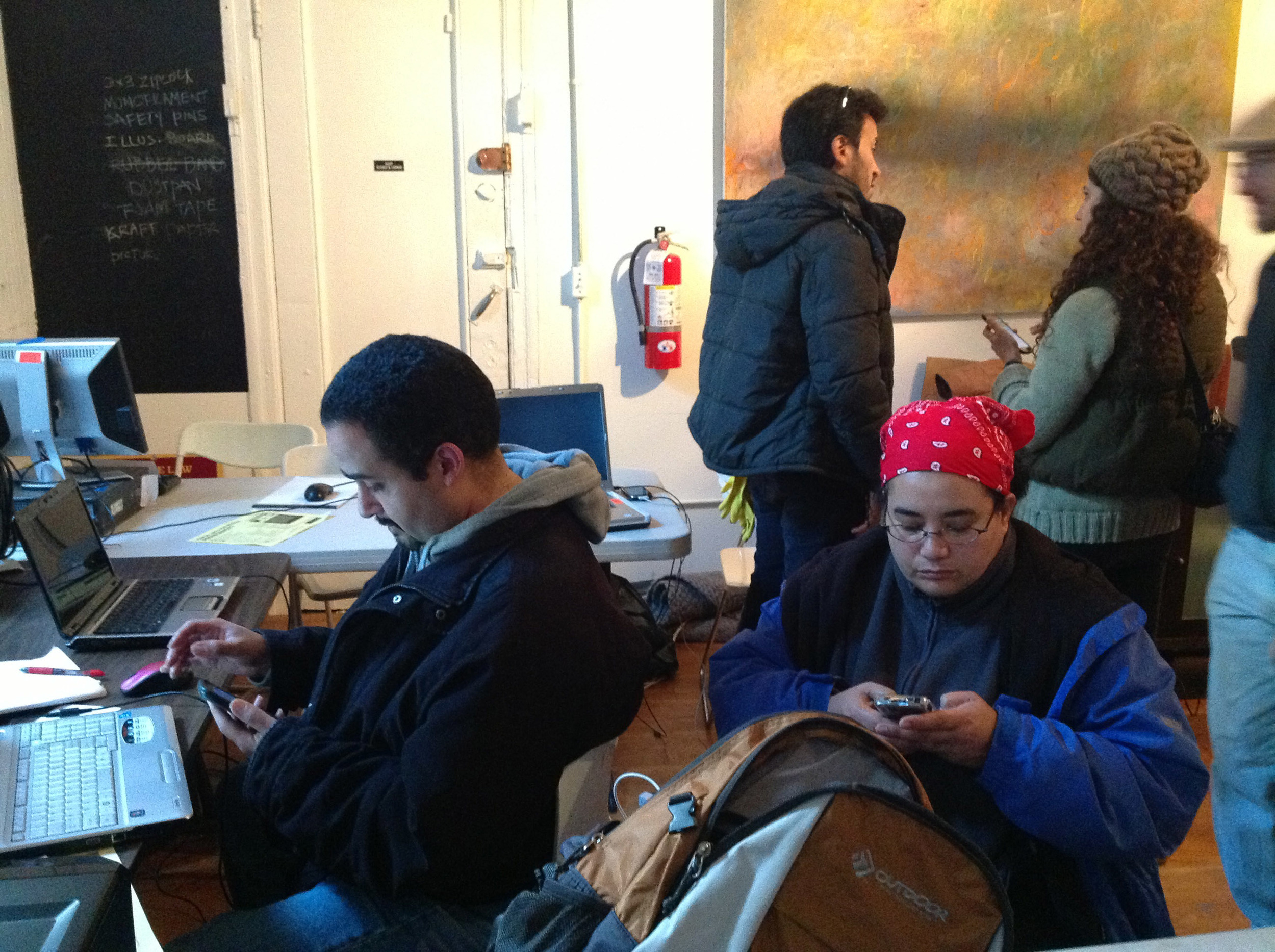
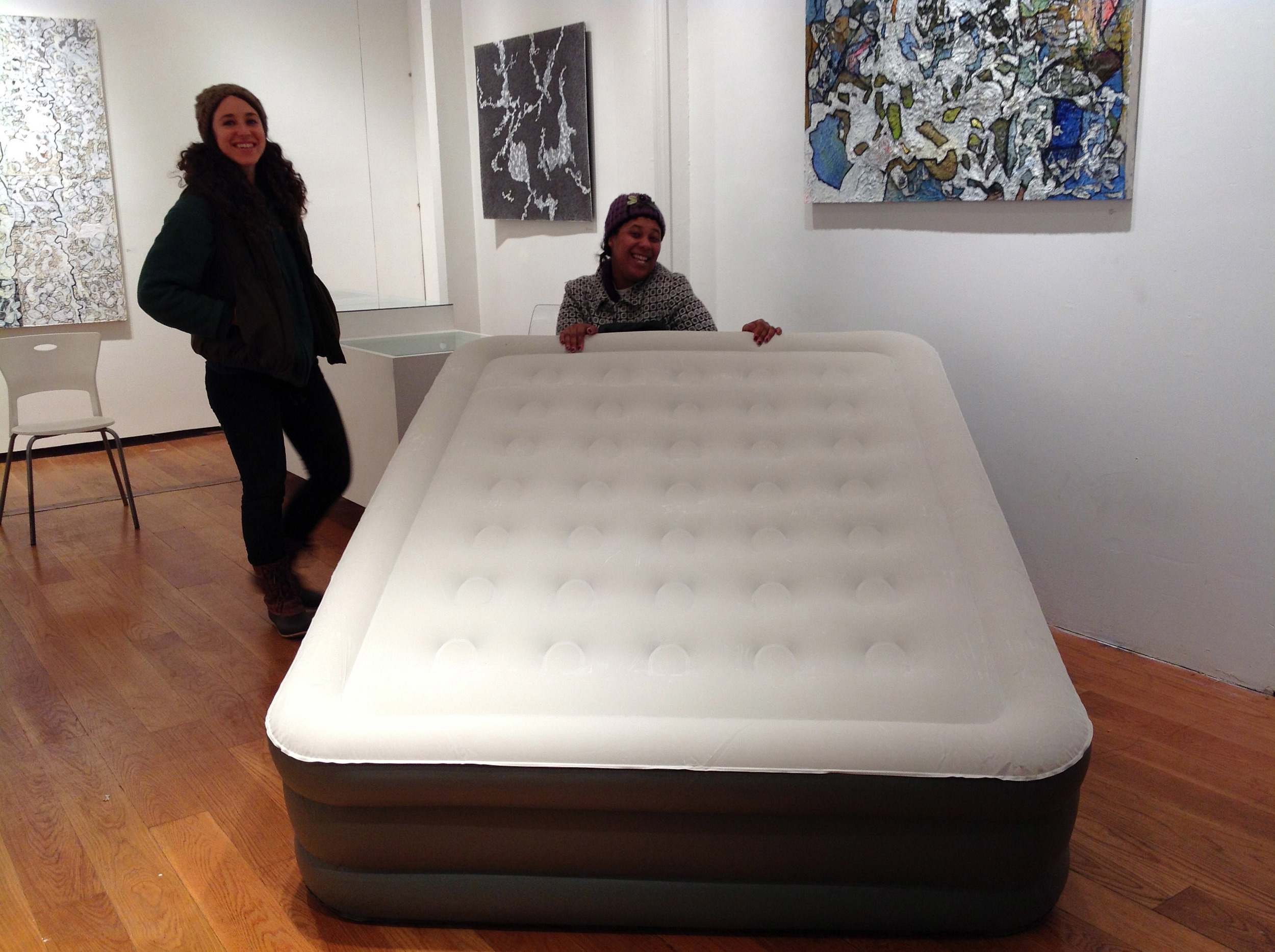
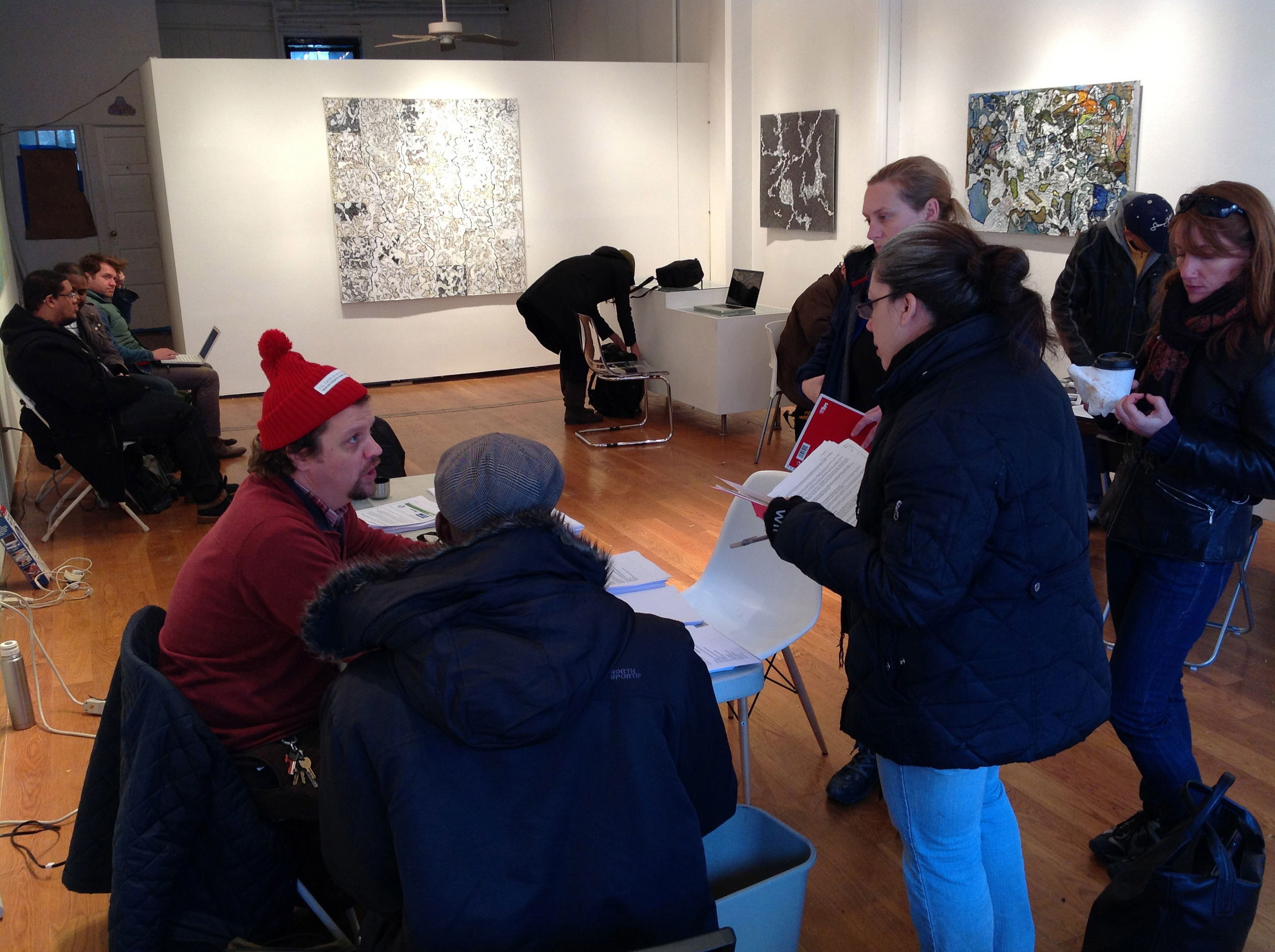
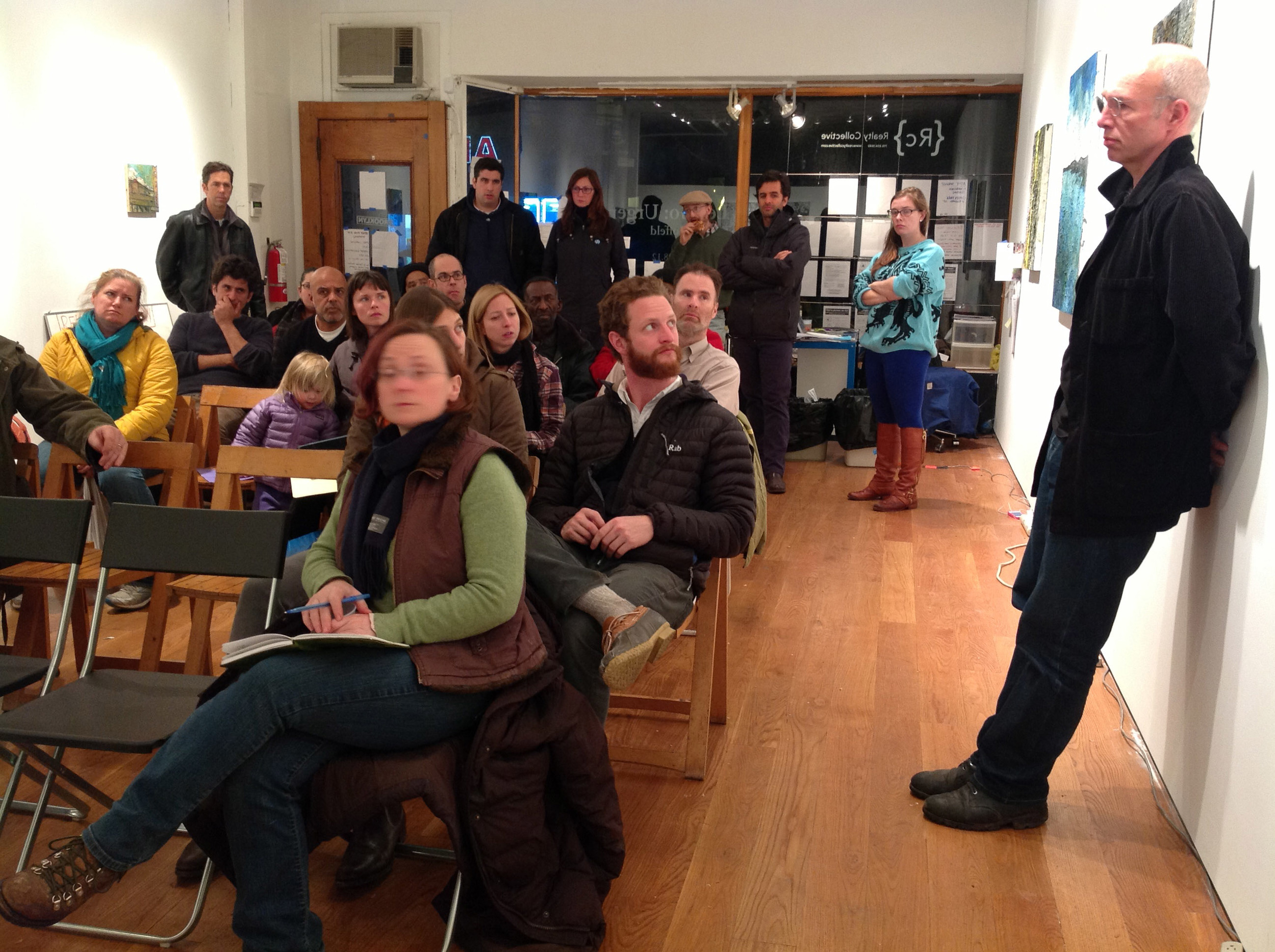
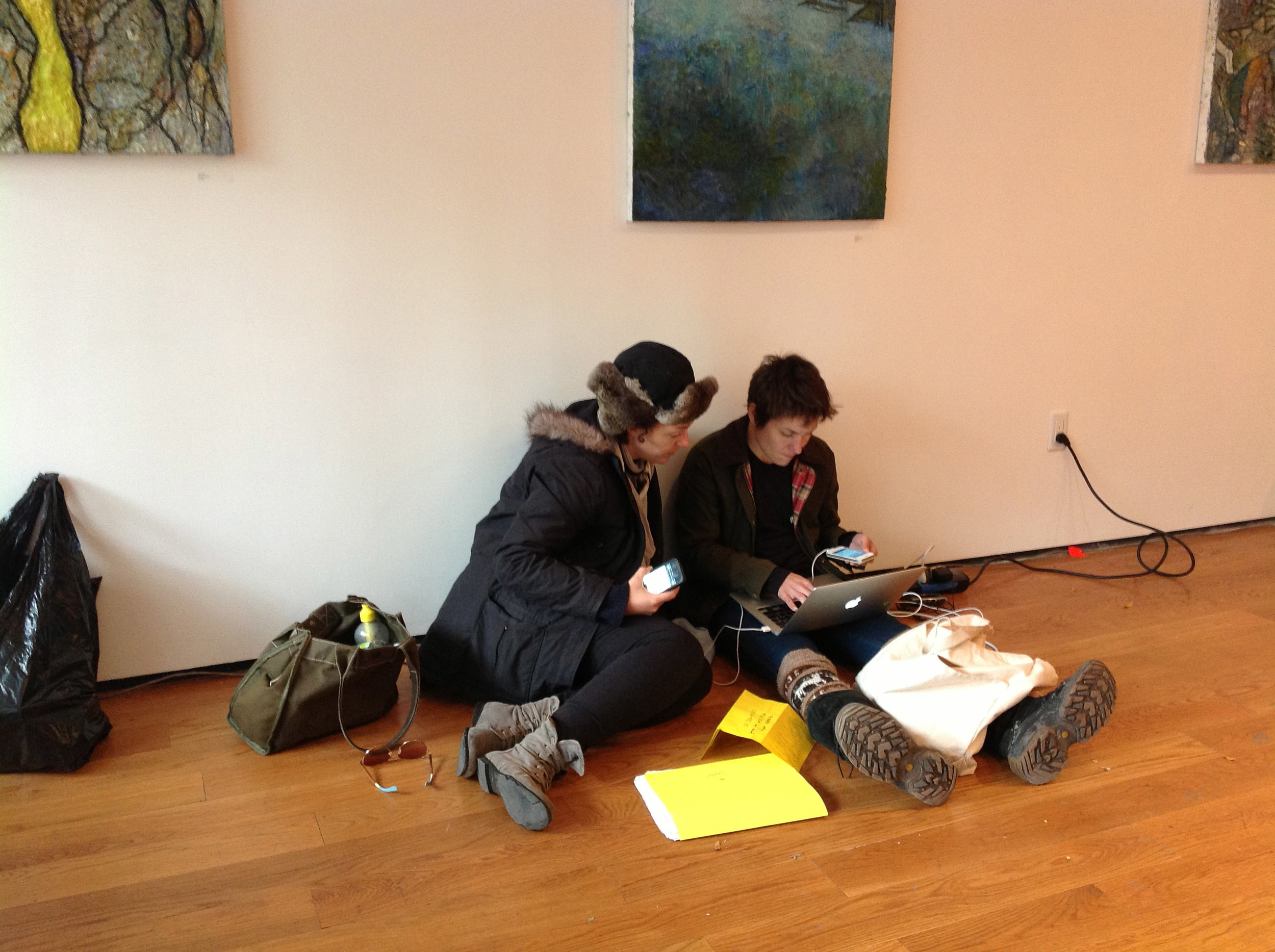
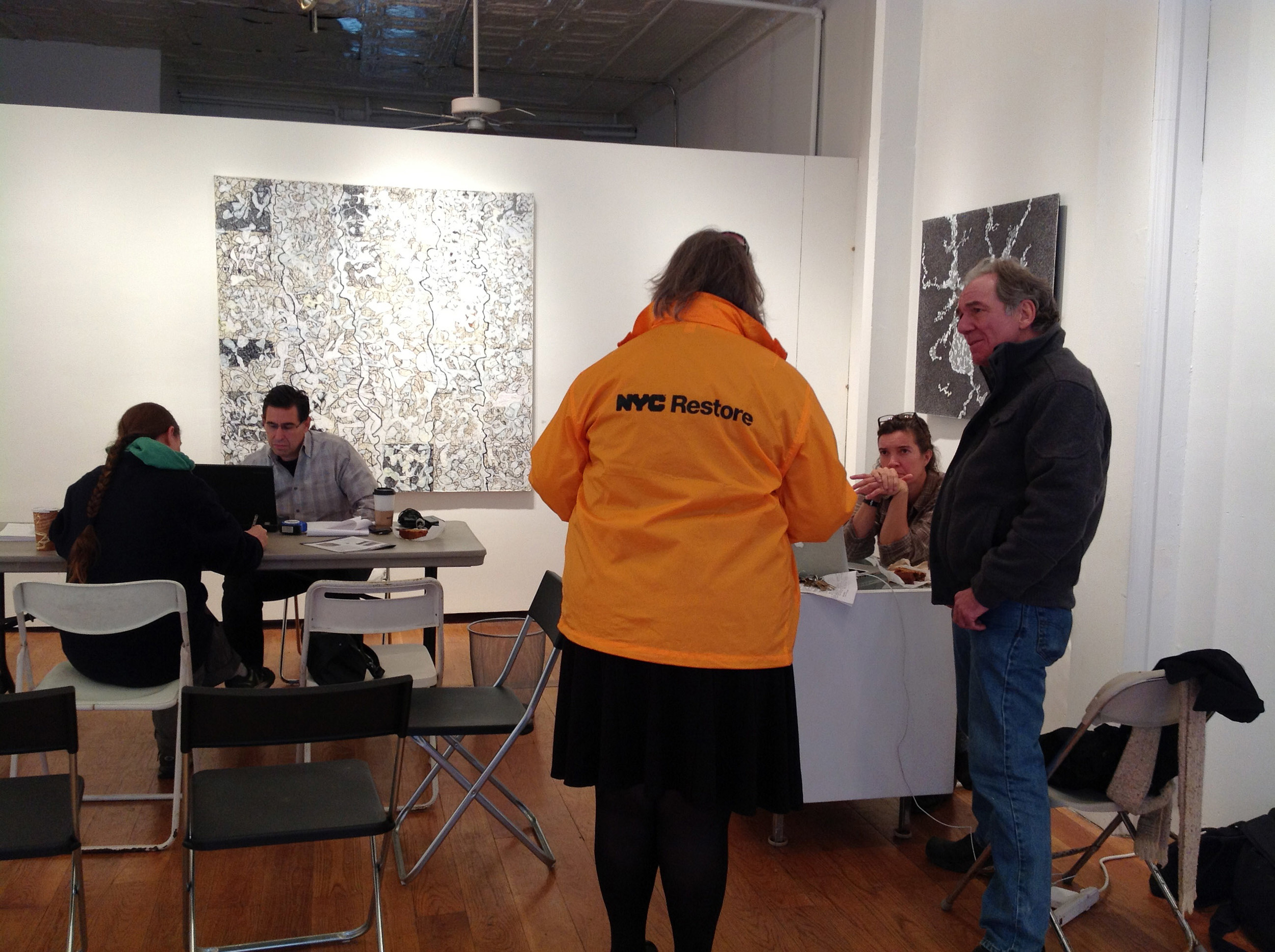
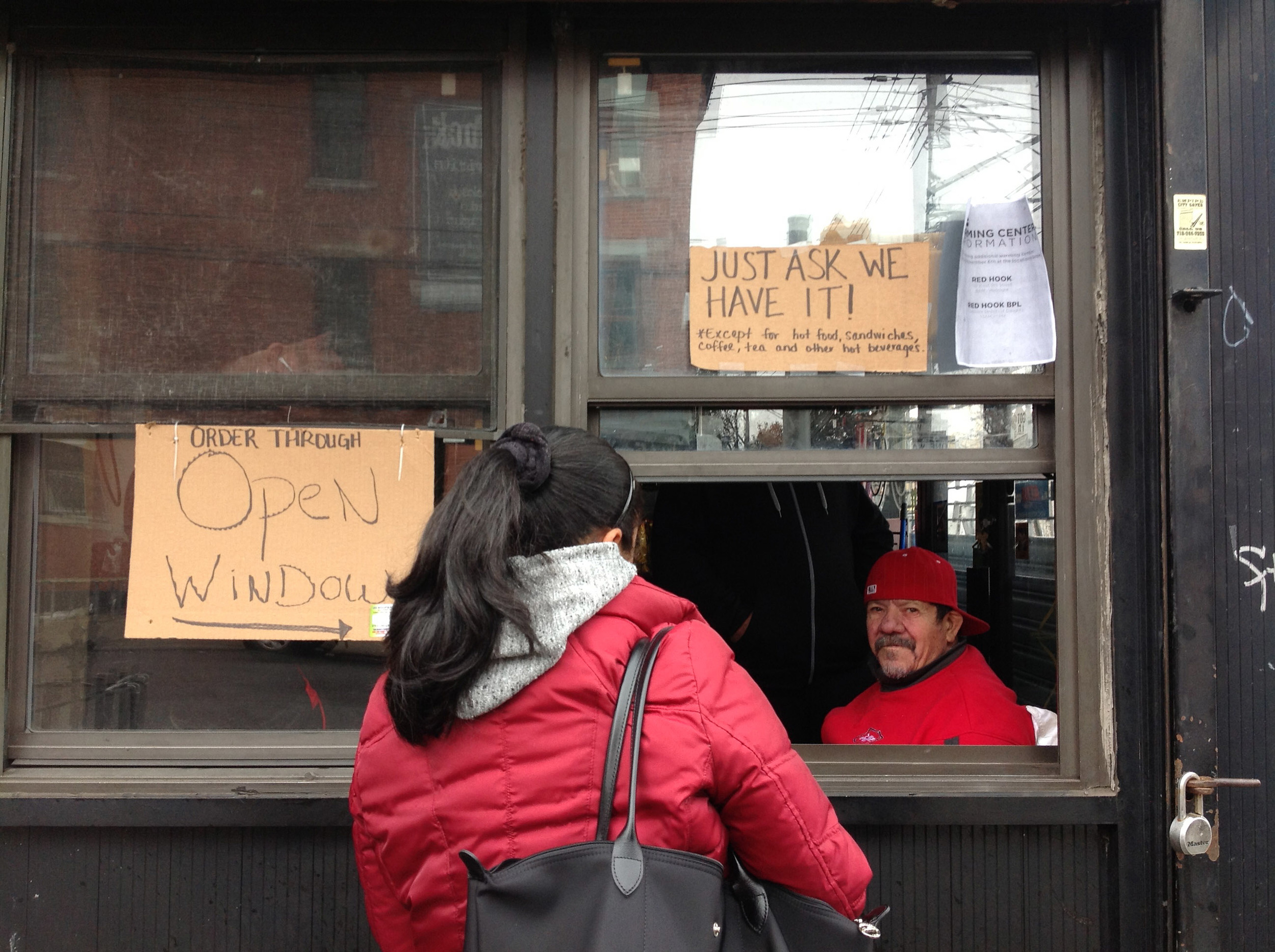
 “351” became a haven for people -- to escape the cold, to charge cell phones, I-pads, and power tools, to check e-mail to blow up a new air bed, to start the FEMA application or an insurance claim, or to wait for an escort to enter an apartment building whose electronic doors didn’t lock without power. Sandy victims remarked that the gallery environment with bright art on the walls was uplifting. The Director of Gallery Brooklyn, Jenna Weber, was so moved by the scene that she offered to donate 10% of exhibition sales to Red Hook relief.

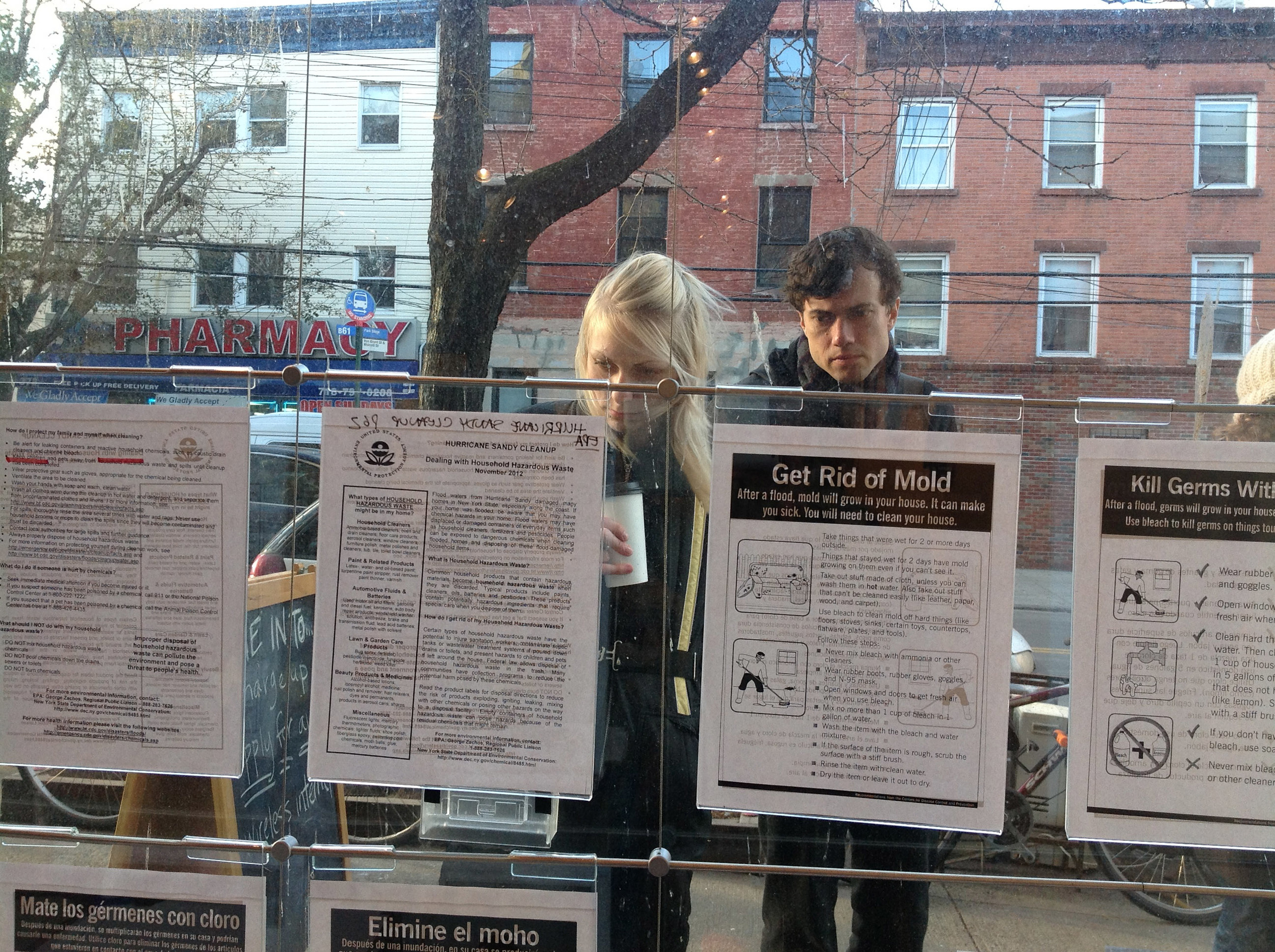
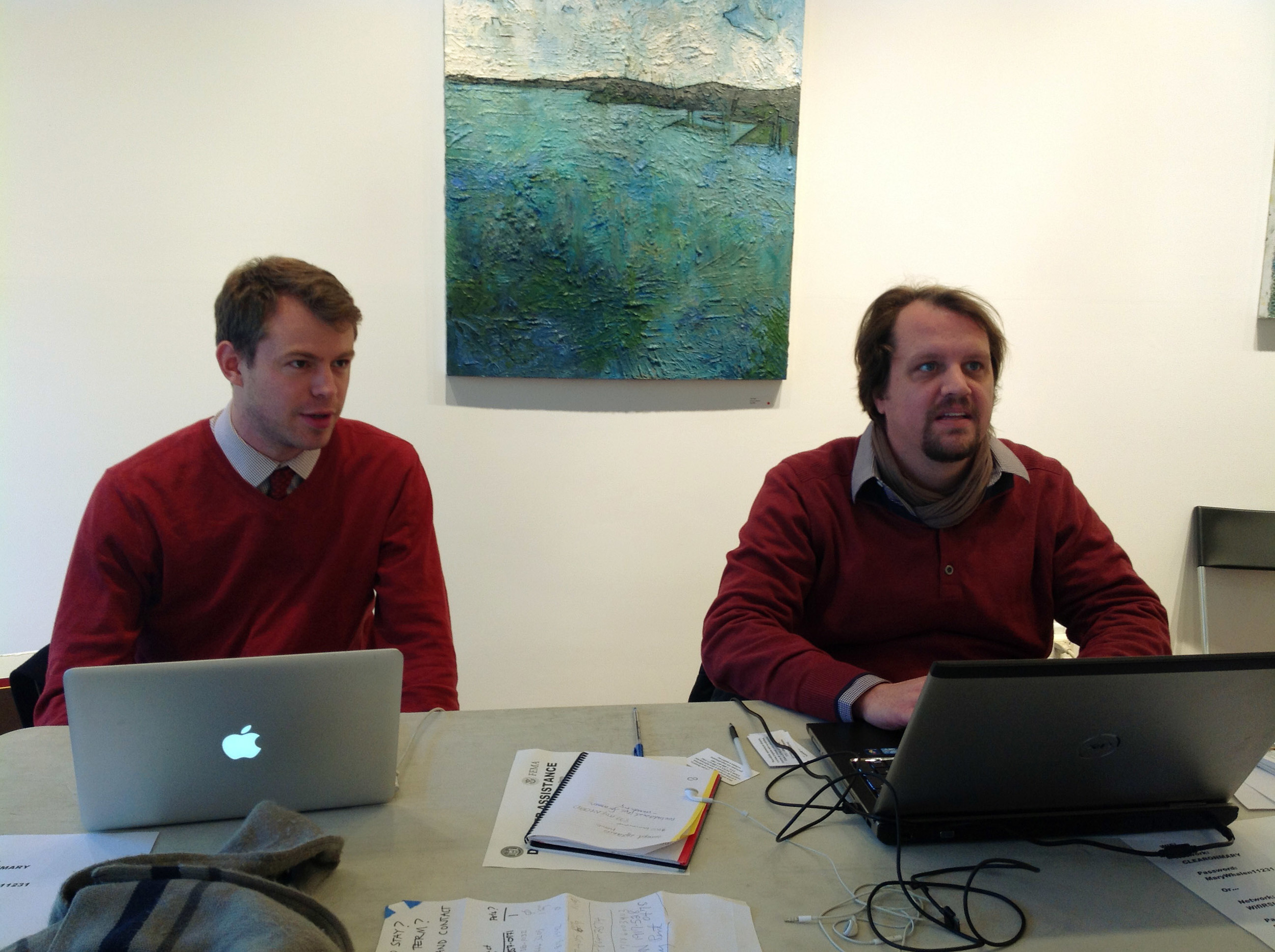
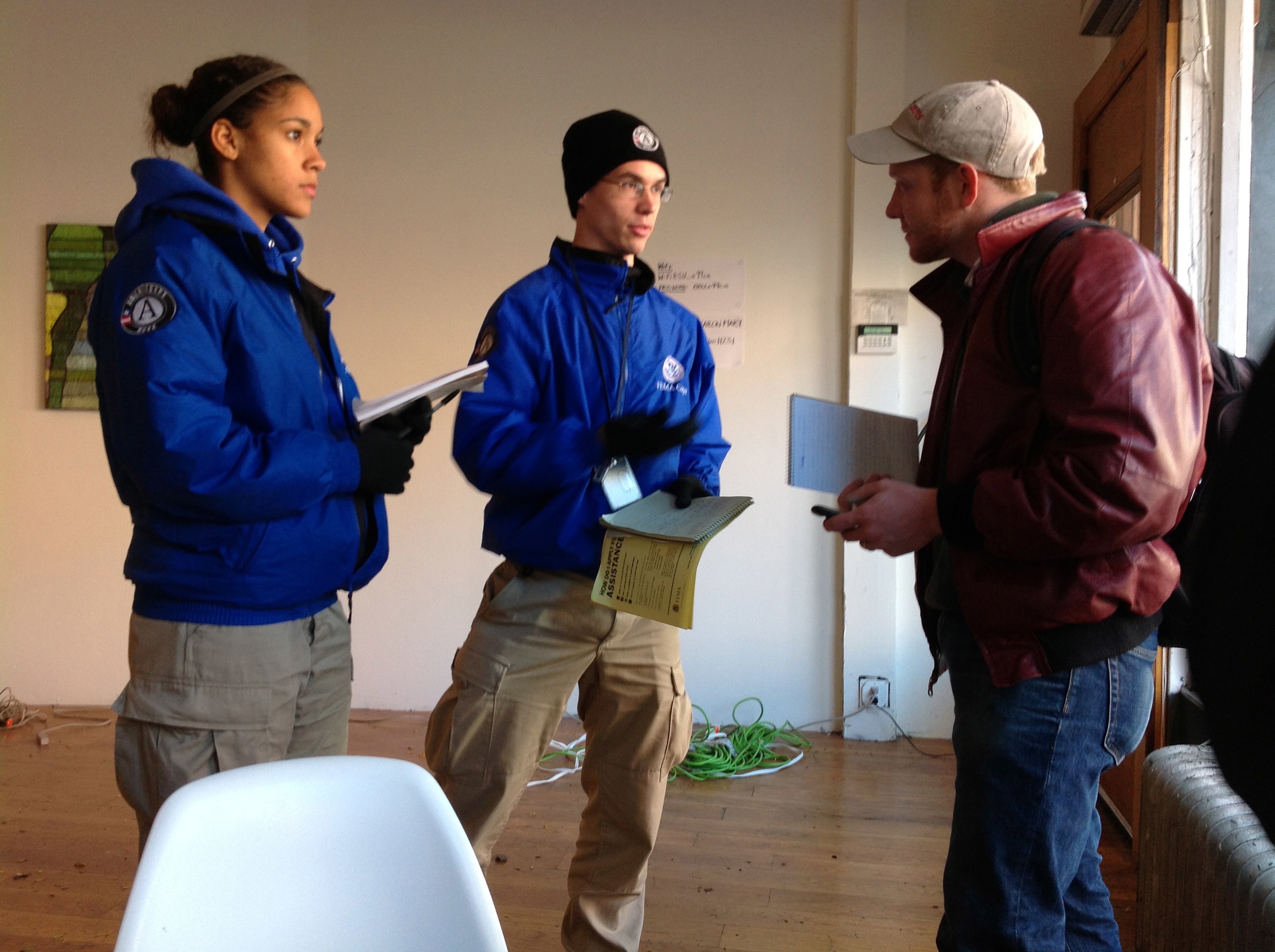
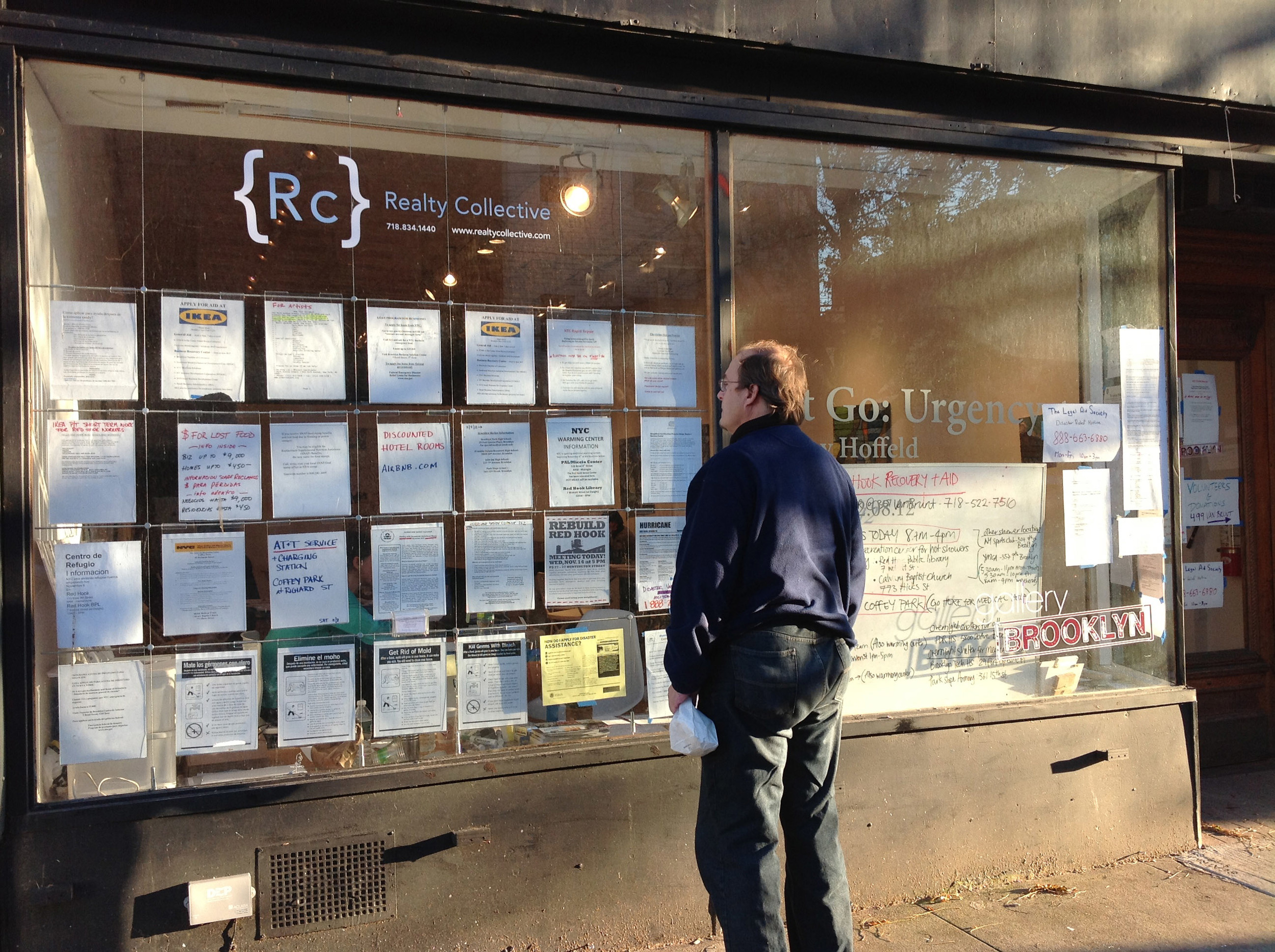
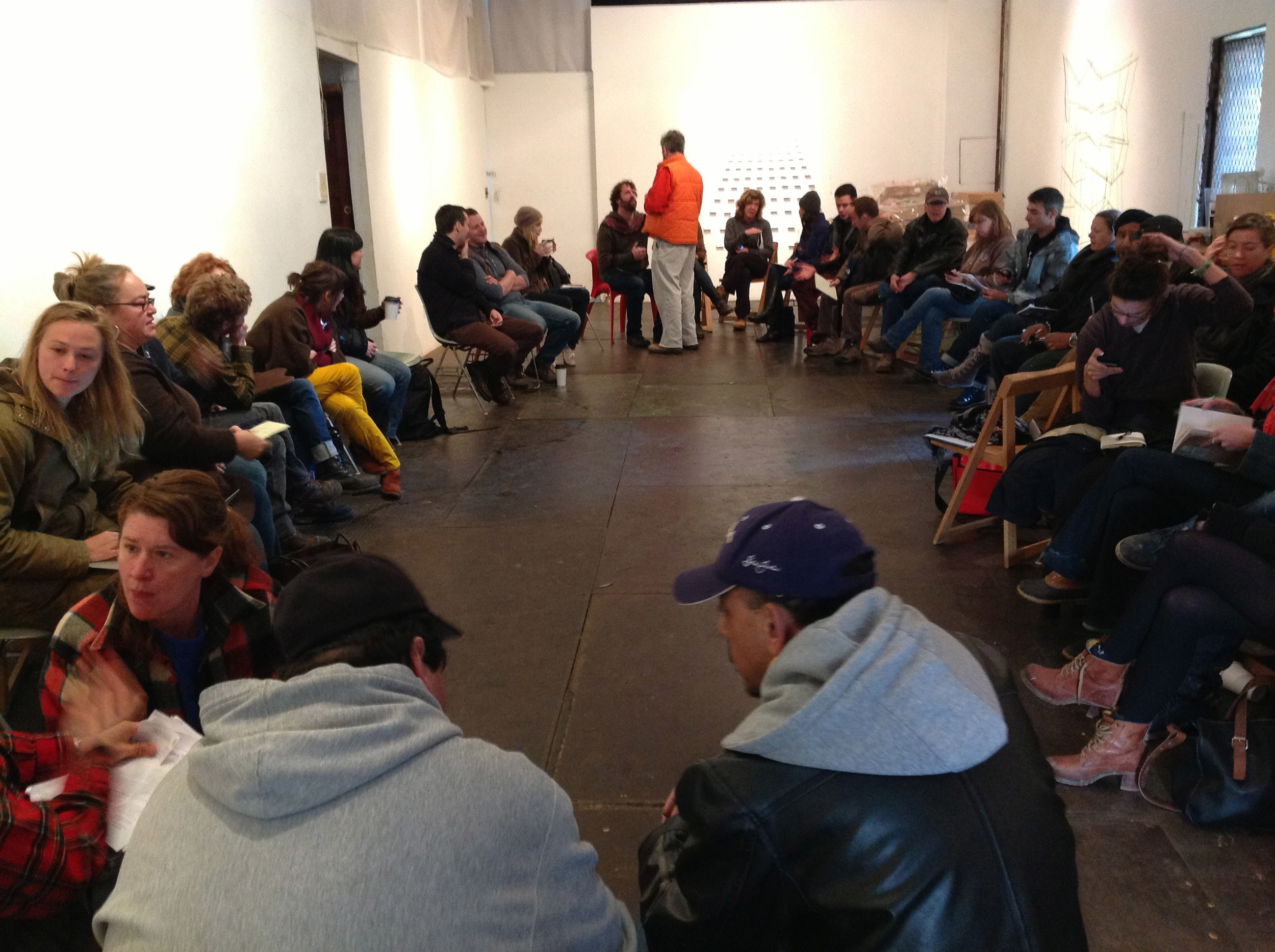
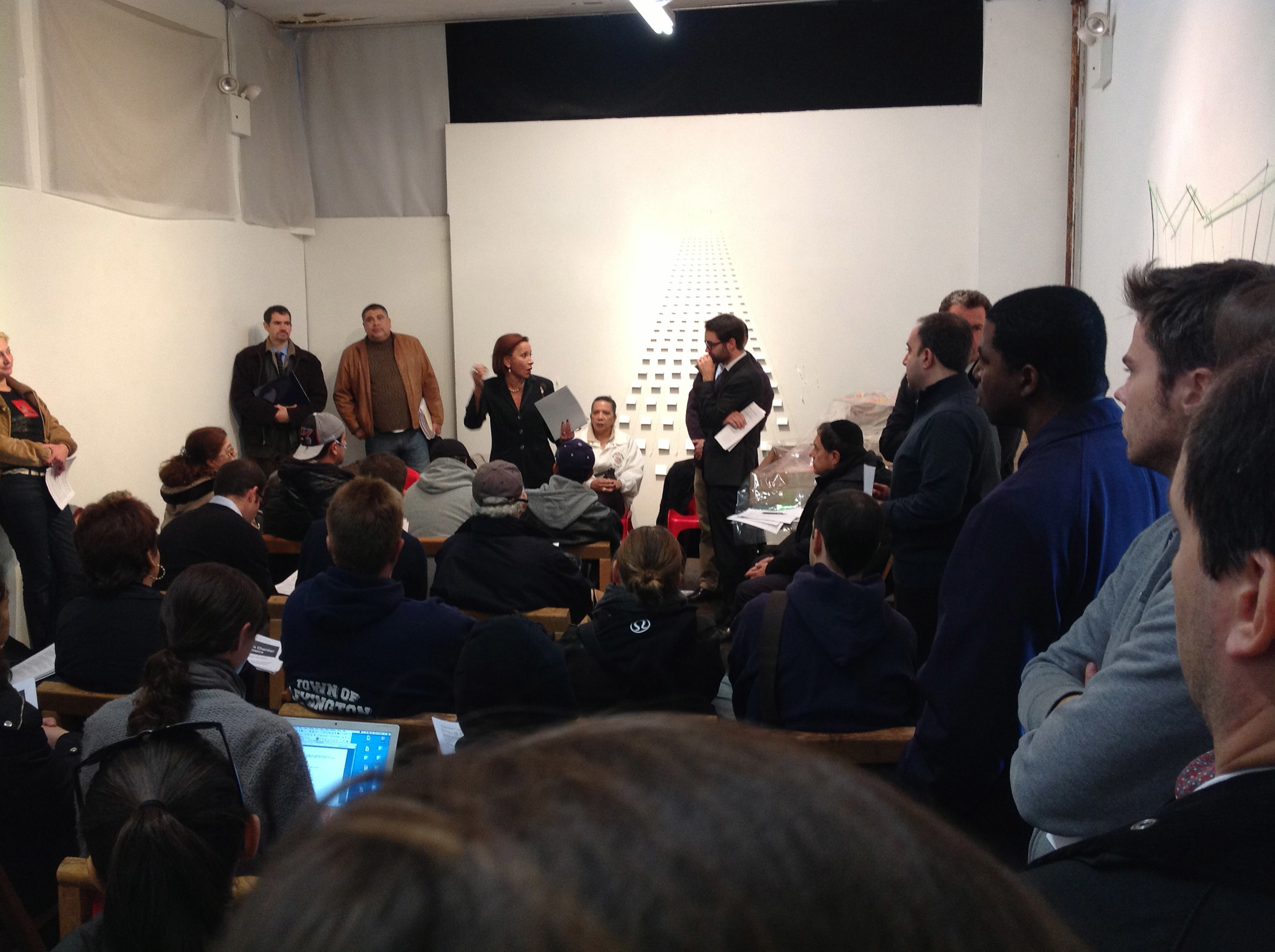
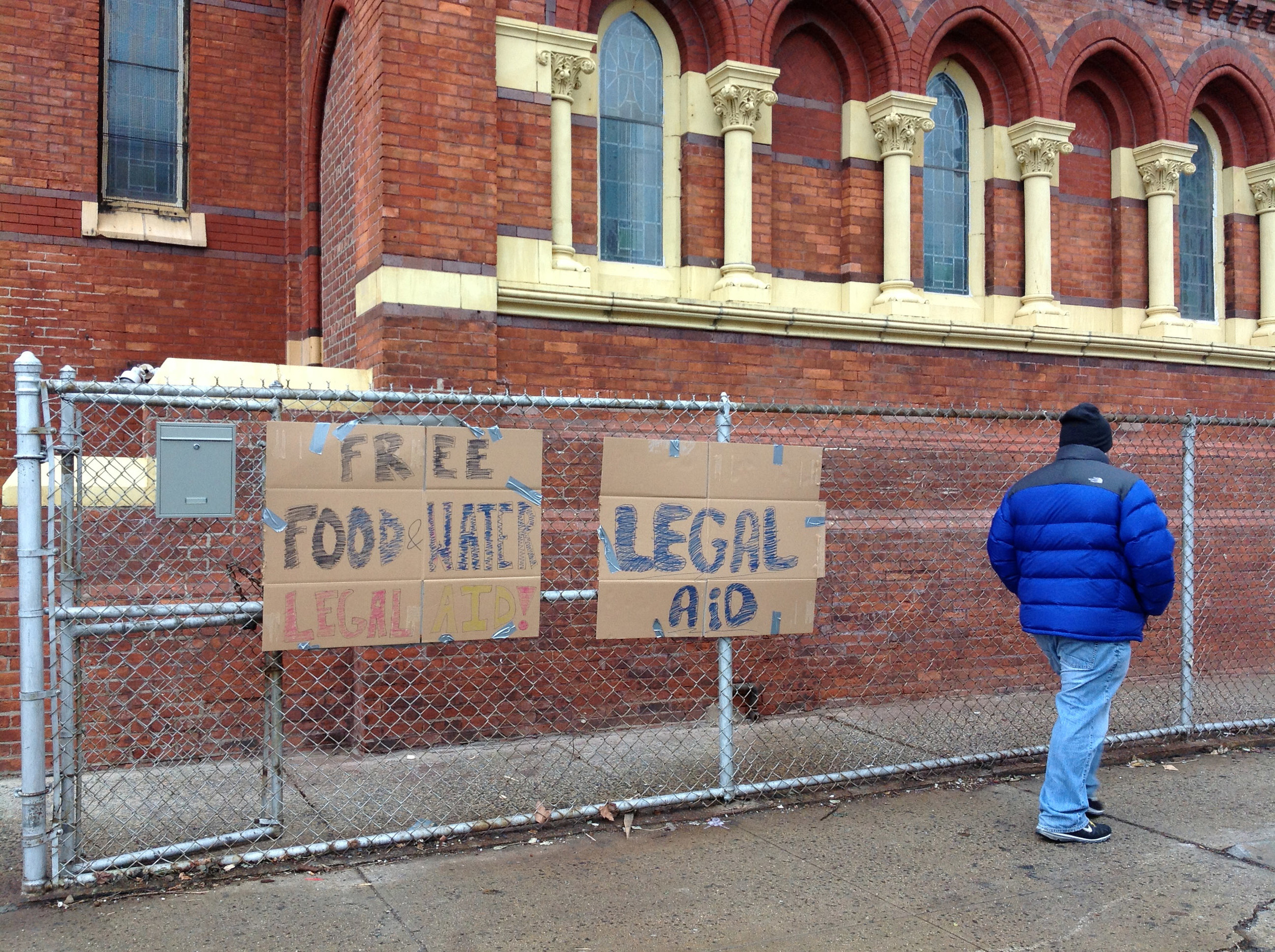
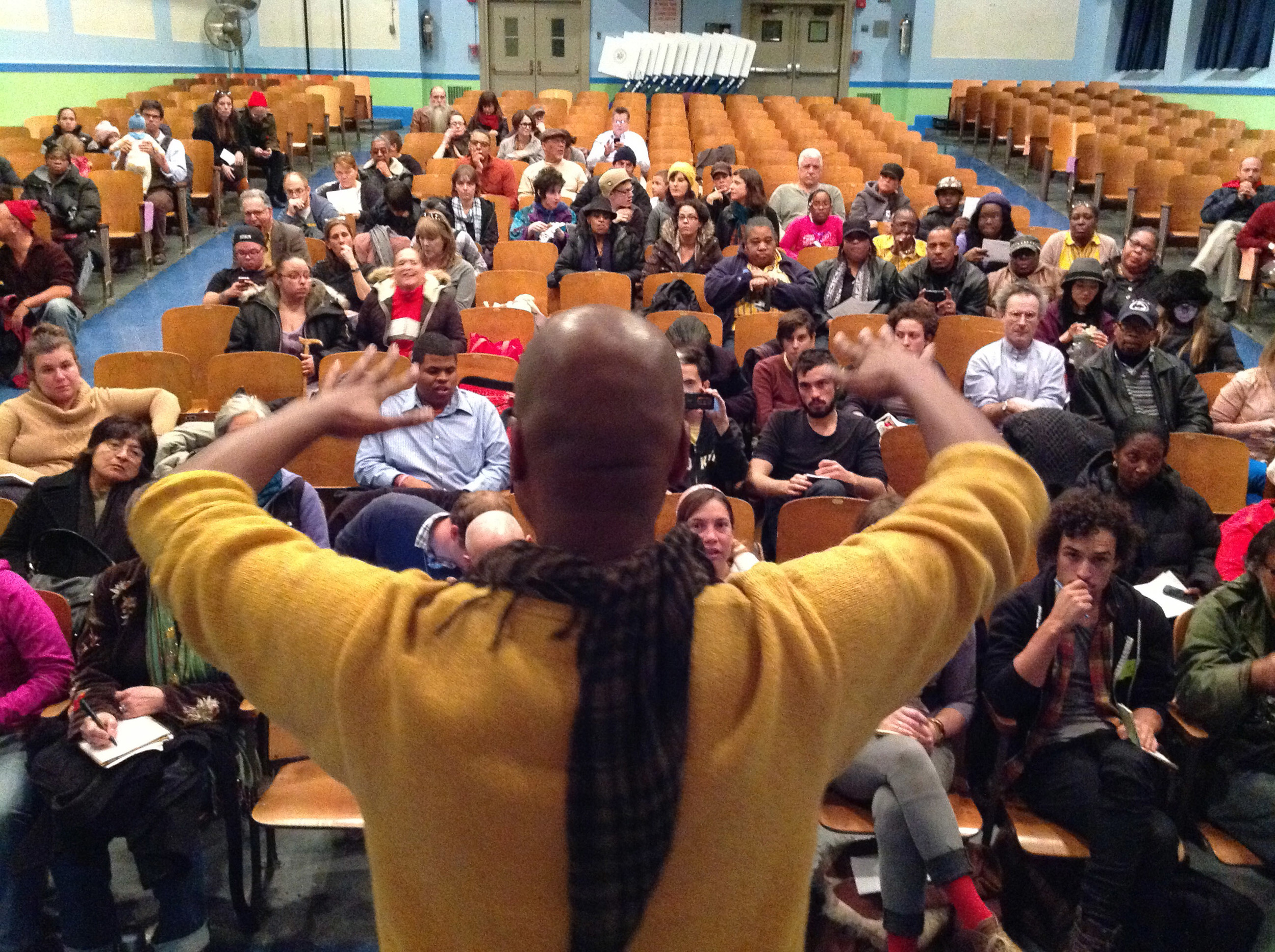
PortSide’s MO was to respond to initiatives or needs coming from the community, through both action and communication. Emergency information replaced real estate listings in the storefront window. “351” was the first small business recovery center in Red Hook, before IKEA’s aid center opened or the FEMA trailers arrived, and served as a hub for Red Hook residents and business people to learn about aid programs while gaining emotional support and tips from one another. Residents and businesses could use the space to set up their own meetings – one day included overlapping sessions with a restaurant supply vendor and a legal aid clinic with 20 lawyers. Realty Collective invited Katrina-savvy architect Jim Garrison from the Pratt Institute to talk to a packed house about resilient ways to rebuild. PortSide served as a conduit to and from the growing sources of outside aid: elected officials, the Mayor’s office, FEMA, and the Department of Small Business Services.

Residents of Pioneer Street showed extraordinary initiative and cooperation on their one block and brought many ideas down the street to PortSide, who helped manage them and shared them with other Red Hook residents.  One example was the coordination of the services of angel electrician Danny Schneider, who arrived from nearby Park Slope in Brooklyn and went on to inspect 60 homes at no charge and to repair many.  (He also volunteered in the Rockaways.)

PortSide closed the center in early December. During PortSide’s time ashore, the shorepower connection to the tanker MARY A. WHALEN was knocked out, and PortSide operated for 35 nights with flashlights and one 15 amp extension cord.

Today, PortSide continues providing Sandy relief work via other social media, working with elected officials and on post Sandy initiatives from the Mayor’s office, and by responding to requests from residents and businesses. Plans are being developed for programs that will help Red Hook learn from its own response and develop response plans for future floods. PortSide wants to bring its two constituencies, the world ashore and the world afloat, together. Inland people can be trained in the mariner knowledge base that enabled PortSide to prepare the ship for the storm and which might have prevented a lot of the damage.

PortSide's nominator for the award, the District Manager of Brooklyn Community Board 6 Craig Hammerman wrote “PortSide’s work is an example of the community-based, mutual-aid system that has caused the heavily-damaged neighborhood of Red Hook to become a model for New Yorkers looking for lessons in the Sandy story.” 

 Statement by Carolina Salguero, Director of PortSide NewYork

All of us here at PortSide NewYork are very honored to receive this White House award and look forward to meeting the other winners so we can learn from their stories. After that, we look forward to growing the post-Sandy flood preparedness programs we would like to offer Red Hook and beyond.  We would like to thank the Port Authority of New York and New Jersey for their support during Hurricane Sandy while we were in their Red Hook container port.  We offer profuse thanks to our partners at “351”, Realty Collective and Gallery Brooklyn, who opened their doors to Red Hook and made the aid center possible. Victoria Hagman of Realty Collective is really a gem to have given so much at a time when her own home was so destroyed by Sandy.  We would like to thank all those volunteers who came in to help, especially the angel electrician Danny Schneider who did work in Red Hook and the Rockaways at no charge.  Speaking personally, I was very moved by the collective spirit which sustained Red Hook in those first dark days.  Let’s keep that spirit alive; it takes a village, we were all it, and we need to keep that spirit going forward.

Statement by Rep. Nydia M. Velázquez (D-NY):

“PortSide NewYork is to be commended for their work protecting the MARY A. WHALEN and establishing relief services for Red Hook.”

 Statement by New York State Senator Velmanette Montgomery
“It gives me great pleasure to give my highest recommendation for consideration as a Champion for Change” to PortSide NewYork.

PortSide NewYork is headquartered on the MARY WHALEN, a decommissioned tanker ship in Red Hook, a coastal community in Brooklyn. PortSide NewYork has been working for years to preserve and communicate the seafaring history of Brooklyn to our schoolchildren and new neighbors. They have embodied community service every day of their existence, but during Superstorm Sandy, they showed exactly how deep commitment to service and community could be.

Thanks to their professional preparations, the MARY WHALEN weathered the storm and the destructive surge in fine shape, but the same could not be said for Red Hook itself. The neighborhood was devastated and lacked electricity and other services for weeks afterward.  The staff of PortSide NewYork, led by the indefatigable Carolina Salguero, came ashore and set up a communications hub and aid center in a donated space. They set up meetings between residents and elected officials, engineers, lawyers, electricians...anyone who needed something came to them and PortSide NewYork reached out to find it. I don't know what we would have done without them.”

Statement by Rob Walsh, Commissioner of the NYC Department of Small Business Services

“Immediately after Hurricane Sandy, I was out in impacted neighborhoods like Red Hook speaking to small business owners about their needs and how the City could help. It was incredible to see the individuals, organizations, and business owners who stepped up to help each other out. PortSide New York served as a strong partner, helping us get the word out about the City’s low-interest loans, matching grants, and other assistance available to small business owners impacted by Hurricane Sandy, and I congratulate them for this well deserved award.

Statement by Carlo A. Scissura, President & CEO of the Brooklyn Chamber of Commerce “Red Hook was one of the neighborhoods hardest-hit by Sandy. It’s because of groups like PortSide that we were able to help businesses in the neighborhood,” said Carlo A. Scissura, President & CEO of the Brooklyn Chamber of Commerce. “By housing members of our staff during those critical weeks following the storm, the Brooklyn Chamber of Commerce was able to help business owners fill out essential loan applications and other paperwork in order to get their stores open again. PortSide’s aid center became a critical hub for the community and a place where they could get relief. We could not have done our work in helping local businesses without them.”

Statement by Danny Schneider, Principal, Schneider Electrical Contracting
“Hurricane Sandy threw Red Hook into a tail spin.  Residents rose to the occasion and with tenacity and synergy, and strengthened their character.”

Statement by Adam Armstrong, Pioneer Street Homeowner, blogger “A View from the Hook”

In the chaotic aftermath of Super Storm Sandy, PortSide New York provided a vital and invaluable resource for the residents of Red Hook. After riding out the storm and saving their own ship, the MARY WHALEN, PortSide came ashore, quickly set up shop at 351 Van Brunt Street and proceeded to make a base - a visible and accessible storefront - from where they could reach out, provide information, resources and assistance to their land lubbing neighbors, most of us who were desperately trying to recover from the immense damage that had been done to our homes and our unique, waterfront neighborhood.

PortSide and their team of volunteers co-ordinated tradesmen to go and physically assist our residents, and they gathered and disseminated information about anything they though would be helpful - FEMA, legal assistance, insurance matters, Con Edison, National Grid, the Rapid Repairs program, etc., and provided a connection to our representatives in government. On many of these matters, PortSide organized meetings and reached out to our residents, and in the case of our street - Pioneer Street - she co-ordinated the creation of a comprehensive contact list so that everyone on our block could share information and provide support to each other. It was - and still is - a wonderful way for the residents of Pioneer Street to keep in touch and get updates on our street's recovery, with Carolina Salguero, PortSide’s Director, checking in regularly to see how things are going and, many month's later, still providing advice and information wherever and whenever she can.

Statement by Gallery Brooklyn

“Gallery Brooklyn raised over $1K from the sale of Brooklyn-born artist, Jeremy Hoffeld, whose oil paintings gave comfort to the shell-shocked residents of Red hook. The funds will be donated to the Red Hook Initiative, a non-profit organization that provides enrichment geared toward the arts for children of the Red Hook community."

About PortSide NewYork

PortSide NewYork is honored to have won a White House "Champions of Change" award for our work during and after hurricane Sandy. We hope the award will allow us to continue our Sandy-aid work, launch new resilience training programs, and attract more assistance to Red Hook. Things look promising; the phone has started to ring.  Until we finish the blogpost about Part II of our Sandy story, we've added photos to a press release below to tell that story. Part I of the story, how we protected the MARY A. WHALEN from Sandy, can be read here.

PortSide NewYork educates people about the BlueSpace, the water part of the waterfront.  PortSide works with the community ashore and the community afloat; our goal is to bring the two closer together, to foster their mutual understanding and to create synergies between the two.  PortSide programs are diverse—they include maritime preservation, visiting vessels, arts and educational programs, community service and advocacy.  What unites them is the focus on water and waterfront issues. Our mission is to bring NYC’s BlueSpace to life.

PortSide has its offices aboard a historic ship, the MARY A. WHALEN, and with her, PortSide has created the world's only oil tanker cultural center, a ship in the National Register of Historic Places. PortSide runs many programs on the MARY, and we run many off the ship as well. 

PortSide NewYork is negotiating with GBX▪Gowanus Bay Terminal for a homeport in Red Hook, Brooklyn!  At our prospective home, the tanker MARY A. WHALEN will be publicly accessible directly from Columbia Street across from IKEA.  [Note: MARY A. WHALEN relocated to Atlantic Basin May 2015]

PortSide’s electricity on the ship was repaired after 35 nights of reliance on flashlights and one 15-amp extension cord.  PortSide seeks professional conservator help with two waterlogged books from the 1850s (stored in a freezer since the flood) and restoration of the antique replacement parts for the ship’s engine which were stored in the shed.

More info

Official description of the White House Champions of Change Sandy awards

"Across the areas impacted by Hurricane Sandy, ordinary Americans are doing extraordinary, innovative things in their communities to respond to and recover from this disaster. By partnering with the whole community, we, as a nation, are better positioned to meet the unique needs of communities and neighborhoods across America."  

PortSide NewYork, and the other 16 winners, were at a White House award ceremony on April 24 for a panel discussion and remarks by the head of FEMA Craig Fugate and the head of HUD Shaun Donovan.   Carolina Salguero, Director of PortSide NewYork represented PortSide on the panel. A video of her remarks is here.

FEMA handled the Sandy nomination process.  The head of FEMA Craig Fugate spoke at the White House Champions ceremony and explained that the awards were important for underlining how the public was now being viewed by FEMA as survivors (not victims) and partners in recovery (not just recipients of aid). 

Thanks to Craig Hammerman, District Manager of Brooklyn Community Board 6 for nominating us. You can read his nomination here

For PortSide's latest Sandy relief information, see our regularly updated blogpost and follow us on Twitter


PortSide NewYork Sandy Story Part 1: saving MARY WHALEN

This is PortSide NewYork's hurricane Sandy story, installment one.  

Installment one is a personal report by Carolina Salguero, Director of PortSide, speaking as Shipkeeper of the MARY A. WHALEN.  This installment covers PortSide's time in port preparing for Sandy, riding out the storm on the tanker, assessing our damage. We think the ship-related segment of our Sandy story is important because it shows how the maritime community in the port of NY-NJ spent days preparing for Sandy.   The maritime community has something to offer inland neighbors in terms of understanding how to assess flood risks and prepare for them.

The second installment of our Sandy story will cover PortSide's effort to help inland Red Hook, Brooklyn recover from the storm. 

The third installment will cover lessons learned and ideas for the future.

What a difference four days can make

Thursday, 10/25/12, Sandy minus four, the PortSide crew is excited to be hosting an elementary school class aboard the tanker MARY A. WHALEN.  After finishing a TankerTour and jolly lunch for 30 on deck with the City + Country School and waving goodbye to their coach bus, Dan Goncharoff says “have you been looking at this storm coming up the coast?”

C + C School visit, Thursday morning

I check the weather websites. This looks like hurricane Irene plus some.  

We convene a crew meeting and start hurricane preparations. School docents become a Sandy prep squad. By end of day, the deck was cleared of anything that could blow, and I am calling and emailing around for crew to help prepare and to ride out the storm on the ship. 

Friday morning, after more info about the storm, I am trying to find a protected berth for the tanker MARY A. WHALEN.  Just days before, we received word that our application had been accepted; the ship was on the National Register of Historic Places! Since the MARY is not fully restored, she lacks some equipment that would help her in a big storm: a working engine (eg, the ability to run away), machinery to raise her anchors if dropped to hold us in place, and a winch to haul in docklines under load. Compensating for that involves some extra forethought. 

Despite our efforts, we can’t find a good alternate berth for the MARY outside of the Red Hook Container Terminal.  Hughes Marine says “We’re out of space. You’ll be able to walk across Erie Basin by the time this is over; it will be so full of vessels.”  A contact at a shipyard says “we flooded during Irene, and this one looks to be worse, you sure you want to be over here?” “No and good luck,” is my answer.

After more checking of the weather, I decide to move the MARY where she rode out Irene, on the other side, the north side, of our current Pier 9B. (The south side lines up with the end of Degraw Street). For non-sailors, here’s how this kind of calculation goes:

Winds were expected to start from NE, swing around to the East and end up SW, but this could always change. If rough weather were coming from anything west to southwest, our current position has us exposed to the wind from the southwest and the fetch (long stretch of water over which wind can build up waves) from Staten Island up the Buttermilk Channel

The fendering (the wooden cribbing protecting ship and pier) is not robust on this side. A big advantage to the north side are some pilings at the inshore end that stand much taller than the pier and which would help prevent the tanker from riding up onto the pier if the surge were really high. 

The north side would have us more exposed from winds at the start of the storm, but the hill of Brooklyn Heights and the pier to the north of us (even though it has no shed) would provide a compensating wind break.  

As the wind clocked around to the south, a wall of containers near the bulkhead would provide a windbreak to the east, and the pier shed would be an enormous windbreak once the wind went south of east.  

A final consideration was that in the extreme case of docklines failing while we were on the northside, the tanker had a chance of bouncing around inside the space between the two piers for a while, maybe long enough for us to get other lines out or call for help; whereas, on the southside of the pier, if our docklines broke, tide or wind could shove the ship up on the rocks nearby to the south (surely the death of the tanker) or shoot us down the Buttermilk Channel towards unknown risks. 

I began calling tugboat companies to request a tow. Everyone is busy with storm prep so getting a tug takes a while.  I have the tug turn the MARY around so her stern faces east, putting her heavier end towards the expected wind direction. Her light bow is my worry.

The tug’s crew helps us put out storm lines, more lines than we would normally use, and double and triple parted lines. (Instead of a line just going from boat to dock, a triple-parted line goes from dock to boat to dock to boat).  The lines are set with a lot of slack to allow the boat to rise during the expected surge.  During Sandy, Peter Rothenberg and I will go out in the wind and rain to ease the lines as necessary

From Thursday until Monday, a changing array of volunteers bang through a punch list: gangway lashed to the deck. Gas generator moved near entry hatch and tested.  Gasoline, food, and water bought. Weepy portholes caulked. PortaSan moved inside the pier shed so it can't blow away.  

More calls to look for crew... Commercial boats have paid crew, but most historic vessels rely on a corps of volunteers and; with so many boats to protect, available bodies were scarce.  Compounding that, due to the dangersome spouses do not allow their partners to volunteer on the historic ships during the storm. Danger is one thing for paid crew; as a volunteer, it's another.

I ask Peter Rothenberg, our volunteer museum curator, if he wants to be crew. Peter makes a speedy calculation, “I hesitated for a moment, thinking this may be really unwise, and then said yes, probably being more reckless (brave?) than normally, because I had just lost my mother, and thus she was unable to question my judgment.”  

Peter Rothenberg

Peter Rothenberg

The harbor is abuzz with chatter on phone, email, and texts sharing weather info, plans, moral support. Mike Cohen has info on the South Street Seaport ships. Mike Abegg is dealing with the Harbor School boats. I talk to tug captains and ask Jan Andrusky, Logistics Manager of Weeks Marine, if she can share weather and Coast Guard updates as she had during Irene. Answer, “yes!” Jan is responsible for floating equipment on the eastern seaboard, the Gulf of Mexico, and more, and has lots of experience and access to weather data.

Bobby Silva, captain of a Reinauer barge up in Albany sends a text: “wish I gave you my keys to move my truck. My baby will be a goner.”  Other Reinauer crew who have not been sent out of town on vessels moved their vehicles from Erie Basin to the second floor of the garage at the Gowanus Home Depot and all their vehicles survived.

About a day before Sandy hit, the word comes that the surge would be at least 8 feet. Time to lengthen docklines.  

A sign that things will be worse than Irene is that the port moves the stack of containers along the bulkhead. My windbreak to the east is gone.  We also hear that the Port Authority will evacuate the port and lock the gates at midday before the surge, so there would be no new help getting to us. I ask the Port Authority Police officer if he will leave port if it gets really bad, “no, I will just drive a dump truck on patrol” is his stalwart answer. 

Somewhere in all this, there is an announcement that subways would stop running in advance of the storm, and Mayor Bloomberg declares evacuation for Zone A areas, which include our neighborhood of Red Hook. An evacuation order is not changing my plans, though it could limit my getting help.  

My mother calls “you’re not staying on the boat during this are you?”  My responsibility is to protect the MARY A. WHALEN and to protect her from doing damage to the property of others. AT 172’ long and 613 gross tons, she is big enough to cause a lot of destruction if she breaks loose.

Sandy is due Monday night. Sunday night, I am one of many recipients of an email telling Red Hook people which bars will be open and what movies are being screened.  This makes me wonder: Is the community ashore prepping for Sandy? Has anyone evacuated? After that email, PortSide’s maritime world feels separated from our shoreside neighbors by more than six blocks and a fence. 

Monday day, the weather rachets up.  My weather station is set up in the galley.  A laptop, a clipboard with regular print-outs of NOAA marine weather, updates from Jan, the worst news highlighted in yellow.  Peter nabs the ship's cat Chiclet and locks her in. As the weather rises, Chiclet cleans herself incessantly.  

I read the shocking news that the HMS BOUNTY has sunk in the storm, at sea. I hear from Paul Amico, a dockbuilder advising us, “I just saw a Don Jon tug heading up the North River with waves breaking over the wheelhouse.” That means 18’ waves in the Hudson.

HMS BOUNTY sinks. Photo courtesy of U.S. Coast Guard​

HMS BOUNTY sinks. Photo courtesy of U.S. Coast Guard

It gets colder and damper. I fire up the galley’s diesel stove, patented in 1918, as much to dry the air as to heat it.  As winds rise, Peter and out go out to add extra lines to the tarp covering the wheelhouse windows. After warming up over tea, I get word that the surge would be at least 12’ and would hit in about 5 hours, right at high tide. 

12’ is NOT good news. I am keen to keep the ship’s light bow from blowing or floating up onto the pier, my big worry during Irene, a risk to both boat and pier. The MARY’s stern is heavy and sits about 8’ in the water whereas her bow is actually up out of the water -- the forward engine room has been stripped, the forepeak has no ballast water, and she is carrying no cargo.  Paul Amico calls, “have you considered a preventer line?”  Yes. I turn to Peter, “time to go back out, time for a preventer line.”   

We run a line to Pier 9A, the pier 265 feet to the north of us.  We have a large collection of lightly-used docklines from tugboat friends. I bend together (that means tie together in mariner speak) two heavy eight-braid tug hawsers, and then add all our other dock lines.  To drag this through the water, we tie together an agglomeration of light line (rope) and hand-haul the collection around to the other pier.  

We are making the line off to a cleat on Pier 9A as the waters start to rise fast.  While heading back to the tanker, the waters crest the bulkhead and pool into the port.

The string piece of the pier is several feet higher than the port landmass, which gives us about 5 minutes to disconnect our shorepower cord, pull it up onto the boat, haul in the ladder, and start the generator. 

Somehow, between unplugging the shorepower from the shed and getting the cord onto the shed, our electrical system develops a short.  This means the generator turns off every time I plug in the shorepower cord. Peter then runs an extension cord to the generator to keep the laptop and mini fridge running.

So begins 35 nights, of relying on flashlights and one 15-amp extension cord, until our shorepower connection can be repaired.

The waters rise. The port’s exterior lights go out. A container lifts and bobs our way.  Humps appear in the water along the pier, like a long Loch Ness monster. I realize I am looking at all the tire fenders floating as high as their straps would allow. Somehow the overhead lights inside the shed stay on, and the windows in the doors afford the surreal view of an indoor sea.  

Peter and I watch orange bursts of light over Manhattan. “Probably transformer explosions,” I say.  Manhattan goes dark. I watch the water for several hours to make sure it isn’t rising and then sleep for several hours.

Lower Manhattan without power except at Staten Island Ferry Terminal. Jersey to the left, midtown to the right. Upsticking bolts show where head logs were ripped off the pier by Sandy.​

Lower Manhattan without power except at Staten Island Ferry Terminal. Jersey to the left, midtown to the right.
Upsticking bolts show where head logs were ripped off the pier by Sandy.

Tuesday’s plan is to shorten the docklines and get off the boat; but the wind is still so high that, even though the shed is a windbreak, the wind roaring over the shed is enough to grab the tippy top of the tanker and push us off the pier. The ebb tide pushes us back onto the pier, and we pull in a little line; then the wind blows us off again. Given how many lines we had out and that they were double and triple parted and since we don’t have a working winch, it takes us three hours of floating back and forth to shorten all the lines and get the boat to the pier.  

I get a few worried calls and emails asking us if the MARY is aground. Perplexing, until I learn that a similar tanker, the JOHN B. CADDELL, is aground on Staten Island, a cautionary tale of what can happen if a ship is not well tended before and during such a storm.

This is not us! Tanker JOHN B. CADDELL aground on Staten Island. Via Twitter​

This is not us! Tanker JOHN B. CADDELL aground on Staten Island. Via Twitter

At dusk, some volunteers make it in. Jenny Kane, Amy Bucciferro, Paul Amico after inspecting the damage at the DUMBO ferry dock.

I tell Peter that PortSide had historic documents stored in one room in the shed. 

Peter looks startled, then irked at me and, as he told us weeks later, “This was news to me and I scrambled to rescue what I could.  Unlike riding out a storm on a ship, dealing with wet paper artifacts I was familiar with.  I had worked in museums for years, with collections stored in leaky basements, and had rescued a lot of paper ephemera after 9/11.  Fearing fused wet paper and mold, I turned the tables on Carolina and charged her to get as many dry sheets and towels as she could find fast.”

PortSide's archive of historic documents is somewhere beneath all this.​

PortSide's archive of historic documents is somewhere beneath all this.

I kick in the door to the stevedore's lounge, and we all schlepp tables up the stevedore’s lounge (I find the height of the second floor oddly comforting after the flood).  Modern books we junk.  Peter begins a painstaking process of separating wet papers, blueprints and photographs, blotting them dry, interleaving them with sheets, weighing them down.  I am bushed and crash into my bunk. 

Peter works until 4 am, bringing things aboard and slowly toasting some near the galley stove.

Over the next several days, Peter covers most horizontal surfaces in the tanker with drying antique documents. “Some of the blue prints lost most of their blue to the water, and the modern pulp paper fared worse than the rag paper of the 1800s; but in the end most of the important items in the collection, if a little worse for wear, were salvaged.”     

Wednesday, the Halloween that never was, Peter and I head into the shed to inspect more things.  

The hard-to-find vintage engine parts that could repair MARY’s engine have been submerged. Ditto all the historic artifacts from Todd Shipyard.  Ditto our electrical transformer. 

I make some calls and am told to douse the transformer in fresh water, dry it, and then spray it heavily with di-electric cleaner. We retrieve buckets of water from our rain barrels (there is no running water connection to the ship) and pour them over the transformer. I locate one outlet with power (which blessedly worked for a few days), plug in a fan and park it in front of the transformer. (The treatment above worked. We are still using this transformer in 2021!)

Drying our rinsed transformer. We were so lucky! Right after several days of drying, the power in the outlet went out. The ebbing waters pinned lots of dunnage around our transformer.​

Drying our rinsed transformer. We were so lucky! Right after several days of drying, the power in the outlet went out. The ebbing waters pinned lots of dunnage around our transformer.

The engine parts are beyond us, and we turn to the artifacts.  

Once upon a time, Peter had carefully wrapped each one in paper and identified each with a number and a photo. That labeling system is gone. We unwrap it all and leave stuff to air out. I console myself with the thought that shipyard artifacts have likely been wet before.

An email arrives saying Red Hook restaurants are cooking their food at a community BBQ rather than have it be wasted, BYO charcoal, and Peter and I bike into Red Hook toting some charcoal.

I leave the port with my spirits high.  The ship is fine, the artifact loss was minimal. Irene had been a great preparatory experience; we had survived Sandy. 

A few blocks down Van Brunt my spirits drop. I was a photojournalist for some 15 years and worked in rough places overseas, and I recognize the signs of disaster.  A burm of garbage three to four feet high lines Van Brunt Street. Dazed and muddy people mill around at the corner of Pioneer Street amid the clatter of generators and a tangle of electrical cords.  

Peter remarks that it looks like a macabre Christmas. Santas, which had been stored in cellars, are now muddy and atop garbage heaps, or, at the bar Bait and Tackle, set up by the door like a dark joke.  In short, the mess ashore is bad, much worse than the damage to PortSide NewYork. I immediately decide that PortSide should come ashore to help our neighbors.   

More on that in the next installment.

PortSide NewYork would like to thank the Port Authority of New York and New Jersey for their support during Hurricane Sandy while we were in their Red Hook port.

For our latest Sandy relief info, see our blogpost, follow us on Twitter.

Additional reporting and editing by Dan Goncharoff and Peter Rothenberg.

The kind of thing we prevented: how a vessel went up on a pier during Sandy.  Photo by Frank Yacino, crewmember of tug KRISTY ANN REINAUER

The kind of thing we prevented: how a vessel went up on a pier during Sandy.
Photo by Frank Yacino, crewmember of tug KRISTY ANN REINAUER

PortSide Waterfront questions for NYC Mayoral candidates attending 2013 Metropolitan Waterfront Alliance (MWA) conference

PortSide NewYork Waterfront questions for NYC Mayoral candidates attending 2013 Metropolitan Waterfront Alliance (MWA) conference:

MWA asked attendees to submit questions for the Mayoral candidates. Here is our list.

  • Given that current waterfront projects of all types struggle excessively for having to deal with multiple bureaucracies, including many which are not conversant with some waterfront issues, will you support the creation of an NYC waterfront department as discussed during the Vision 2020 process?
  • Vision 2020 is a great corrective to NYC’s waterfront revitalization plans for the attention it gives to water-related and waterborne uses.  What will you do to ensure that Vision 2020 is a plan which is put into effect?
  • NYC has piers designated “for views” which makes them unavailable for boat docking. We believe boats should able to use these piers; we believe boats add to the view.  Will you support our Piers4Boats campaign?
  • NYC has many inactive piers suitable for boats, especially in the EDC’s portfolio. What will you do to put these assets to use?

    Note: 4/9/13, the day of the conference, the EDC announced the results of the RFP they issued about a year before which was reported in the WSJ. BillyBey (of the ferries) will be the operator with Metropolitan Waterfront Alliance (MWA) providing the marketing.

  • Will you support the creation of a Floating Historic District, similar in spirit to historic districts for buildings, to raise the protection and endorsement of historic ships?
  • Historic vessels struggle to find operating places in NYC (visiting and permanent), what will you do to support them?
  • What plans do you have for resiliency in the wake of hurricane Sandy?
  • Do you have a waterfront plank in your mayoral campaign platform? If so, what is it?
  • Do you have a staffer devoted to waterfront issues? If so, who? If not, why not or when are you going to fix that?

Posted 1 week ago by Carolina Salguero

Labels: waterfront Christine Quinn conference John Liu Bill de Blasio Bill Thompson MWA urban planning New York City Vision 2020 Metropolitan Waterfront Alliance policy Mayoral Mayor 2013 campaign

Red Hook Sandy Surge Map & How to Assess Future Flood Risk

Updated 4/19/23

Hurricane Sandy badly flooded Red Hook, Brooklyn on October 29, 2012.  One of the many terrific responses from inside the community was the map made by cartographer Jim McMahon. 

Map created by Jim McMahon. Permitted uses include educational use, emergency preparedness, resiliency planning. No commercial uses granted.

Jim McMahon works for Scholastic and lives in Red Hook.  McMahon went around Red Hook and measured the elevation above sea level at many points and recorded where there was flooding.  PortSide NewYork would like to thank him for allowing us to share this map.  It is a very useful guide for calculating the risk of Red Hook flooding in the future.  

He suggests that elevation markers be placed flood zones for future preparedness. See the DNAInfo story about why he created the map here.

To calculate the risk of flooding at a location:

You need to take the height of the expected storm surge, the time it is expected, and compare that time to the tide cycle in the harbor. Places are most vulnerable at the point of high tide.  To calculate projected surge risk  at that point, you have to add the height of the incoming water to the height of the tide at that time.

There is about a 5 foot difference between high and low tide in NYC; so a 5' surge, if it comes at low tide, will not run into Red Hook.  That's why we were were spared by 2011's hurricane Irene, the surge did not hit at high tide. 

There are two high tides and two low tides each day. There is roughly six hours between high tide one and low tide, and then another six hours until the second high tide. In other words, the high tides are 12 hours apart and the low tides are 12 hours apart.  

Wind can compound the effects of rising waters in that winds from the south will push the Atlantic Ocean onto land and push the water in the Upper Bay towards Red Hook. Winds from the northeast would push the waters away from Red Hook.

Wind also has an effect on the water within the harbor in terms of creating local waves.  The big Upper Bay (between Red Hook and the Statue of Liberty and Staten Island) is a big water space which can create fetch issues if the wind is coming from west or southwest. Tide + surge + wind over water or fetch = more water hitting the shore at peak of crashing waves.  If we don't have big waves, we are at the lowest range of risk for the tide level.  Here is a definition of fetch.

An area of the water surface over which waves are generated by a wind having a constant direction and speed. Also, it is the name given to the length of the fetch area, measured in the direction of the wind from which the seas are generated. One of the ingredients for lake effect snow is the fetch of the water over which cold air can gain moisture. from http://www.weather.com/glossary/f.html

In Red Hook, there were also many underground springs, so sometimes flooding here comes from groundwater welling up and not just seawater coming in.  Add to that, the water coming from overflowing sewers, and Red Hook can have water coming in from many sides.

Due to climate change, we all need to be more aware of flooding risks, engage in emergency preparedness and resiliency planning.

Get current weather information from PortSide’s weather station on top of the wheelhouse of our historic ship MARY A. WHALEN here.

Fun historical fact:  There is one spot close to the harbor which did not flood during Sandy, that is the square defined by the blocks of Dikeman, Coffey, Van Dyke Street between Conover & Ferris Street. That is where there was once a high hill on Cypress Island near the Revolutionary War era Fort Defiance (the fort for which the local restaurant is named), a hill which was leveled to make fill. The site of that hill remains higher than the filled area near it.

You can see the hill on old maps, such as the one below.  This also shows how much of Red Hook has been filled to make the peninsula as it is today.  

PortSide NewYork creates programs that capture and explain such history; we call them WaterStories since they tell Red Hook's history along a waterfront theme.  This historical information clearly applies to emergency planning in addition to general education.

More in the “Resiliency 101” section of our virtual museum here

This is from a "Ratzer map" or a map drawn by Bernard Ratzer in the 1770s. There is a New York Times story about the Ratzer map at the Brooklyn Historical Society here.

.

EPA-Gowanus-Superfund-reunion-en-Red-Hook-Espanol


English version of this is here


Querida comunidad de Red Hook,

Todos hemos estado enfocados en los efectos del huracán Sandy, ahora PortSide quisiera llamar su atención a otro asunto importante que afectará a Red Hook. Se trata del Canal de Gowanus, que define nuestra costa este y sur. 

Mediante un proceso que ha estado en marcha por aproximadamente dos años, la EPA (Agencia de Protección Ambiental) ha declarado al Canal de Gowanus como sitio Superfund (uno de los lugares más tóxicos del país). Este es un tema complejo que requiere gran consideración y, lamentablemente, mucha investigación para entenderlo. Véase un mapa interactivo de Gowanus en la página del EPA, aquí.

Infórmese y/o participe en las reuniones importantes relacionadas con el proyecto Superfund de la EPA durante el miércoles 23 y el jueves 24 de enero de 2013. (Véase mas detalles abajo)

La EPA tienes planes de dragar (eliminar) los materiales tóxicos del canal, y Red Hook ha sido identificado como una posible ubicación donde colocar el material removido, a ser remediado en una “establecimiento de almacenamiento confinado” o CDF. 

En simple español, material remediado quiere decir que el material removido o dragado ha recibido tratamiento, de manera que el nivel de toxicidad ha sido reducido considerablemente. 

La EPA y otras “entidades responsables” (empresas y entidades gubernamentales alrededor del Gowanus) invertirán cerca de medio billón de dólares en la remediación, por lo que este proceso Superfund representa una gran oportunidad para el desarrollo económico local, además de la limpieza del medio ambiente. 

Las reuniones se llevarán a cabo:

Miércoles, 23 de enero de 2013, 6:30-9:00pm: P.S. 58, Carroll Gardens
Jueves, 24 de enero de 2013, 7:00-9:00pm: PAL Miccio Center, Red Hook**
(**Traducción simultánea estará disponible**)

Los folletos de las reuniones estan disponibles en

El plan de la EPA esta disponible aquí

El periodo de comentarios para el Plan Propuesto del Canal Gowanus se cerrara el 28 de marzo de 2013. Los comentarios podran ser enviados a GowanusCanalComments.Region2@epa.gov.
 
Para mas informacion o consultas, puede comunicarse con
Natalie Loney
EPA
Community Involvement Coordinator
Tel 212-637-3639
Fax 212-637-4445

Puede obtener copias impresas de la documentacion e investigacion en:

Carroll Gardens Library
396 Clinton St.
Brooklyn, NY 11231

Joseph Miccio Community Center
110 West 9th Street
Brooklyn, NY 11231

EPA-Region II
Superfund Records Center
290 Broadway, 18th Floor
New York, NY 10007-1866
212-637-4308

PortSide quiere alentar a la comunidad de Red Hook a involucrarse mas.
De las comunidades a lo largo del Canal Gowanus y la Bahia de Gowanus, Red Hook ha tenido menos participacion en este proceso. Le animamos a buscar un grupo de la comunidad local, al “Community Advisory Group”del Supetfund (CAG), cuyos miembros tienen una gran cantidad de conocimiento sobre los aspectos tecnicos y ambientales, ademas del proceso politico. El CAG esta abierto a cualquier persona y podria ser un recurso para la comunidad de Red Hook según avanza el proceso. 

Existe otro sitio Superfund en Nueva York, Newtown Creek. El grupo comunitario “Newtown Creek Alliance” esta muy comprometido con el proceso de Superfund en el area. La pagina web del Superfund CAG de Newtown Creek esta disponible aquí.

EPA-Gowanus-Superfund-Meeting-in-Red-Hook


Version en Espanol esta aqui

Dear Red Hook,


We have all been focused on the effects of hurricane Sandy, and now PortSide would like to draw your attention to another important waterfront issue which will affect Red Hook.  It relates to the Gowanus Canal which defines our eastern and southern border. 


In a process that has run for about two years, the EPA (federal Environmental Protection Agency) has declared the Gowanus Canal a Superfund site (or one of our nation’s most toxic places); and December 28, 2012, they released their plan for how they propose to clean up the canal. This is a complex issue which requires careful consideration and, hate to say it, some homework!   

An interactive EPA map of the Gowanus is here.  Wikipedia's definition of a Superfund is here and their history of the canal is here.


Get informed and/or speak at some important meetings relating to the EPA Superfund proposed plan this week: 
 
Wed 1/23/13, 6:30-9:00pm P.S. 58, Carroll Gardens


Thurs 1/24/13 7:00-9:00pm PAL Miccio Center, Red Hook

*note that the Red Hook meeting starts later than the Carroll Gardens Meeting; that is not a typo!)

* Simultaneous Spanish translation will be available at the meeting in Red Hook.


EPA meeting flyers to share


EPA plan is here


The EPA is receiving public comments until March 28, 2013.  Comments may be sent to GowanusCanalComments.Region2@epa.gov.


Questions may be directed to


Natalie Loney

EPA
Community Involvement Coordinator
Tel 212-637-3639
Fax 212-637-4445


Hard copies of the EPA Gowanus Superfund plan are at:


Carroll Gardens Library

396 Clinton St.

Brooklyn, NY 11231


Joseph Miccio Community Center

110 West 9th Street

Brooklyn, NY 11231


EPA-Region II

Superfund Records Center

290 Broadway, 18th Floor

New York, NY 10007-1866

212-637-4308

More background


The EPA plans to dredge (remove) toxic materials from the bottom of the canal, and mandates that New York City stop allowing sewage to run into the canal during rain storms.  Red Hook has been identified as a possible location to place dredge material in a “confined disposal facility” or CDF.  

There is currently a proposal for a Red Hook CDF at GBX-Gowanus Bay Terminal generated by GBX in consultation with the EPA

Any dredge material that would go into a local CDF would be of the least toxic grade (there are 3 levels of toxicity in the Gowanus) and would come from the Gowanus waters nearest GBX (eg, south of the Hamilton Avenue Bridge.)


In prior meetings, the EPA has also explained that dredge material could be remediated locally or shipped away for remediation.  The GBX-Gowanus Bay Terminal includes a proposal for local remediation at their site.


In plain English, remediation means that the dredge material has been treated so that it is no longer toxic to a degree that causes concern. 


Nearly half a billion dollars will be spent on remediation, so this Superfund process represents a chance for economic development and jobs in addition to the environmental clean-up. 


PortSide wants to encourage Red Hook to get more involved. 


Red Hook has been less involved with this Superfund process than other communities along the Gowanus Canal and Gowanus Bay.   

We encourage you to seek out a local community group, the Superfund “Community Advisory Group” or CAG (prounced like gag with a K at the start) whose members have a lot of expertise on the technical and environmental issues as well as the political process. The CAG is open to anyone, and could be a resource to Red Hook as this process moves forward.


Note, there is another Superfund site in New York City, the Newtown Creek.  The Newtown Creek Alliance is a community group very involved with their Superfund process, and the Newtown Creek Superfund CAG website is here


Help-the-Walking-Landmark-Celia-Cacace-Mayor-of-Carroll-Gardens

On Manhassett Place which was
wiped out by the BQE


Celia Tribute Party
Launch of “Bring Celia Back from Wisconsin” Campaign
Sunday January 1/13/13, 3:30pm to 6:30pm, details

Celia Maniero Cacace
Fearless, feisty, loving and frank.  A champion of our community’s weaker members
biography by Carolina Salguero/Director/PortSide NewYork

Celia Maniero Cacace is the mother and walking memory of the neighborhood she still calls South Brooklyn Red Hook; that’s Carroll Gardens, Columbia Waterfront District and Red Hook for those of you got here after the 1960’s.

First Communion
To walk Court Street with the diminutive, doting Celia is to feel in the presence of a community Mayor. She’s stopped every few feet or hailed from across the street by seniors or children to share news or advice.

Having served as a one-woman social service agency for decades, 76-year old Celia is now in need of some help herself.  She is obliged to move from her apartment since the building is being sold, and she needs to find that rare, inexpensive place in a neighborhood where prices have soared beyond the fixed incomes of seniors.  Know someone who wants a granny au pair, or granny doorman?  A committee is forming to help her find a place; and if need be, help launch some fundraising to cover the gap between her fixed income and the rent.  She moves out of her current place on January 14 to her son’s in Wisconsin.

We are organizing a send-off party for Celia and a campaign to bring her back since it looks like she will be moving to Wisconsin on Monday 1/14/13 as no Brooklyn apartment has been found. The "Bring Celia Back" campaign kicks off Sunday January 1/13/13.  Everyone is invited. Please bring a memory of Celia if you can.

Celia’s life and prodigious memory describe a time when people stayed in a neighborhood—Celia has lived her whole life in 8 apartments within a 10 block radius— and when this area was largely Italian, as far back as when Italians still faced discrimination as the new immigrants. 

Even today, Celia’s back straightens as she says, “my older sister Jennie was one of the first Italian-Americans to knock down the walls on Wall Street.  She was an amazing mathematician.

Graduation from PS 142
(8th grade)
Celia is the 8th child of nine, of parents from the Island of Ischia in Italy.  Her mother worked as a governess in France before emmigrating to the United States.  With pride, Celia says her mother gave birth to her last child at 51.  The family was displaced from 107 Rapelye Street for the construction of the BQE, an early experience with public works which might be what sharpened Celia’s ability to analyze land use issues.

Tomboy Celia broke her nose and ran with the boys until she was married in 1960 to the boy next door Joseph Cacace. 

She had two sons, Gregory and Robert, and was widowed early in 1979. 

Over the years, Celia’s community service had formal and informal components.

She served for more than twenty years as an active member of Community Board 6, on the Housing, Human Services, Economic development, Land Use, Landmark, Transportation, and City Properties Committees.  Celia has been recognized for her perfect attendance at CB6 meetings, which demonstrated her serious purpose and commitment to her appointment to the Community Board. Aside from keeping meticulous meeting notes in her famous black and white copy books in multiple color inks, Celia is also remembered for her "compound questions", as City Council member Brad Lander has noted.  

Celia’s role in CB6 and other public meetings was often the voice speaking truth to power.  Her private good works took the form of tending to the community’s weaker members without fanfare or public acknowledgement.

"Keeping company" with future husband
Joey Cacace
That work followed the rhythms of the pre-blog, air conditioning and play date era when life was lived and information exchanged on the stoop and playgrounds, in street festivals and over laundry lines strung behind the brownstones.  Someone needing help would be told “go see Celia.”

Her helping likely began, she’s not keeping track, with coordinating summer jobs for youth of Italian American Club of South Brooklyn which had her run clean up crews for the annual Feast of Our Lady of Sorrow. That Feast began around 1945 and ran from Kane to Summit Street. Celia joined the tradition in the 1960s, and worked the feast until its waning years on Court Street in the 1980s. She found work for youth, and for adults, in the booths, worked with Sanitation to keep the feast site clean and well run and prevented fights between the teens.

Over the decades, she would get summer jobs for teens. She was firm about the rules. “You gotta get your parents to talk to me, kid”, to make sure they approved, “faccia a faccia” (“face to face” in Italian).   All her serious business is done faccia a faccia; forget the phone.


During the 70s and early 80s, she organized festivals in Carroll Park with clowns, concerts and DJs. Ever inclusive, she arranged for teens to have DJ time, and insisted they play some of everyone’s music, Italian, Puerto Rican, rock n roll and oldies. She also allowed teens to DJ before the feast and procession, cannily roping in and managing the younger generation. 

Celia and husband Joey at
jazz club Birdland

“If they blasted the music, they had to account to me since I was the person speaking for them. I had a nice rapport, I never pointed my finger at them. If I had to talk to someone, I would walk them down the block and talked to them privately. If you talk to them in front of the other kids, then they would rank them out.”

Celia also helped reactivate the original Society of Mother Cabrini of South Brooklyn, and their feast and procession.  Celia has that rare combination of deep pride in her identity (a layering of family, ethnicity, neighborhood) and the ability to simultaneously support others affirming their own, plus the smarts to understand that everyone needs to be included for a community to work.
Ever the intermediary between groups, she facilitated special events like the 100th anniversary for the Norwegian Seaman’s Church (now condos), coordinating between the Scandinavians, the Italians and the police; and helped arrange donations for many churches not her own.

By the 1990s, she was ensconced at a desk at Postal Press on Court Street, where I first spotted her when I went in for photo copies.  Her small head would pop up from behind a desk piled high with clippings from local papers.  I observed a steady stream of people coming in to have hushed consultations over the counter with her:  problems with bad landlords, unfair evictions, seniors who didn’t understand their meds and had Celia be a liaison with the pharmacist, older Italians needing translation help, teens looking for jobs, people who needed help with city permits or were stymied by bureaucracy, or were just overwhelmed for whatever reason.

How Celia handled special event parking
changes in 1978, with NYPD permission,
of course!
By the 2000’s, I would catch up with Celia at Joe’s Restaurant on Court Street, where she spent hours every morning cutting clippings from local papers and serving as on-the-spot greeter, advisor and nanny. Many a weekend morning, I saw young parents come in for brunch and sit frazzled by their children. Celia would step in with toys she bought on sale or at stoop sales and then boiled and bleached at home. I could see parents relax and see them find time for one another as the tikes’ action was transferred to Celia.

Celia’s beef with the term “Carroll Gardens” is that she remembers the slight to her pride. This area was once redlined, her own family could not get a loan; and real estate brokers and other activists invented the term in the 60’s to help market the brownstone area and delineate it from what is now called Red Hook “across the tracks” of the BQE. Rather than rebranding where she lived and pulling away from others, Celia preferred to help get jobs for people from “the Hook” and to wear a t-shirt “I live in South Brooklyn Red Hook not Carroll Gardens and I’m proud of it.”  It’s a “love us for who we are, not who you want us to be” approach. She delivers a lot of love on the ground.
Several years back, I and Allison Prete, the director of the documentary film about the Gowanus Canal “Lavendar Lake” agreed that someone should make a documentary about Celia Cacace.  Her stories, meeting notes and clippings are legion.  As her apartment is being packed up, some 40 bankers’ boxes have already been transferred to an archivist, journalist and local historian.


Celia Cacace is mother and memory of this community which needs her as much as she needs to be here.  We are organizing a “Tribute to Celia” party for her and a campaign to bring her back. That kicks off Sunday January 1/13/13.  Everyone is invited. Please bring a memory of Celia if you can.

There is a great series of photos of Celia on the blog Pardon Me for Asking

Councilman Brad Lander and Celia at CB6 Holiday Party 2012

Celia Cacace Tribute Party
Sunday January 1/13/13
3:30pm to 6:30pm
Mama Maria’s Restaurant
307 Court Street
Brooklyn, NY 11231
$20 for everyone under 65, $10 for seniors
RSVP to Community Board 6
(718) 643-3027, ext 201


Did Celia live in your house?
Local addresses of Celia Cacace

Note taped to Celia's kitche wall from 5-year old who
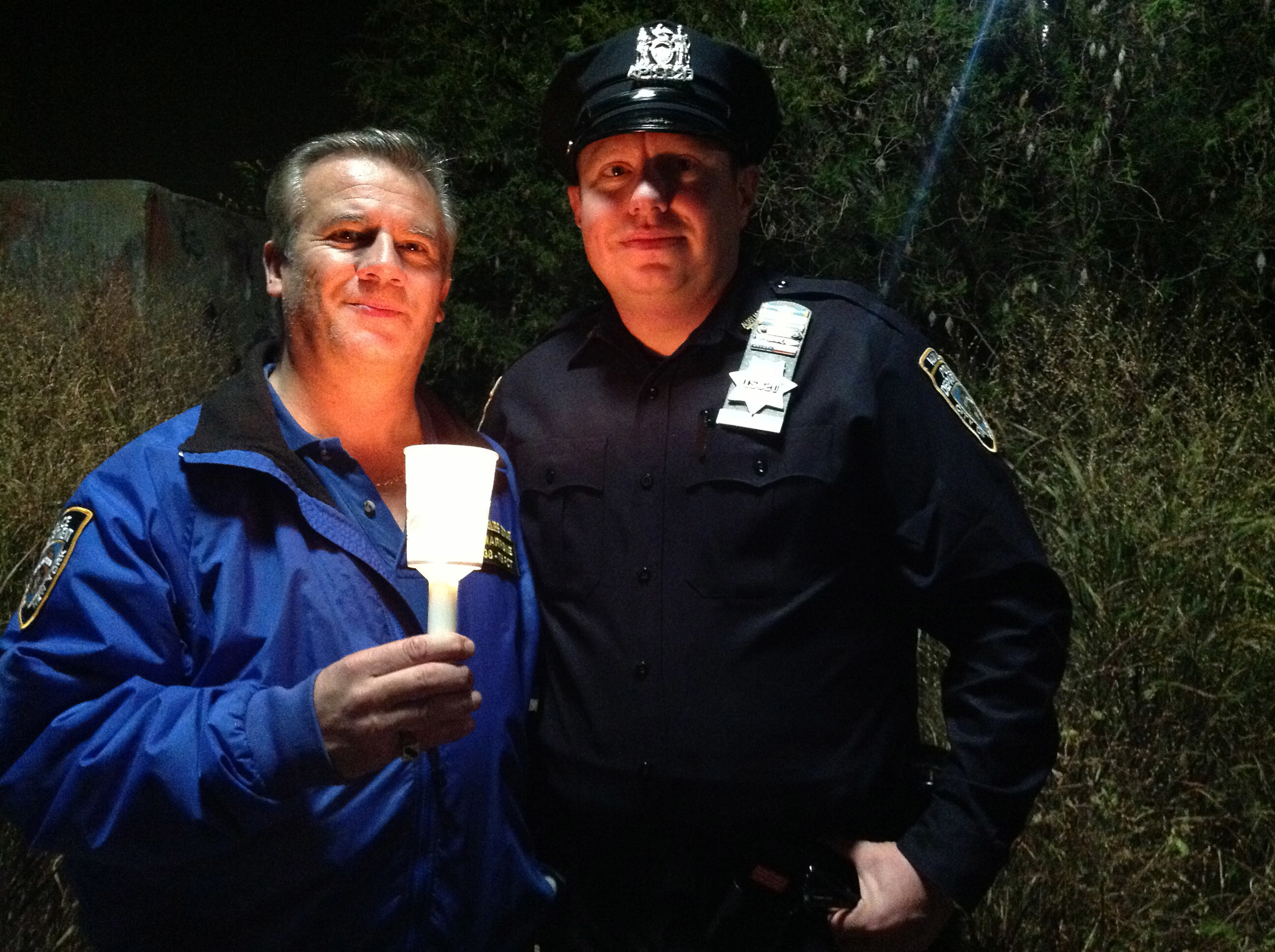
Celia gave a popsicle
107 Rapelye Street
288 Van Brunt Street
28 First Place
64 Third Place
252 President Street
271 Union Street
285 President Street